In order to encourage trucking companies to buy and drive safer trucks, AnnaLeah & Mary for Truck Safety has created decals to affix to trucks which have installed a stronger rear guard and/or added side guards — thereby meeting safety standards for rear and side underride protection, as spelled out in the STOP Underrides Bill.
In hopes that this recognition of fleet safety leadership will help to prevent the loss of other precious lives, we launched this program on May 4, 2020 –remembering our loss of AnnaLeah and Mary in an underride crash seven years earlier on May 4, 2013.
Jerry attached the first SaferTruck Bono Award to a trailer in the process of being upfitted with a Rear Reinforcement Attachment and a full-length side guard system.
In order to encourage trucking companies to buy and drive safer trucks, AnnaLeah & Mary for Truck Safety has created decals to affix to trucks which have installed a stronger rear guard and/or added side guards — thereby meeting safety standards for rear and side underride protection, as spelled out in the STOP Underrides Bill.
In hopes that this recognition of fleet safety leadership will help to prevent the loss of other precious lives, we are launching this program on May 4, 2020, as we remember our loss of AnnaLeah and Mary in an underride crash seven years ago on May 4, 2013.
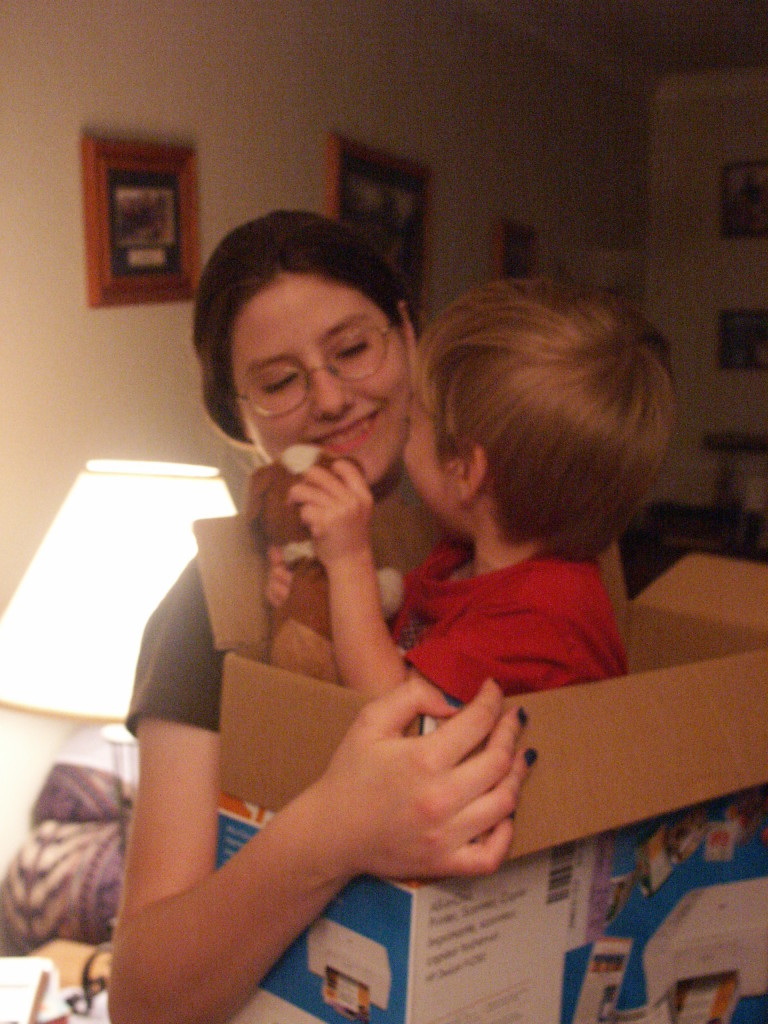
The SaferTruck System Bono Award is for trucks on which a stronger rear underride guard has been installed to prevent underride deaths at the rear of trucks. We chose this name in reference to the patron saint, Beuno or Bono (Latin, bonus = good), known for the protection of children — using the image of Mary’s beloved stuffed toy St. Bernard, Gertie.
Statue of Mary’s Gertie at the girls’ gravesiteMary with her beloved Gertie in 2012
The SaferTruck System Christopher Award is for trucks which have had side guards installed to prevent underride deaths at the sides. We chose this name in reference to the patron saint/advocate of travelers, Christopher — keeping in mind AnnaLeah’s love of medieval history and dragons.
Dragon statue at the gravesite
AnnaLeah’s stuffed toy dragonAnnaLeah with her nephewAnnaLeah with her niece and nephew, 2012Mary and her Gertie in a photoshoot by her sister Susanna, circa 2010
With special thanks to Mary & AnnaLeah’s brother, Isaac Karth, who created the designs for these two SaferTruckSystem awards.
Safer Trucks Receive Commemorative Awards for Contribution to Safer Roadsflipbook
See more underride tragedies at Underride Crash Memorials.To add more information on this story or to add other underride crashes to be remembered, send an email to underridemap@gmail.com. Please use this Interactive Underride Crash Map Crash Location Input Form to provide us with accurate information . (Note: the map is currently not online; but we would keep the information for future updating.)
A recent article from Transport Topics caught my eye. It’s all about this & that concerning side skirts on trailers (for fuel savings). Lots for a trailer buyer to consider when making a decision.
Installing the complete system takes 2.5 man-hours, he said.
Wikipedia has to say this about cost: As of 2009, a set of trailer skirts cost between C$1500 and C$3000 (US$1300 to $2700). Standard trailer skirts have an estimated payback period of ten to eighteen months, while “advanced” skirts (those that improve fuel efficiency by over 7%) are estimated to pay for themselves in seven to fourteen months.
Seriously?! An AngelWing side guard can be installed in close to that amount of time. And if side guards were socially acceptable and widely embraced so that they readily available to purchase (you know how supply and demand works, right?), the price could quite likely be comparable. Plus side guards may enhance fuel savings when used with side skirts.
So why the fuss from the industry about the cost of LIFE-SAVING side guards!?
Read the whole article for yourself and tell me why there is such resistance to installing comprehensive and effective underride protection and outright opposition toward a mandate which would require it.
Fifty-one years ago, on March 19, 1969, (I learned in 2016) the US DOT was recorded as saying that they intended “after technical studies have been completed, to extend the requirement for underride protection to the sides of large vehicles.”
They have not done so (even though it has been proven possible & technicalstudies have been done) — just like they have not mandated rear guards to be stronger or front guards to be installed.
On March 19, 1969, I was thirteen years old. Little did I know about what they had said or that in 8 years I would get married on March 19, 1977 (43 years ago today), that in the ensuing years I would bear nine children, teach them at home, raise most of them to adulthood, and bury two of them due to preventable Death By Underride.
In November 2017, Lois Durso and I were privileged to meet the inventor of this design –Wabash engineer, Rod Ehrlich — along with his son Mark Ehrlich, who have been a vital part of this important research. Rod died in October 2018, after a long career of useful contributions to the trailer industry — including more than 60 patents, and most recently a side underride guard patent.
Wabash National continues their side underride protection R&D, as evidenced by a side underride guard patent filed on April 17, 2018, and issued on February 4, 2020. The prototype was introduced in a September 2017 commercial vehicle show in Atlanta.
“A side underride system configured to be coupled to a trailer may comprise a first skirt wall coupled to the trailer, positioned below a first side wall of the trailer, and extending along a first length of the trailer between a skirt wall front end and a skirt wall rear end and a cable system including a first cable coupled to the trailer, positioned below the first side wall, and extending along a second length of the trailer between a cable system front end and a cable system rear end, the skirt wall rear end being positioned forward of the cable system rear end.”https://patents.justia.com/patent/10549797
In fact, we were able to see a successful crash test of his design. As evidenced by Rod’s work, along with that of many other engineers, this country has the talent to bring about effective solutions to deadly underride. Unfortunately, the lack of a mandate is holding the trucking industry back from moving forward with tangible action to once and for all get it on the road.
Let’s grab the baton from Rod’s legacy. Surely we can put our heads together and reach the finish line in the long-standing pursuit of that elusive goal: underride protection on the sides of all large trucksso that we might save lives and prevent horrific injuries.
Lois Durso-Hawkins, Atlanta TMC Conference, March 2018 Wabash side impact guard prototype, March 2018, Atlanta TMC Conference
What is DOT going to do about deadly truck underride? That is the question.
On February 27, 2020, at an Appropriations Subcommittee Hearing on DOT’s 2021 Budget Request, Congressman David Price (D-NC) asked Secretary of Transportation Elaine Chao about DOT’s plans to address the GAO truck underride recommendations. Here’s her reply:
“We actually just talked about this just yesterday. So this is a priority. We understand it. We do have a timeline & we want to get that to you.” @SecElaineChao
I’m looking forward to seeing DOT’s timeline for addressing GAO Truck Underride Recommendations. I’m hoping that it will reflect a decision to make underride a priority. After all, rear underride regulations have not been updated since 1996, we’ve been waiting for DOT to act on side underride regulations for fifty-one years, and there’s been radio silence on front underride/override.
And it may well be more as underride deaths are vastly undercounted.
Underride can happen to anyone at any time anywhere.
Raleigh News&Observer reporter Richard Stradling attended our workshop on underride, Turning Tragedy Into Advocacy: Two moms on a mission to make truck crashes more survivable, at the North Carolina Vision Zero Traffic Safety Conference on August 6, 2019. It inspired him to investigate the underride issue and this week he published the result of his in-depth research:
I appreciate the time he took to present the viewpoints of multiple stakeholders and then go a step further. He provided a platform for counterargument, allowing us to question or challenge potentially misleading information so that the reader could be more fully informed and not left with the wrong impression.
In 2016, Aaron’s team conducted a full overlap rear crash test at approximately 35 mph closure. This test, which was conducted on a reinforced trailer that had already suffered significant rear collision damage. The lightly reinforced rear guard wasn’t able to prevent underride. (TrailerGuards.com)
Aaron’s team has continued to develop trailer underride guards. Recently, they crashed a reinforced trailer with a 2012 Chevy Impala at 38 mph and approximately 25% overlap. This test illustrated that bolt on reinforcements can prevent deadly underride and passenger compartment intrusion (PCI).
Video of Crash Test into a 2005 Vanguard Trailer with a reinforced rear underride guard at 38 mph on January 25, 2020:
Compare that to a crash test by IIHS of a Vanguard 2013 trailer with a weak rear underride guard at 35 mph — at 8:28 on this video:
Crash car after the 38 mph collision into the rear of a tractor trailer: No Passenger Compartment Intrusion (PCI) Hallelujah!!!
Compare that to the initial design of the Rear Reinforcement Attachments on March 12, 2016:
Now that we have proof that these lightweight aluminum plates can prevent deadly underride, should we simply encourage voluntary adoption of this life-saving safety solution? Or should we require every truck in the U.S. to install safety equipment which can meet that level of performance?
In other words, are we going to make it the law to install equipment which can prevent underride when passenger vehicles collide with the rear of large trucks?