Tag Archives: USDOT

Did DOT Violate the Information Quality Act When it Published Side Underride Guard Research?

The Department of Transportation published a report in May 2020, A Literature Review of Lateral Protection Devices on Trucks Intended for Reducing Pedestrian and Cyclist Fatalities. The published report purported to fulfill a $200,000 contract (number SA9PA1) awarded by the Federal Motor Carrier Administration (FMCSA) to the John A. Volpe National Transportation Systems Center. In 2019, Volpe Center researchers turned in a draft of that report, entitled, “Truck Side Guards and Skirts to Reduce Vulnerable Road User Fatalities: Final Report on Net Benefits and Recommendations” (DOT-VNTSC-FMCSA-19-01). The published literature review left out many of the original objectives outlined in the contract between FMCSA and the Volpe Center to study the effectiveness of truck side guards to reduce Vulnerable Road User deaths.

Senior Agency Officials Suppressed Side Guard Research — Impacting Regulatory Analysis

ALMFTS investigated by requesting documents pursuant to the Freedom of Information Act. Internal agency emails reveal that the Department — not the study’s authors — rewrote the Volpe Center Report, in violation of a federal guidance on conducting peer review. The emails document that a NHTSA official made revisions to the original report rather than making recommendations to the study’s authors — as would be done in a genuine peer review.

Here is a subset of those emails — a list of some of the more relevant and revealing ones, which document that revisionism rather than review of a research study took place:

USDOT Emails Via FOIA – Documentation of Violation of OMB Peer Review Guidance

This is a violation of an Office of Management & Budget guidance on peer review — at the peril of Vulnerable Road Users who are at risk of known, unreasonable, and preventable truck underride injuries and death, as well as occupants of passenger vehicles. 

Relevant documentation: Timeline of Events Concerning the Volpe Center Side Guard Research Report

When one errs, the right thing to do is to correct the error. The right thing to do here is to correct the information the Department erroneously published. What will the Secretary of Transportation do, at this juncture in history, to protect these souls entrusted to his care?


If only the federal traffic safety agency had fought as hard to get side underride protection on the roads as they did to keep them off the roads, those roads would be a whole lot safer. Although it is only one piece of a larger puzzle, the Volpe National Transportation Systems Center report on truck side guards — before Department officials suppressed its findings — illustrates the cost effectiveness of a technically-proven road safety countermeasure.

Critique of NHTSA-Contracted Elemance Rear Impact Guard Research

Secretary Duffy,

The Department of Transportation (DOT) engaged Elemance LLC in 2022 to evaluate three current designs of rear impact guards. Unfortunately, Elemance conducted Finite Element analysis of two obsolete rear underride guards that were not current designs at the time of the contract. In fact, both of those designs had been proven a decade earlier to be crash-deficient. The two manufacturers — Great Dane and Wabash — have developed designs with safer, stronger rear-guard designs. Elemance compounded that error by employing an erroneous definition of Passenger Compartment Intrusion. Elemance’s research findings, Heavy-Truck Rear-Impact-Guard Finite Element Simulation and Analysis, are flawed and backwards-looking rather than helpful to the Department and Congress in evaluating current and future rear underride guard performance and regulatory standards.

Please find attached a detailed critique by engineers who are well-acquainted with the underride problem and solutions. This is what the engineers concluded about the NHTSA-contracted research:

In view of the defects in the Elemance report, a follow up study should be commissioned to evaluate examples of current state of the art rear impact guards that have been in service since 2016 and 2017 respectively. The study should utilize the correct definition of PCI and more accurately assess injury risk.

The Department should act promptly to address the flaws in this federal research in order to fulfill its mission to reduce roadway injuries and deaths.

Jerry and Marianne Karth

Note: This critique was submitted as a Public Comment on September 3, 2025, to the U.S. Department of Transportation in response to their Request for Comments on priorities for the 2026 Surface Transportation Reauthorization.

This video created by the Insurance Institute for Highway Safety twelve years ago explains their Rear Impact Guard crash testing research and how the federal standard is failing to protect road users:

This video is a compilation of IIHS Rear Impact Guard crash tests with old and new guard designs for many of the major trailer manufacturers:

This video demonstrates the night & day difference between old and new designs by one manufacturer:

The Missing Piece of the Roadway Safety Puzzle: National Roadway Safety Advocate

It was puzzling to me how very challenging it is to advance safety measures to save lives. Then I realized that there is a MISSING PIECE of the PUZZLE: there is no National Roadway Safety Advocate at the US Department of Transportation.

Put together this online jigsaw puzzle: https://jigex.com/NfTV3

Then make a comment online to Secretary Sean Duffy (at USDOT). Let him know that you want him to put a person to work as soon as possible who will be a dedicated resource to victims and their families – a National Roadway Safety Advocate.

Submit your Public Comment here no later than August 20, 2025.

(step-by-step instructions)

Then, please share this request to amplify your voice.

Read more here.

DOT Is Asking For Input. Tell Them To Give Crash Victims a Voice

When it comes to changes needed to make our roads safer, who cares more deeply than crash survivors or victim families? The Department of Transportation is asking for the public to submit their comments on what should be included in the 2026 Surface Transportation Reauthorization Bill; Secretary Duffy is looking for ideas to make our roads safer.

Let him know that you want victims to have a voice within the Department and that a means to do so has already been proposed by Senator Lujan and Congressman Cohen. The DOT Victim & Survivor Advocate Act would create a National Roadway Safety Advocate to serve as a voice for victims and survivors of roadway crashes and their families — ensuring their perspectives are considered in transportation safety policies.

I know from twelve years of road safety advocacy that this resource is extremely important but is not currently available to assist those who are keenly motivated to bring about change. Let Secretary Duffy know that you want him to put that plan into place.

Submit your Public Comment here no later than August 20, 2025.

(step-by-step instructions)

Then, please share this request to amplify your voice.

Podcast from Streetsblog, July 29, 2025, What Will It Take To Give Victims and Advocates a Voice at US DOT?

There are too many families like the ones who have told their stories below. They need to be heard. . .

I’m grateful for everyone who takes the time to submit a comment. You can see all comments submitted here. Running list of comments requesting a National Roadway Safety Advocate are here.

Quotes from supporters are available here (a list of safety groups and victim/survivors quoted in Senator Lujan & Congressman Cohen press release upon bicameral introduction of the DOT Victim & Survivor Advocate Act).

What Don’t They Want to See? DOT Declines to Send Observer to Underride Crash Test… AGAIN!

“TEAM Underride,” a loosely-organized coalition of engineers, researchers, safety advocates, and families of underride victims have planned multiple underride crash tests, underride crash test events, and a vigil for underride victims. Two of those events were in D.C. — an D.C. Underride Crash Test Event on March 26, 2019 in the Audi Field parking lot one mile from DOT and an Underride Victim Vigil in September 2023 on the sidewalk in front of the DOT building on New Jersey Avenue in D.C.

Despite multiple communications inviting the Department of Transportation, and especially NHTSA who is responsible for underride rulemaking, to these events, less than a handful of department representatives have shown up. What’s with that? What don’t they want to see? What they should want to see is honest to goodness research being undertaken to solve the decades-old problem of Death By Underride — proof-positive that the ball is in their court to issue regulations which could end countless preventable tragedies.

I emailed multiple people at DOT on January 11, 2019 — inviting them to our March crash test. Then, on February 6, 2019, after Lois Durso and I had checked out the Audi Field parking lot and walked over to DOT from there, we hand delivered a stack of event flyers and asked that they be distributed. I was told, “We will make sure that the event flyers are distributed.” Only one person — from FMCSA, which is not primarily responsible for underride rulemaking — bothered to come. Two months isn’t enough notice to put it in their schedule (no travel approval necessary)?

On July 11, 2023, I sent an online scheduling request to the Office of the Secretary — hoping that Secretary Buttigieg could attend the August 3, 2023, Raleigh Underride Crash Test Event. I followed up with an email to the Office of the Secretary. On July 19, I received this reply:

Unfortunately, DOT will not be able to send a representative to the event in Raleigh. Our team is sorry this didn’t work out, but we’re grateful for your continued advocacy and safety work and look forward to continued collaboration.

This is what they would have seen — had they bothered to come: Underride Crash Tests – Unguarded Trailer vs Guarded Trailer

Raleigh Underride Crash Test Event, August 3, 2023

I received a reply on August 23, 2024, to my August 5 request for the Secretary — or someone from the Department — to come to the Raleigh Underride Crash Test Event on September 13, 2024. I understand that Secretary Buttigieg could not fit it into his schedule, but the response was rather disturbing — though not surprising:

Thank you very much for the follow-up. Unfortunately, DOT won’t be able to send a representative for this event. We’re very sorry it won’t work out this time, and we are sending our best for an impactful event next month.

It won’t work out this time?!

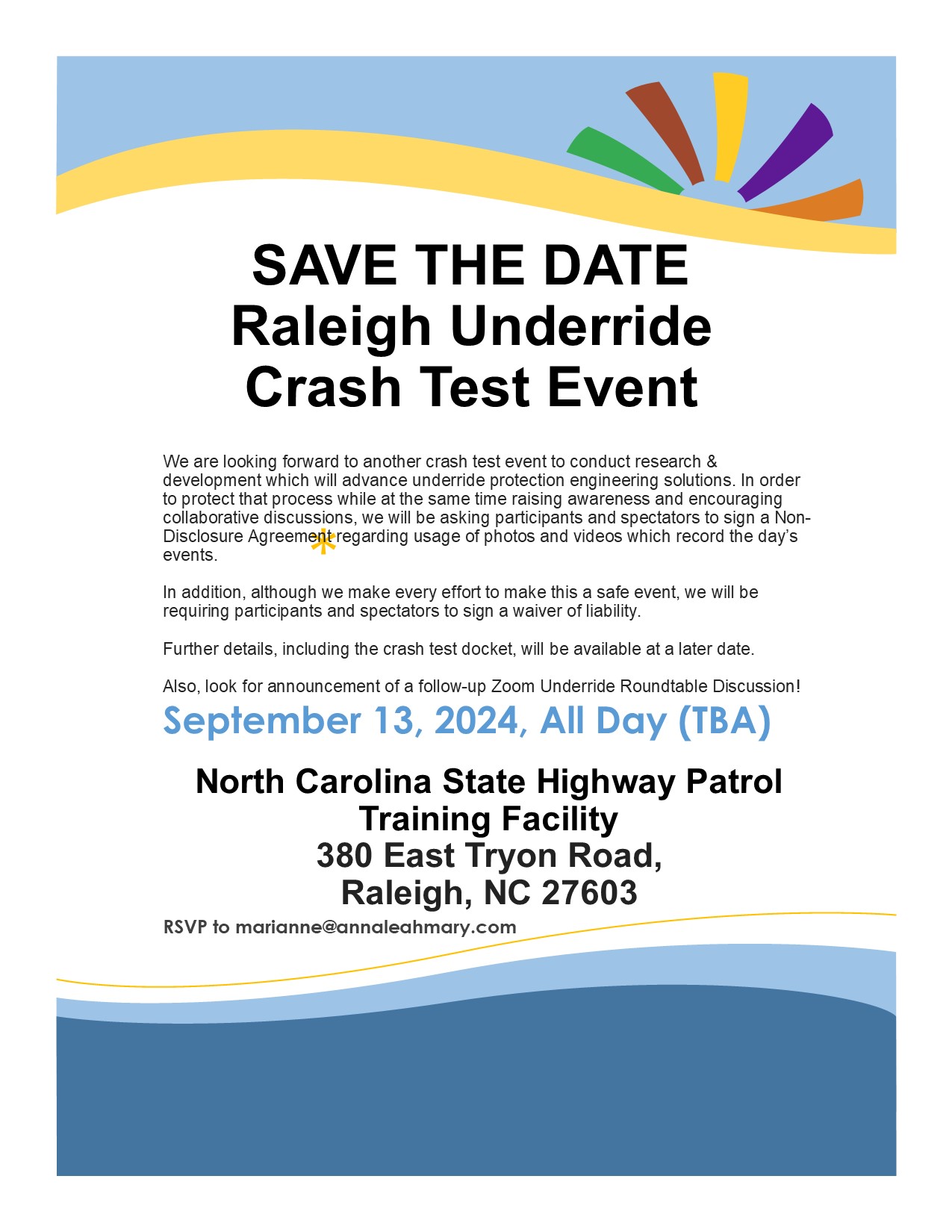
Here’s the event flyer for the crash testing event coming soon in Raleigh at the North Carolina State Highway Patrol training facility: Raleigh Underride Crash Test Event – SAVE THE DATE: September 13, 2024

Be there, or be square!

NHTSA Defends Itself to Congress – Woulda, Coulda, Shoulda

Last week, I was surprised to learn that the National Highway Traffic Safety Administration {NHTSA) had published a self-analysis of their progress — dated June 2024. NHTSA responded with an 8-page explanation to Congress after a federal advisory committee condemned the safety agency for 55 years of inaction on underride crash protection in a scathing 410-page report published last month.

The committee, called the Advisory Committee on Underride Protection (ACUP), was created by Congress in 2021, and established by a NHTSA charter in 2022, to assess NHTSA’s progress at advancing public safety and make recommendations to the Secretary of Transportation. The ACUP’s report documented a long history of agency reluctance to regulate the trucking industry’s safety practices, exposed allegations of misconduct by senior officials, and called for the reversal of recent rulemaking that the committee believed made “no substantial progress” to improving public safety. The report concluded, “[V]ery little has changed regarding side underride guard advancements in the last 50 years and no substantial progress has been made by DOT to prevent these horrific crash fatalities and injuries.”

All I can say is that NHTSA’s apologia to Congress is woefully inadequate. In a nutshell, “Woulda, coulda, shoulda.”* It further documents that the agency continues its disturbingly long history of inaction. Safety delayed is most certainly safety denied.

The ACUP report can be found here. NHTSA’s report can be found here.

* Put another way, “Spare me the useless & endless excuses!”

Press Release

DOT Announced A National Roadway Safety Strategy; Now It’s Time To Talk About What That Means

I’m grateful that the U.S. Department of Transportation announced their National Roadway Safety Strategy (NRSS) on January 27, 2022. Like others, I’ve waited a long time to hear that news.

  • We cannot tolerate the continuing crisis of roadway deaths in America. These deaths are preventable, and that’s why we’re launching the National Roadway Safety Strategy today – a bold, comprehensive plan, with significant new funding from President Biden’s Bipartisan Infrastructure Law,” said U.S. Transportation Secretary Pete Buttigieg. “We will work with every level of government and industry to deliver results, because every driver, passenger, and pedestrian should be certain that they’re going to arrive at their destination safely, every time.” U.S. Transportation Secretary Pete Buttigieg Announces Comprehensive National Roadway Safety Strategy, January 27, 2022
  • While U.S. DOT has many tools at its disposal and will shoulder our
    responsibility, this must be a coordinated effort with our stakeholders across the public sector, private sector, advocacy, and research communities. National Roadway Safety Strategy, USDOT, January 2022

On the other hand, I heard strikingly similar rhetoric when Secretary Foxx spoke about the Toward Zero Deaths initiative in March 2015, as well as when NHTSA launched the Road to Zero Coalition in partnership with the National Safety Council on October 5, 2016 (more than a year after we launched our Vision Zero Petition). Here are some relevant quotes:

Deja vu. And what has changed? In any case, here we are. So let’s talk about how the NRSS could be applied to a specific traffic safety issue — truck underride. One Safe System principle included in the NRSS is Redundancy:

  • Redundancy is Crucial. Reducing risks requires that all parts of the transportation system be strengthened, so that if one part fails, the other parts still protect people.
  • The Safe System Approach emphasizes that redundancy is critical, and safer roadways mean incorporating design elements that offer layers of protection to prevent crashes from occurring and mitigate harm when they do occur.

This sounds exactly like the combination of crash avoidance technologies (along with improving driver behavior) to prevent crashes from happening, plus underride protection to reduce injuries when crashes do occur. In fact, I’ve previously written about that very topic:

The reality is that crash avoidance technologies cannot prevent all crashes. Even though crash avoidance technologies may be able to reduce speed at impact, they doesn’t necessarily prevent a collision from happening in every instance. In fact, when collisions do occur between a passenger vehicle and a large truck — even at 15 mph — they will likely result in deadly underride and Passenger Compartment Intrusion unless effective underride protection has been installed on the truck. 

The NRSS uses the word zero 16 times, including here:

  • Zero is the only acceptable number of deaths on our highways, roads, and streets. The United States Department of Transportation is committed to taking substantial, comprehensive action to significantly reduce serious and fatal injuries on the Nation’s roadways.
  • U.S. DOT recognizes the Safe System Approach as encompassing all the roadway safety interventions required to achieve the goal of zero fatalities, including safety programs focused on infrastructure, human behavior, responsible oversight of the vehicle and transportation industry, and emergency response.

Therefore, I will expectantly draw the conclusion that the redundancy principle and the goal of zero fatalities will spur the US DOT to carry out their responsibility to oversee the transportation industry and thereby issue comprehensive underride protection rulemaking — front, side, & rear, on both tractor-trailers and Single Unit Trucks. To do otherwise is hypocrisy.

Will it be necessary for me to continue to ask the question: Is every death unacceptable? Were my daughters’ lives considered worth saving — along with countless other victims of Death By Underride? Is #ZeroTrafficDeaths meaningless rhetoric? Or, is it possible that I can count on the Department of Transportation to prioritize the saving of lives by issuing comprehensive underride rulemaking in which cost benefit analysis is no longer weighted in favor of industry?

Likewise, can I expect when NHTSA is informed of potential safety defects that they will proceed with formal investigations  — no matter how many deaths and serious injuries have been reported?

Underride Crash Victim Memorial Posts