
This week, I had a conversation with Ralph Nader about the truck underride problem. Now, he has been an important activist in the automobile safety space for decades and his advocacy has saved many lives. Unfortunately, underride is a problem that existed when he began his consumer advocacy efforts yet people — still to this day — continue to die from that preventable problem. Why is that? Well, it’s the trucks (not the cars).
Here’s the Ralph Nader Radio Hour podcast of that conversation published on December 20, 2025, at 24:45 on this link: Trouble in Toyland 2025 / Stop Underride.
What we talked about, but which apparently got edited out of the final version, was the full extent of the problem. Ralph asked me a couple of times how many people died every year from underride. I started out by describing how vastly undercounted underrides are — both due to the fact that an underride checkbox doesn’t exist on the state crash report forms for most states and also because NHTSA excludes many categories of victims from their regulatory cost benefit analysis. Since he wanted a number, I said that there were at least 600 underride deaths a year. But the actual number is higher, especially when you count the deaths of Vulnerable Road Users — pedestrians, bicyclists, and motorcyclists — all of whom face lethal underride dangers, too.
A presentation which I made a few weeks ago to NHTSA Administrator Jonathan Morrison provides a few more details about the extent of the underride problem and the flawed analysis by NHTSA: Preventing Underride Deaths At 40 mph FINAL – Make Truck Crashes SURVIVABLE and here are my presenter notes: NHTSA Administrator Morrison Meeting – Presenter Notes. This slide captures numbers for annual underride fatalities:
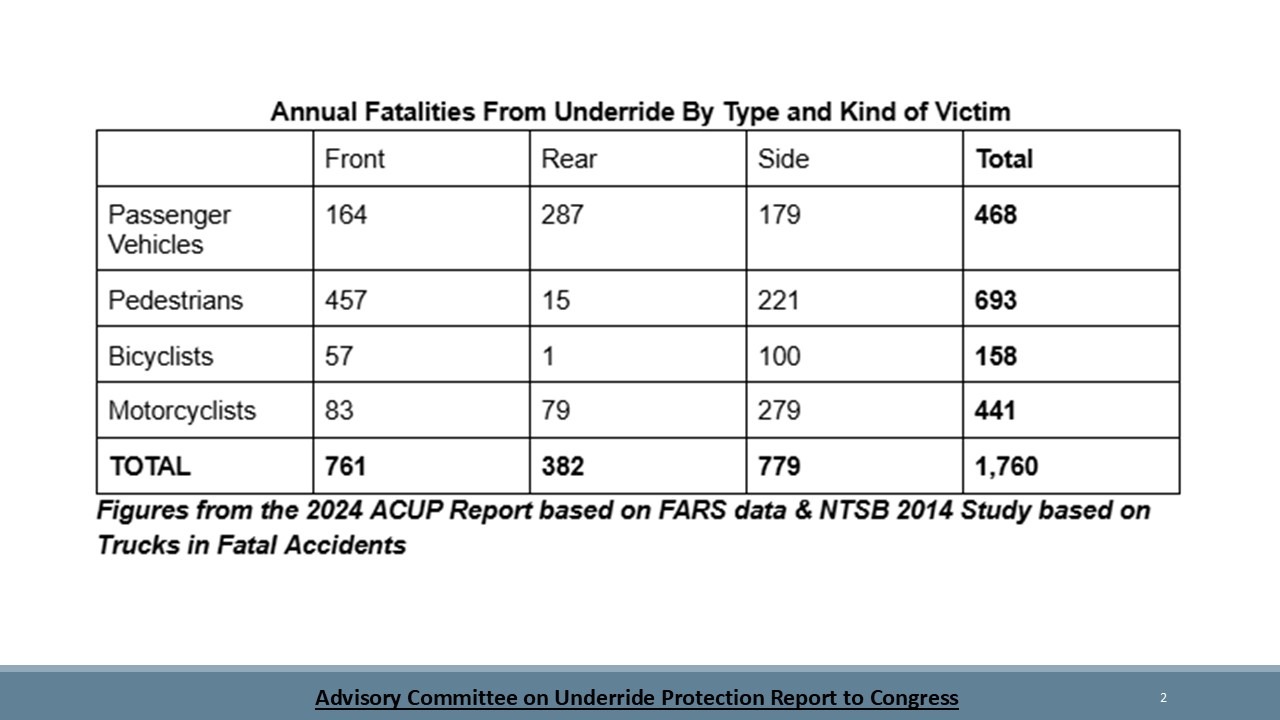
Out of 40,000 annual traffic deaths, 4.5% are caused by underride. Underrides are lethal for car passengers because the bottom edge of trailers stands above all of the passive safety features incorporated into passenger vehicles, e.g., crush zones, bumpers, airbag sensors, seat belt tensioners.
When cars and large commercial motor vehicles interact, the bottom of the trailer can intrude into the occupant survival space and cause life-threatening injuries such as decapitation and crush injuries. The same risks face bicyclists, motorcyclists, and pedestrians when they get swept under large commercial trucks and get crushed by the rear wheels.
Underride deaths cannot be eliminated by changing driver behavior or even crash avoidance technology. (It’s not the crash that kills; it’s the underride.) They can only be eliminated by the installation of physical guards, known as “impact” or “underride” guards, to the sides and rear of trailers. This is LOW HANGING FRUIT – a problem not as hard to solve as impaired or distracted driving.
Preventing underride deaths at 40 mph is possible. But it will not happen through voluntary action by trailer manufacturers. This is a failure of the marketplace. Government regulation is intended to correct for market failures, and NHTSA has the power to do that.
AnnaLeah & Mary for Truck Safety and Aaron Kiefer have been invited to demonstrate underride crash testing next year at the 2026 Southeast Commercial Motor Vehicle Safety Summit co-hosted by the FMCSA in Raleigh on August 11. I invited NHTSA Administrator Morrison and FMCSA Administrator Barrs to take advantage of this opportunity to witness firsthand the life & death difference of underride protection.
Preventing underride deaths is not a Republican issue. It’s not a Democratic issue. Neither Party has made a difference in the underride policy space. I asked Administrator Morrison to make that part of his public service legacy.
And that is why, knowing of Ralph’s promotion of civic advocacy, I mailed a proposal to him a month or so ago. You see, we share a common dream for the mobilization of a network of citizen advocacy groups — one in each of the 435 Congressional districts. This outside-the-box strategy has the potential to build bridges between polarized citizens, enabling them to find common ground thereby uniting and amplifying their voices — empowering We The People to bring about needed change in our country.
