Thank you, Stoughton Trailers, for leading the way in safety. At no added cost or weight to your customers.
Stoughton Trailers is proud to announce that it has successfully met the Insurance Institute for Highway Safety (IIHS) TOUGHGUARD® requirements at an elevated speed of 40 MPH, surpassing the 35-mph standard IIHS previously set for the van trailer industry.
Upon learning of Stoughton’s decision to make this improved protection available on all of their new trailers, Karth said, “Stoughton’s cooperative efforts to improve the performance of its rear impact guard demonstrates a genuine commitment to safety. Stoughton is to be commended for taking a significant leadership role in design and safety. In my opinion, many lives will be saved as a result of Stoughton’s efforts.”
Thanks to STOUGHTON’s improved Rear Impact Guard, Terry Rivet survived a truck crash in March 2017.
Stoughton Press Conference at TMC 2017 Conference
Speaking at Stoughton’s Press Conference in 2017
Stoughton’s Engineering Innovation won’t bring AnnaLeah & Mary back, but it will save others.
Video from 2016 Crash Test: In this toughest IIHS underride guard test, 30 percent of the front of a midsize car strikes a parked Stoughton trailer at its outermost corner at 35 mph. Underride guards are weakest at the outer edges of a trailer.
Oh, by the way, Stoughton also has a side guard patent. Will they lead the way in fully guarding their trailers from underride and lethal passenger compartment intrusion?
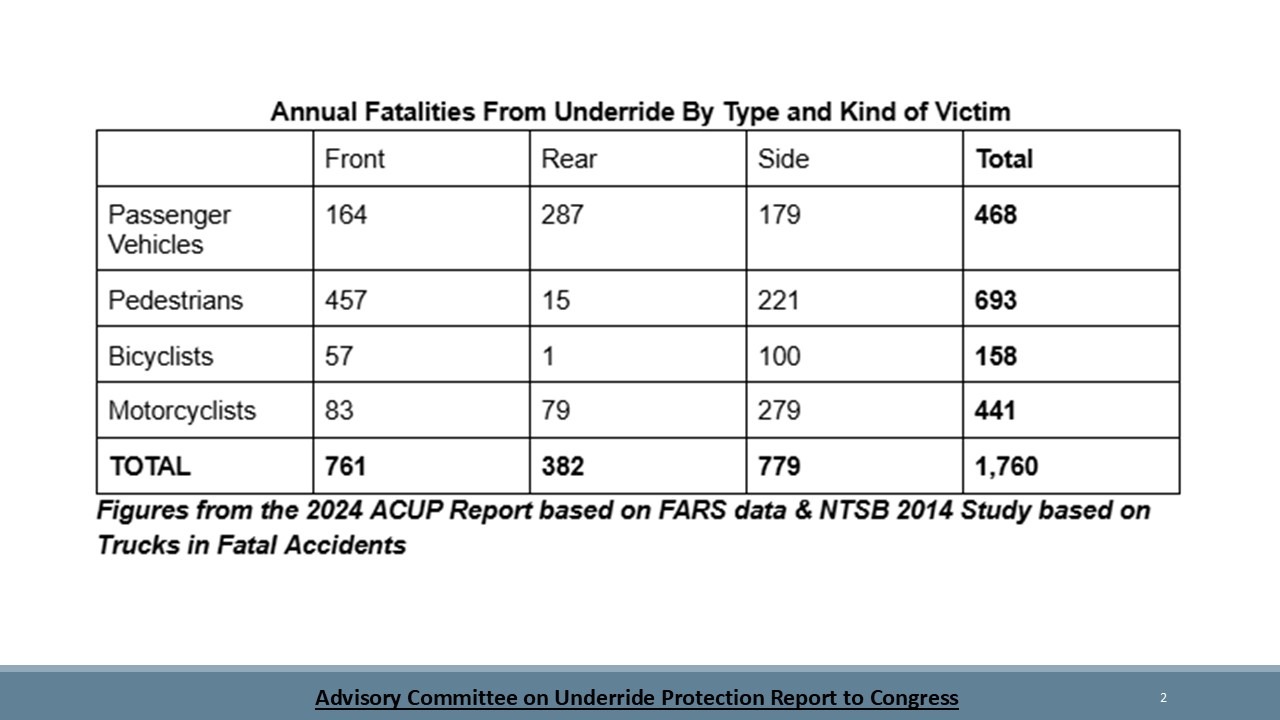
Have you lost someone close to you, or in your community, because of a truck crash? Hundreds of people die every year when pedestrians, cyclists, motorcyclists, and occupants of passenger vehicles go under trucks.
It can happen to anyone — even if their car has a 5-Star Safety Rating — like it has happened to tens of thousands of Americans including my daughters, AnnaLeah (17) and Mary (13). It can happen to you.
ALL HANDS ON DECK! Join a STOP Underrides National Town Hall via Zoom on April 15 | 🕖 8 – 9 pm ET |RSVPHERE
You will be able to tell your U.S. Senators and Representative that you want them to pass the STOP Underrides Act of 2026. This bill will make strong underride guards mandatory so that truck crashes become more SURVIVABLE.
Your voice at this unique advocacy gathering can help us get this long-overdue legislation across the finish line. Please register below. We’d love to have you join TEAM Underride in this way.
Ask your Members of Congress to participate, and multiply your voice by telling others about this opportunity.
Note: If you are unable to attend, please contact me at marianne@annaleahmary.com so we can help you to share your story with your Members of Congress.
STOP Underrides National Zoom Town Hall SAVE THE DATE – FRONT & BACK
I was glad to see that John Gallagher (FreightWaves) highlighted an aspect of the STOP Underrides 2.0 Bill which should be of interest to industry and Republicans:
In an effort to address long-standing complaints from the trucking industry that underride protection equipment adds weight and increases fuel costs, the new bill includes a performance standard whereby any new side underride guards must “contribute to fuel efficiency through the integration of aerodynamic design or components furthering fuel efficiency.” The provision is aimed at offsetting the operational costs of the guards by essentially requiring them to function as side skirts. Legislation would require crash protection on new trucks
However, in his description of the new bill, he also mentions that prior versions included a retrofit requirement which is not in the 2026 legislation. While it is true that previous versions of the bill, in 2017 and 2019, contained a retrofit requirement, we decided to remove that provision in the 2021 re-introduction of the STOP Underrides Bill. We did that not because we no longer thought it beneficial for the saving of lives but in order to garner broader Republican support.
Thankfully, we already had the support of Senator Marco Rubio, who had co-led underride legislation with Senator Kirsten Gillibrand since it was first introduced in 2017:
“Hundreds of individuals across the nation are lost to underride collisions every year, with Florida unfortunately ranking among the top states for reported fatalities,” Rubio said. “As a parent with kids of driving age, I look forward to working in a bipartisan fashion to advance efforts to make our roads safer.” Senators Kirsten Gillibrand and Marco Rubio introduce bill to prevent truck underride deaths
In fact, we had been in discussions with Senator Richard Burr, our Republican Senator in North Carolina since August 2013 just a few months after our crash. We continued discussions with his staff over the years and in 2021 knew that he would become an original cosponsor if we removed the retrofit requirement.
You see, he wasn’t shortsighted; he saw the big picture. He knew that strong underride regulations would be a Win/Win situation—good for victims of truck crashes because they would have a better chance of surviving but also good for business when all relevant factors are taken into account.
Although Senator Burr has retired and can no longer support this legislation, I hope that his former colleagues will see the light and follow in his footsteps. To that end, I have held ongoing conversations with the Offices of our current North Carolina Senators, Thom Tillis and Ted Budd — keeping them updated on the underride crash testing which we have conducted in Raleigh.
Likewise, I’ve had conversations with Republican staff of the House T&I Committee and Senate Commerce Committee, as well as many other Republican legislators, including Senator John Thune (former Chair of the Commerce Committee), Senator Ted Cruz (current Chair of the Commerce Committee), and Senator Todd Young, who represents Indiana where three trailer manufacturers are headquartered. One of them, Wabash Trailers, proudly announced their improved rear underride guard in 2016 and showcased their side guard prototype at a trucking conference in 2017 — although they are, regrettably, not installing them on their trailers at this time.
Since we no longer have Senators Rubio and Burr to champion underride protection, I would be beyond delighted if these sitting Senators would choose to lead the way in strong Republican support of this common-sense legislation.
Today, U.S. Senators Kirsten Gillibrand (D-NY) and Ben Ray Luján (D-NM) and U.S. Representatives Steve Cohen (D-TN-9), Mark DeSaulnier (D-CA-10), and Deborah Ross (D-NC-2) introduced legislation to help prevent deadly truck underride crashes.
Legislation was introduced in 2017, 2019, and 2021. Underride provisions were included in the 2021 Bipartisan Infrastructure Bill. The 2026 Stop Underrides Act 2.0 would expand on current restrictions by instructing rulemaking to require side underride guards on new trucks, improving data collection, and directing additional research on underride crashes. Specifically, this bill would:
Require the National Highway Traffic Safety Administration (NHTSA) to finalize rulemaking requiring side underride guards on commercial trucks.
Restart the Department of Transportation’s (DOT) Advisory Committee on Underride Protection, to provide recommendations for how to reduce underride crashes and severe injuries and fatalities caused by underrides.
Require the DOT to publish a website making underrides research accessible to researchers, industry, and advocates.
Instruct the National Academies of Sciences, Engineering, and Medicine to conduct a study on the prevalence of underride incidents, including those involving the fronts of large trucks.
Instruct NHTSA to create free, on-demand web-based training for state and local law enforcement to better identify and document underride crashes.
Instruct the Government Accountability Office to conduct a study of the implementation of NHTSA’s 2022 rear underride rule and provide suggestions to better improve the rule.
Instruct NHTSA to review its Fatality Analysis Reporting System (FARS) and correct crashes in the database that should have been classified as an underride but were not — including Vulnerable Road Users, i.e., pedestrians, bicyclists, and motorcyclists.
The House bill is H.R. 7354. Its companion bill in the Senate is S. 3775. You can read the full bill text here.
“Truck underride guards are one of the best and easiest solutions for protecting passengers during collisions with large trucks,” said Senator Gillibrand. “The Stop Underrides Act 2.0 is commonsense legislation that will protect passengers and make our roads safer. I look forward to working across the aisle to get this passed.”
“I’m proud to join my colleagues in introducing life-saving legislation to make our roads safer,” said Senator Luján.“The Stop Underrides Act will help prevent deadly underride crashes and protect families from tragic, preventable loss. I’m grateful for Senator Gillibrand’s leadership on this important issue, and I look forward to working with my colleagues to get this bill signed into law.”
“The Stop Underrides Act 2.0 would help prevent these terrible and too-often fatal truck-trailer accidents by ensuring that cars can no longer slide underneath trucks,” said Representative Cohen. “In introducing this legislation, I’m reminded of my constituents Randy and Laurie Higginbotham who lost their son in an underride crash in Memphis in 2014. The Stop Underrides Act 2.0 builds on important progress made in the Infrastructure Investment and Jobs Act and will save lives by helping to end these fatal crashes.”
“With truck underride collisions claiming the lives of at least 300 people per year, the time to act on reforms is now. Small changes will make a big difference, and we cannot leave any room for error,”said Congressman DeSaulnier. “I am proud to join my colleagues in advancing this bill to put an end to these avoidable tragedies.”
“Requiring trucks to have underride guards is a simple way to prevent hundreds of deaths on our roads,” said Congresswoman Ross.“These guards are a proven, effective safety measure that will reduce underride crashes as well as severe injuries and fatalities caused by underrides. I have heard directly from families in my district about the lives this improvement could save. I’m proud to introduce legislation that will prevent vehicle fatalities and make our roads safer for drivers in North Carolina and across the country.”
We had the opportunity to discuss underride with our representative, Congresswoman Ross, during a 2025 Town Hall. We appreciate her responsiveness and her support of this important legislation.
In the Senate, the Stop Underrides Act 2.0 is cosponsored by Senators Richard Blumenthal (D-CT), Chris Van Hollen (D-MD), Tammy Duckworth (D-IL), and Elizabeth Warren (D-MA). This bill is supported by the Advocates for Highway and Auto Safety, America Walks, AnnaLeah & Mary for Truck Safety, Cascade Bicycle Club, Casey Feldman Foundation, Center for Auto Safety, EndDistractedDriving.org, Families for Safe Streets, International Brotherhood of Teamsters, League of American Bicyclists, Institute for Safer Trucking, Kids and Car Safety, Ride Illinois, Ride of Silence, Road Safe America, Sylvia Bingham Fund, Safe Routes Partnership, Stop Underrides, and Truck Safety Coalition.
UPDATE March 13, 2026: Hundreds of people die every year when pedestrians, cyclists, motorcyclists, and occupants of passenger vehicles go under trucks. Please consider joining a STOP Underrides National Town Hall via Zoom April 15 | 8 – 9 pm ET |RSVP HERE.
Your voice at this unique advocacy gathering will let your U.S. Senators and Representative know that you want them to pass the STOP Underrides Act of 2026.
Michael David Schuster, 57, was pronounced dead of his injuries after collision on Wednesday, Dec. 31 between pickup and a tractor trailer, said Deputy Kingman Police Chief Joel Freed, confirming Schuster is the brother of Mohave County Sheriff Doug Schuster.
Because the bottom of a truck is higher than the bumper of passenger vehicles, when there is a collision the smaller vehicle easily slides under the truck and the first point of impact is the windshield. Seatbelts, airbags, and car crumple zones do not function as intended in underride crashes —front, side, and rear — leaving passenger vehicle occupants vulnerable to life-threatening injuries.
Michael David Schuster, Precious One Gone Too Soon
See Underride Crash Memorials posted here and at #STOPunderrides Tweets. To add photos or more information on this story or to add other underride crashes to be remembered, send an email to underridemap@gmail.com. Please use this Interactive Underride Crash Map Crash Location Input Form to provide us with accurate information . (Note: the map is currently not online; but we would keep the information for future updating and to aid in underride advocacy efforts.)
Note: In order to raise awareness and preserve the memories of underride victims — precious ones gone too soon — I have periodically written memorial posts on what could potentially be underride crashes; but be aware that this is not a comprehensive, exhaustive record of all such crashes. I am not a crash reconstructionist, and I do not have all the facts on these crashes; but underride should be investigated as a potential factor in truck crash injuries and deaths.
This week, I had a conversation with Ralph Nader about the truck underride problem. Now, he has been an important activist in the automobile safety space for decades and his advocacy has saved many lives. Unfortunately, underride is a problem that existed when he began his consumer advocacy efforts yet people — still to this day — continue to die from that preventable problem. Why is that? Well, it’s the trucks (not the cars).
What we talked about, but which apparently got edited out of the final version, was the full extent of the problem. Ralph asked me a couple of times how many people died every year from underride. I started out by describing how vastly undercounted underrides are — both due to the fact that an underride checkbox doesn’t exist on the state crash report forms for most states and also because NHTSA excludes many categories of victims from their regulatory cost benefit analysis. Since he wanted a number, I said that there were at least 600 underride deaths a year. But the actual number is higher, especially when you count the deaths of Vulnerable Road Users — pedestrians, bicyclists, and motorcyclists — all of whom face lethal underride dangers, too.
Out of 40,000 annual traffic deaths, 4.5% are caused by underride. Underrides are lethal for car passengers because the bottom edge of trailers stands above all of the passive safety features incorporated into passenger vehicles, e.g., crush zones, bumpers, airbag sensors, seat belt tensioners.
When cars and large commercial motor vehicles interact, the bottom of the trailer can intrude into the occupant survival space and cause life-threatening injuries such as decapitation and crush injuries. The same risks face bicyclists, motorcyclists, and pedestrians when they get swept under large commercial trucks and get crushed by the rear wheels.
Underride deaths cannot be eliminated by changing driver behavior or even crash avoidance technology. (It’s not the crash that kills; it’s the underride.) They can only be eliminated by the installation of physical guards, known as “impact” or “underride” guards, to the sides and rear of trailers. This is LOW HANGING FRUIT – a problem not as hard to solve as impaired or distracted driving.
Preventing underride deaths at 40 mph is possible. But it will not happen through voluntary action by trailer manufacturers. This is a failure of the marketplace. Government regulation is intended to correct for market failures, and NHTSA has the power to do that.
AnnaLeah & Mary for Truck Safety and Aaron Kiefer have been invited to demonstrate underride crash testing next year at the 2026 Southeast Commercial Motor Vehicle Safety Summit co-hosted by the FMCSA in Raleigh on August 11. I invited NHTSA Administrator Morrison and FMCSA Administrator Barrs to take advantage of this opportunity to witness firsthand the life & death difference of underride protection.
Preventing underride deaths is not a Republican issue. It’s not a Democratic issue. Neither Party has made a difference in the underride policy space. I asked Administrator Morrison to make that part of his public service legacy.
And that is why, knowing of Ralph’s promotion of civic advocacy, I mailed a proposal to him a month or so ago. You see, we share a common dream for the mobilization of a network of citizen advocacy groups — one in each of the 435 Congressional districts. This outside-the-box strategy has the potential to build bridges between polarized citizens, enabling them to find common ground thereby uniting and amplifying their voices — empowering We The People to bring about needed change in our country.
Proving that underride protection can save lives is not enough to convince federal regulators that underride mandates should be issued. The regulatory process requires that a rule be cost effective. There are many factors which should go into a cost benefit analysis equation. Unfortunately, we are aware of a multitude of flaws in this process and that includes excluding certain categories of underride victims:
victims of crashes where the posted speed limit is above 40 mph (not taking into account Delta-V forces in collisions);
victims of crashes which involve multiple vehicles (NHTSA only includes two-vehicle crashes in their regulatory analysis!);
as well as overestimating the weight of guards, not counting the fuel savings of side guards installed in conjunction with side skirts, or ignoring the cost to industry of lawsuits for preventable fatalities.
The Department of Transportation published a report in May 2020, A Literature Review of Lateral Protection Devices on Trucks Intended for Reducing Pedestrian and Cyclist Fatalities. The published report purported to fulfill a $200,000 contract (number SA9PA1) awarded by the Federal Motor Carrier Administration (FMCSA) to the John A. Volpe National Transportation Systems Center. In 2019, Volpe Center researchers turned in a draft of that report, entitled, “Truck Side Guards and Skirts to Reduce Vulnerable Road User Fatalities: Final Report on Net Benefits and Recommendations” (DOT-VNTSC-FMCSA-19-01). The published literature review left out many of the original objectives outlined in the contract between FMCSA and the Volpe Center to study the effectiveness of truck side guards to reduce Vulnerable Road User deaths.
ALMFTS investigated by requesting documents pursuant to the Freedom of Information Act. Internal agency emails reveal that the Department — not the study’s authors — rewrote the Volpe Center Report, in violation of a federal guidance on conducting peer review. The emails document that a NHTSA official made revisions to the original report rather than making recommendations to the study’s authors — as would be done in a genuine peer review.
Here is a subset of those emails — a list of some of the more relevant and revealing ones, which document that revisionism rather than review of a research study took place:
This is a violation of an Office of Management & Budget guidance on peer review — at the peril of Vulnerable Road Users who are at risk of known, unreasonable, and preventable truck underride injuries and death, as well as occupants of passenger vehicles.
When one errs, the right thing to do is to correct the error. The right thing to do here is to correct the information the Department erroneously published. What will the Secretary of Transportation do, at this juncture in history, to protect these souls entrusted to his care?
If only the federal traffic safety agency had fought as hard to get side underride protection on the roads as they did to keep them off the roads, those roads would be a whole lot safer. Although it is only one piece of a larger puzzle, the Volpe National Transportation Systems Center report on truck side guards — before Department officials suppressed its findings — illustrates the cost effectiveness of a technically-proven road safety countermeasure.
The Department of Transportation (DOT) engaged Elemance LLC in 2022 to evaluate three current designs of rear impact guards. Unfortunately, Elemance conducted Finite Element analysis of two obsolete rear underride guards that were not current designs at the time of the contract. In fact, both of those designs had been proven a decade earlier to be crash-deficient. The two manufacturers — Great Dane and Wabash — have developed designs with safer, stronger rear-guard designs. Elemance compounded that error by employing an erroneous definition of Passenger Compartment Intrusion. Elemance’s research findings, Heavy-Truck Rear-Impact-Guard Finite Element Simulation and Analysis, are flawed and backwards-looking rather than helpful to the Department and Congress in evaluating current and future rear underride guard performance and regulatory standards.
Please find attached a detailed critique by engineers who are well-acquainted with the underride problem and solutions. This is what the engineers concluded about the NHTSA-contracted research:
In view of the defects in the Elemance report, afollow up study should be commissioned to evaluate examples of current state of the art rear impact guards that have been in servicesince 2016 and 2017 respectively. The study should utilize the correct definition of PCI andmore accurately assess injury risk.
The Department should act promptly to address the flaws in this federal research in order to fulfill its mission to reduce roadway injuries and deaths.
Jerry and Marianne Karth
Note: This critique was submitted as a Public Comment on September 3, 2025, to the U.S. Department of Transportation in response to their Request for Comments on priorities for the 2026 Surface Transportation Reauthorization.
This video created by the Insurance Institute for Highway Safety twelve years ago explains their Rear Impact Guard crash testing research and how the federal standard is failing to protect road users:
This video is a compilation of IIHS Rear Impact Guard crash tests with old and new guard designs for many of the major trailer manufacturers:
This video demonstrates the night & day difference between old and new designs by one manufacturer:
It was puzzling to me how very challenging it is to advance safety measures to save lives. Then I realized that there is a MISSING PIECE of the PUZZLE: there is no National Roadway Safety Advocate at the US Department of Transportation.
Then make a comment online to Secretary Sean Duffy (at USDOT). Let him know that you want him to put a person to work as soon as possible who will be a dedicated resource to victims and their families – a National Roadway Safety Advocate.
Submit your Public Commenthere no later than August 20, 2025.