Ted Scott, from the American Trucking Association, just emailed me with the news about the new rear underride guard design announced yesterday by Wabash (a trailer manufacturer).
The new rear impact guard is constructed of advanced high-strength steel. Its patent-pending design features two additional vertical posts and a longer, reinforced bumper tube, all of which are engineered to work together to absorb energy better and deflect rear impact at any point along the bumper. In addition, the new guard is fully galvanized to resist corrosion.Wabash Debuts Rear Impact Guard Design for its Dry Van Trailers
Thank you, Wabash, for your commitment to safer trucks.
“Our work on the rear impact guard, and trailer performance in general, isn’t finished,” added Giromini. “Innovation is ongoing at Wabash National. We’re continually looking at ways to optimize total performance through engineering and the use of advanced materials in ways that make sense for our customers.”
I hope that means that they will also be looking at side guard and retrofitting solutions as well.
And thank you, J.B. Hunt, for already ordering 4,000 new trailers with the improved underride protection to put on our roads.
“The National Highway Traffic Safety Administration (NHTSA) is announcing a meeting that will be held in Washington, DC on March 10-11, 2016 to explore ways to promote evidence-based behavior change in a traffic safety setting.
“The Driving Behavioral Change in Traffic Safety workshop will include presentations and discussions on a number of topics including analysis and feasibility of using different approaches to changing behavior; exploring promising untested strategies; identifying long-term pathways to eliminate fatalities; and considering how evidence-based behavior change strategies can be used in the broader policy discussion.
“Attendance at the meeting is limited to invited participants because of space limitations of the DOT Conference Center. However, the meeting will be available for live public viewing on the NHTSA Web site (www.nhtsa.gov).” Meetings: Driving Behavioral Change in Traffic Safety
Sounds promising. . . I hope to see meaningful results which can be widely-dispersed. And focused on while also addressing environmental and vehicular causes of traffic deaths.
Note: While taking classes at the University of Michigan in 1979 for my Master of Public Health degree in Health Behavior & Health Education, one of the things I learned, which has stuck with me, is that fear is not always the best motivator for changing behavior. In other words, knowing that something you do could end your life or that of someone else doesn’t necessarily change our actions. It doesn’t always sink in.
That needs to be kept in mind as we attempt to encourage better driving behavior.
The question was brought to my attention as to whether truck side guards, if they were strong enough to prevent passenger vehicle underride (i.e., probable death or severe injury), would be more harmful to pedestrians and cyclists (Vulnerable Road Users–VRU).
I didn’t know. So I asked the experts with whom I am acquainted, and this is what I found out:
Hi MarianneWell-designed rear, side, front underride protection on trucks, will not make it more dangerous for pedestrians and cyclists, but potentially make it safer for peds and cyclists.
Adjunct Assoc. Professor George Rechnitzer, Transport and Road Safety (TARS) Research, University of New South Wales (UNSW), Web: http://www.tars.unsw.edu.au/
The other feedback, which I received from a crash reconstructionist friend who sees the aftermath of lots of crashes firsthand, was more short and to the point: “I think that stronger side skirts will save lives no matter what vehicle is in play. Would you, as a cyclist, rather bump your head on a resilient skirt (or a flexible one like mine for that matter) or slide underneath a trailer and end up looking like a pancake?”
Goodness, I sure hope that we can help shed light on issues such as these at the Underride Roundtable on May 5, 2016. Delays resulting from endless debate and/or stalling on problem-solving has already led to too many needless and preventable deaths.
After launching the Vision Zero Petition online, I waited a bit before I signed myself. I took a moment to decide what comment to make.
596: Marianne Karth, Rocky Mount, North Carolina,
United States
There is no one that this does not potentially impact in some way. We
are asking for bold and decisive action to reduce tragic, preventable crash
fatalities. Don’t wait until it touches you personally to move heaven &
earth to identify and require the best possible protection. Once a loved
one becomes a motor vehicle crash statistic, it will be too late–they will
not come back to you.
Kind people have said to me, ‘She is with God.’ In one sense that is most certain. . . But I find that this question, however important it may be in itself, is not after all very important in relation to grief. . . You tell me, ‘she goes on.’ But my heart and body are crying out, come back, come back. Be a circle, touching my circle on the plane of Nature. But I know this is impossible. I know that the thing I want is exactly the thing I can never get….It is a part of the past. And the past is the past and that is what time means, and time itself is one more name for death, and Heaven itself is a state where ‘the former things have passed away.’ (pp. 24-25)
Reality never repeats. The exact same thing is never taken away and given back. . .For that is what we should all like. The happy past restored. And that, just that, is what I cry out for, with mad, midnight endearments and entreaties spoken into the empty air. (p. 26)
It’s easier than you think – Parachute is leading the way
Parachute is a charity helping Canadians stop the clock on predictable and preventable injuries.
We want Canadians to live long lives to the fullest
Prevention is about education, knowledge and empowerment. Parachute is leading, inspiring and mobilizing Canadians of all ages. We are creating a movement and building awareness and understanding of the issue of injury, to keep Canadians safe at home, on the road, at work, and at play.
Our focus is on motor vehicle collisions, sports and recreation, and seniors’ falls
While young people make up only 13% of licensed drivers, they account for one-quarter of all road-related injuries and fatalities
40% of head injuries in children aged 10 to 19 occur during sports
85% of hospitalizations of Canadian seniors are on account of a fall
We can change the statistics and save lives.
Unlike curing a deadly disease, the solutions are simple. We have the power. We have the knowledge. We have the resources. We have the vision.
“‘In short, don’t educate—or hector or threaten—for safety’s sake: design for it. After all, as [Neil] Arason [author of No Accident] is fond of quoting from a New England Journal of Medicine editorial, safety caps on prescription medication have saved more children’s lives than endless exhortations to their parents.
“When the life-saving potential of drivers and roads are exhausted, turn to what Arason considers the most important leg of the tripod, the vehicles themselves. They have been getting safer for decades for those inside them, at a steady if slow pace. In 1950,Popular Mechanics magazine was already campaigning for the seat belts that would not become mandatory for decades, urging its readers to order the belts from aircraft manufacturers and install them themselves. Helpful measures now would include banning the bull bars so deadly to pedestrians.
“Above all, governments should mandate the safety features already offered as options on higher-end cars, prompting new economies of scale that would force down prices. . .
“’I really think we are at a golden moment, a turning point,’ Arason says. ‘The technology is here, and only getting cheaper. They are doing these things in Europe. If we start with what Canadians can buy into—better regulations, safer roads, getting higher-risk drivers off the road—we can change things by 2035.
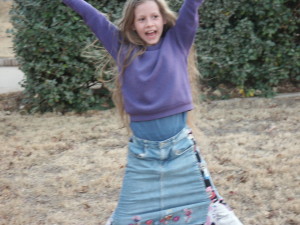
“I want to be famous somehow. I don’t know how but I just do.” Mary Karth, April 2013. (Photo 2005)
The Save Lives Not Dollars: Urge DOT to Adopt a Vision Zero Policy Petition reached 16,500 signatures today. I guess you “got” your wish, Mary, because a lot of people have heard about you and your sister and are standing with us to speak up for safer roads.
From the Vision Zero Petition. . . a comment from signer #15,929
D. J. Young
11 hours ago
OH
“For a free and democratic society, Vision Zero is a moral obligation. For our leaders to tolerate 33,000 traffic-related deaths and untold disabling injuries per year is a national tragedy. None of these people should have been discarded through the application of a flawed cost-benefit analysis approach to highway safety policy. Please help every person have a safe drive home.”
32,719 people died in U.S. traffic crashes in 2013. Two of those people were my daughters, AnnaLeah (17) and Mary (13). That number decreased to 32,675 deaths in 2014–down by 44, but still far too many deaths in my book. In fact, early estimates show 2015 trending higher.
And how many of those deaths were due to truck underride and could have been prevented by a stronger, more effective underride protection system? Underride deaths are preventable and unnecessary and now is the time to take extreme action to reduce these deaths–no matter who caused the crash!
I survived a horrific truck crash in which our car was pushed by a truck into the rear of another truck. Backwards. My daughters in the back seat were not so fortunate; they went under the truck and the truck broke their innocent bodies.
The underride problem is just one example of the fixable problems we need to address. Michael Lemov has written an eye-opener, Car Safety Wars: One Hundred Years of Technology, Politics, and Death in which he tells us that in the more than 110 years since the first traffic crash in 1898, more than 3.5 million Americans have been killed and more than 300,000,000 injured in motor vehicle crashes [p.9]. This, I learned, is 3x the number of Americans who have been killed and 200x the number wounded in all of the wars fought by our nation since the Revolution [p.10]. Imagine.
Worldwide it was estimated that 1.2 million people were killed and 50 million more were injured in motor vehicle collisions in 2004.[2] Also in 2010 alone, around 1.23 million people were killed due to traffic collisions.[3]This makes motor vehicle collisions the leading cause of deathamong children 10–19 years of age (260,000 children die a year, 10 million are injured)[4] and the sixth leading preventable cause of death in the United States[5] (45,800 people died and 2.4 million were injured in 2005).[6] It is estimated that motor vehicle collisions caused the deaths of around 60 million people during the 20th century,[7] around the same as the number of World War II casualties.
Lemov’s book sheds light on many things including the fact that, although the blame was often put on the driver for crashes in the 20th century, in fact crashes and crash deaths are additionally caused by other factors including environmental and vehicle factors. He uses a term which I had never heard before–post-crash injury or “second collision.” He describes it this way: ”
It is the collision of the occupants of a vehicle with its interior, or the road, after the initial impact of a car crash. Ultimately the creativity of a few scientists, doctors, and investigators. . . developed an understanding of what actually happens to a human body in a car crash. . . Researchers gradually developed ideas they hoped would prevent this second collision. [p.16]
We can thank these researchers for paving the way for improved vehicle safety, including things like seat belts, air bags, and even car seats that lock in position. But, for far too long, it has been a major battle –as Lemov says, a car safety war — to bring about changes which will save lives.
Our own crash demonstrated the many factors which can contribute to the occurrence of crashes as well as to the deaths and horrific injuries which too often occur as a result. We learned the hard way that many of these are preventable and that Our Crash Was Not An Accident.
Following that, we worked to promote underride research and have helped to organize an international Underride Roundtable on Thursday, May 5, 2016, when researchers, government officials, and industry leaders will gather to discuss truck underride crashes and how to reduce the risks for passenger vehicle occupants, bicyclists, and pedestrians. We will explore the scope of the problem and how regulation and voluntary action can help address it. There will also be a demonstration of underride guard performance in a crash test.
I learned that one of the biggest obstacles was that public policy and more specifically DOT rulemaking is impacted by a requirement for cost/benefit analysis which tips the scale in the favor of industry lobby and the almighty dollar and makes a mockery out of the word safety. Human life becomes devalued in the process when a safety measure is rejected because it “may not have significant safety consequence.”
This is illustrated in the history of Federal rulemaking on truck underride guards outlined by the Insurance Institute for Highway Safety, where it was indicated that in
1974: US Secretary of Transportation says deaths in cars that underride trucks would have to quadruple before underride protection would be considered cost beneficial.
I determined to battle such an inconceivable, incomprehensible, and unconscionable attitude and determined to find a better way to protect travelers on the road. After talking with numerous engineers who either were convinced that safer underride guards could be made or had already designed ones, I also discovered a global movement that calls for the reduction of crash deaths and serious injuries: Vision Zero – An ethical approach to safety and mobility.
Why are we devoting our lives to pushing for a DOT Vision Zero policy? Because I truly believe that it can have an impact not just on truck safety but on all issues related to highway and auto safety–including auto safety defects, driver training requirements, all kinds of impaired driving (including distracted driving, drunk driving, and driving while fatigued), and proven national traffic safety standards which should be adopted by all states.
Add your voice to ours! Sign & share our Vision Zero Petition. Help us persuade President Obama to set a National Vision Zero Goal & to sign a Vision Zero Executive Order which will allow DOT to adopt a Vision Zero rulemaking policy.
We are taking these petitions (almost 16,000 signatures to date) to Washington, DC, on March 4, where we will be meeting with DOT policy officials to discuss the need for this radical change in how our nation protects the travelers on our roads.
It is time to stop acting like the value of a human life can be measured with and compared to corporate $$$. Every delay costs someone their life.
Let’s get it right, America. Somebody’s life depends on it. Lots of somebodies.