This morning, Senator Gillibrand took the opportunity at a Senate Environment & Public Works Committee Hearing to ask Chris Spear, CEO of the American Trucking Associations, some questions about truck underride.
Thank you, Senator Gillibrand, for continuing to move us forward toward an end to preventable underride tragedies.
I met with Chris Spear on March 29, 2017, to discuss our newly drafted underride bill. And I wrote a post in May in response to the kinds of concerns he raised in the hearing today. He asked Senator Gillibrand to encourage NHTSA to speed their evaluation of whether the added weight of side guards would compromise the structural integrity of trailers.
And here is the response to Mr. Spear’s concerns — from the inventor of the AngelWing side guard, Perry Ponder:
AngelWing has undergone extensive standard industry testing and analysis including durability track testing. Designed by a trailer engineer (me), AngelWing works in harmony with existing trailer designs with no effect on the trailer structure or durability.
We launched an Interactive Underride Crash Story Map earlier this week. We have only just begun to add links for the thousands of underride tragedies which are too well remembered in the decades of neglect of this problem. Many families may not even have realized that they lost their loved one because of preventable underride.
It has been an exciting day and the bill has gotten needed attention. Signatures continue coming in expressing public support. Glad that Jerry Karth, Susanna Karth and Caleb Karth could be there today. Rebekah Karth Chojnacki is gathering the news reports for us (we just got home from DC). Peter Karth developed the interactive underride crash map (patiently working with his mother) — to which I now need to keep adding crash information. Isaac Karth updated the website. Levi Karth brought us exciting news of his engagement. And Samuel Karth keeps us smiling with news of Jerome.
I am very thankful for the media coverage of the Introduction of the Bipartisan/Bicameral STOP Underrides! Act of 2017. The problem of underride has been poorly understood, and I am hopeful that this action on the part of four legislators — Senator Gillibrand, Senator Rubio, Congressman Cohen, and Congressman DeSaulnier — will get the ball rolling toward greater awareness and decisive action.
December 13, 2017, UPDATE: We now have an Interactive Underride Crash Story Map. We have only just begun to add links for the countless underride tragedy stories. If you have information on an underride crash, or would like to add more details about the people touched by these tragedies, email us at underridemap@gmail.com. Here is the map.
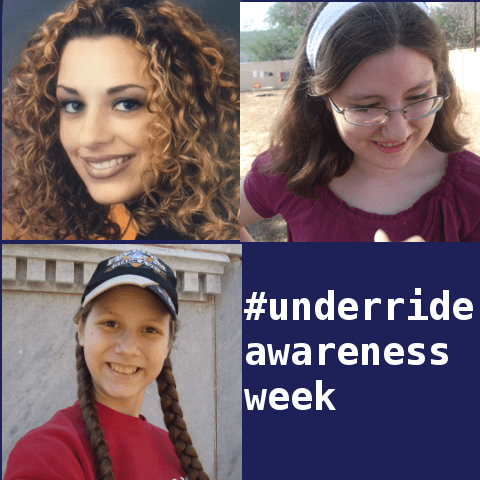
We have launched the Stop Underrides Bill Petition today. Please sign & share. Public support is crucial to ending Death by Underride. #underrideawarenessweek
On 12/12/2017, Senator Gillibrand, Senator Rubio and Congressman Cohen will introduce the Stop Underrides! Bill. This important legislation will save countless lives.
DATE: TOMORROW, Tuesday, December 12th
TIME: 10:15 AM
PLACE: Senate Visitors Center 212
United States Capitol Visitors Center
First St NE
Washington, DC 20515
Early in the day, as travelers made their way to Thanksgiving celebrations, WUSA9 reported that yet one more person has died due to a defective truck design.
Retrofitting the millions of trucks on the road could mean people like this man would live to see another day.
A man has died after a car crash on the Capital Beltway early Thanksgiving morning, police say.
Christopher S. Padilla, 30, of Alexandria, was killed when his 2013 Honda Civil crashed into the back of a parked tractor-trailer in Franconia, Virginia, early Thursday, Virginia State Police said.
The driver of the tractor-trailer had mechanical trouble early Thursday and pulled onto the right shoulder of I-495 just south of Exit 173/Van Dorn Avenue, police said.
He inspected his vehicle and was about to drive away when he felt the impact of the crash.
I just learned about an underride crash in Nevada on Sunday. The photo in the news report tells the sad and senseless story.
The semi driver began braking and made an improper left turn into the dirt center median with signage marked “No U-Turn” and “Authorized Vehicles Only.” The driver of the Kia then struck the trailer of the semi causing the Kia to be partially pinned under the trailer.
A 3-year-old girl who was injured in Sunday’s crash on northbound Interstate 15 near Moapa has died.
The girl was airlifted to Sunrise Pediatrics with critical injuries and succumbed to the injuries sustained in the crash.
Truck underride is what frequently happens when a passenger vehicle collides with a large truck. Because the truck was unfortunately defectively designed to be above the level of the crush zone of the smaller vehicle, the passenger vehicle goes under the truck and the crashworthy safety features of the car are not able to work. Or, to put it another way, the truck enters the occupant space of the passenger vehicle — too often resulting in horrific death and debilitating injuries.
Hundreds of people die this way every year — the victims of senseless, preventable death by underride. Yet, for decades, this problem has been left unchecked. Little has been done to preserve the occupant space and make truck crashes more survivable. Why is that?
Basically, the government has waited for the trucking industry to prove that it could do something to prevent these deaths. The trucking industry, for its part, has been waiting for the government to tell it whether or not, and how, to address this problem — before devoting R & D resources to it in order to come up with solutions. Meanwhile, the unsuspecting traveling public is left vulnerable and precious blood continues to be needlessly spilled on our roads.
Stalemate. Catch 22. Limbo. Standstill. Impasse.
The STOP Underrides! Bill will break this deadlock and get the ball rolling so that creative engineers can put effective underride protection on every truck — resulting in more truck crash survivors who can live to see another day.
This bill has been drafted by Senator Kirsten Gillibrand. On December 12, 2017, Senator Gillibrand, Senator Rubio, and Congressman Steve Cohen will be introducing it in Congress. They are all seeking Republican co-sponsors for this long-overdue, life-saving legislation.
I am the survivor of a terrible truck crash. I am the mom of two daughters who did not survive. The difference? Their part of the car went under the truck; mine did not.
In the aftermath, I found out that the rear underride guard could have been made stronger to withstand the crash so that AnnaLeah and Mary might — like me — have been survivors of a terrible truck crash. I learned that, if effective underride protection was installed on trucks, we could save hundreds of people who die every year when a truck enters their occupant space. So now, I am a mom on a mission to make truck crashes more survivable.
How did it come about? In October 2012, Jerry and I moved to North Carolina with the three youngest of our nine children. Four of the nine were going to college in Texas. When they all came home for Christmas break, we got the news that our oldest daughter, Rebekah, had just gotten engaged. We planned a big trip to Texas in May for the celebration of a wedding, four college graduations, and two family birthdays (AnnaLeah turning 18 & Vanessa turning 4).
Mary baked a seven-layer engagement cake to surprise Rebekah when she arrived for the holiday. Rebekah asked me to sew her wedding dress and we shopped for a pattern and material. In the ensuing months, Mary (13) served as a model for her sister’s wedding dress, and AnnaLeah sewed a little bride’s dress for a surprise birthday present for Vanessa.
On May 4, 2013, we packed our Crown Vic and headed for Texas. But the trip did not go as planned and it turned out to be AnnaLeah’s and Mary’s last journey they would make on this earth. We came upon slowed traffic on I-20 in Georgia (from a fatal crash two miles ahead, two hours earlier). We slowed down, but a truck driver did not — hitting our car and sending it into a spin so that the car went backward into the tractor-trailer ahead of us. The rear underride guard failed to withstand the crash and the back of the car went under the trailer.
AnnaLeah and Mary were in the backseat. AnnaLeah died at the scene and Mary a few days later from her very serious injuries.
In the four years following that day, we have been working hard to turn tragedy into advocacy — including the drafting of the STOP Underrides! Bill soon to be introduced in the U.S. Congress to mandate the installation of technology to end these preventable tragedies.
In memory of Roya, AnnaLeah, and Mary (and countless others!), let’s pass comprehensive underride protection legislation in order to STOP every kind of Underride tragedy!
My daughter, Rebekah Karth Chojnacki, is an Instructor for a First-Year Experience class at the University of Texas at Arlington. Her students were required to do a community service project as part of the class. They chose to work on our underride prevention advocacy efforts.
First they gave us some feedback on our various social media sites. Then they divided up into three groups and did some research to determine just how many votes we would need to get in order to pass the STOP Underrides! Bill — especially those hard-to-get Republican votes.
Here are the results:
Making progress toward better underride protection is a team effort involving many, many people; and I am thankful for the students’ practical assistance. I hadn’t looked at the numbers previously and, when Rebekah shared the results of their class project, I thought, “Maybe this won’t be so hard to win after all!”
So, why would the various engineers & inventors & manufacturers choose to not collaborate? Seriously, I cannot think of any other reason than that they hope to get the competitive edge with their underride prevention technology. Make a higher profit. I’m willing to listen to other possible answers to my question.
Just think what that means. . . one more way that the value of human health and life is taking a back seat to economic gain.
But really, who is gaining and who is losing? I know that this is a simplistic look at the matter, but we shouldn’t forget the fact that Research & Development of technology to stop cars from going under trucks (or trucks from going inside cars) is not inexpensive. Crash testing is costly — the crash cars and crash trailers and crash dummies and cameras and analytical tools, not to mention the crash team.
So why on earth would we want multiple manufacturers and engineers to reinvent the wheel — wasting precious resources, time, money and ultimately human lives because of the delay?
Back in 2014, we were told by one manufacturer that, “we are not competitive about safety.” It is imprinted in my brain. Frankly, I’m not so sure I believe it, and the whole thing makes me very frustrated and angry and makes the grief all the more painful. Let’s pull our resources together and act like we truly want to solve this preventable problem.
 Help hasten the installation of effective truck underride protection. Sign & Share our petition: Congress, Act Now To End Deadly Truck Underride!