All posts by Marianne

$ gain motivates engineers to end underride tragedies? Nothing further from truth.

Two separate comments which I read today implied that some are inferring that the hope of turning a profit is what primarily motivates engineers to develop solutions to end underride tragedies. Nothing is further from the truth.

The fact of the matter is that most of those, who stick out their necks to go against the stream of opposition to implementing underride solutions, are doing so on their own time and out of their own pocket because they have seen the devastation of underride crashes over and over and have decided to try and do something about this travesty!

The truth is that those, who oppose progress in this means of preventing motor vehicle fatalities, might be the ones more likely motivated by financial gain. Just sayin’ . . .

Wrong-headed thinking of industry leaders

Of course, I have to add here that the regulated-industry reaction is only to be expected because they are organizations whose duty it is to protect their bottomline — despite being composed of individuals who, on their own and following their own consciences, might react differently.

So, who should we let determine the fate of vulnerable travelers of our roads?

Another Successful TrailerGuard System Safety Skirt Crash Test : No Passenger Compartment Intrusion

On Saturday, June 2, 2018, Aaron Kiefer’s volunteer crew of crash testers, conducted another round of crash testing with his TrailerGuard System consisting of a polyester webbing Safety Skirt connected to his aluminum Rear Reinforcement Attachment (which strengthens the existing rear underride guard).

Crash Test #1 showed some Passenger Compartment Intrusion (PCI), which means the people in the car would have been injured. Analysis of the results showed that the webbing was likely too low and not able to catch the car.

Crash Test #2, on the other hand, was very successful: no PCI. The car was damaged from the collision but did not go under the trailer and rebounded back. 35 mph Delta-V force, 31 mph impact speed

Aerial view from a drone:

Q. What does it mean that the air bags did not deploy?

A. The acceleration was low enough that the car decided that it didn’t need them. So the crash pulse was “long” due to the flexibility/energy absorbing of the webbing. According to the air bag control module report, the car deployed the driver seat and passenger seat belt pretensioners. However, the severity of the crash was judged below the threshold to require the frontal air bags. This is due to the fact that the deceleration was achieved over a long duration (over 200 ms) and that the decleration rate was low.
Q. So, how would occupants have fared?
A. The occupants would have been fine in this 30+ mph collision since PCI was avoided and the energy was absorbed by the webbing and the vehicle structure. the threshold for air bag deployment of a vehicle of this type striking a solid object is 10-15 mph.
Crash testing — especially without the backing of corporate R&D resources — is time-consuming but well worth the effort. Imagine where we would be in terms of preventing devastating truck underride if we all collaborated to get the job done!

Glimpses of 13-year old Mary’s hopes & dreams — from a letter she wrote to herself 2 weeks before she died

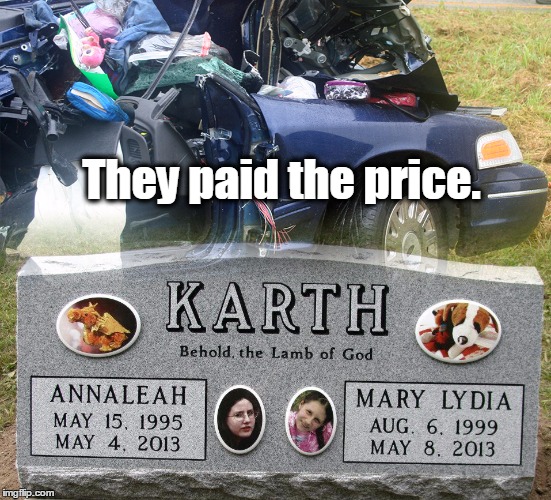
Glimpses of 13-year old Mary Lydia Karth — her questions, hopes, & dreams — from a letter she wrote to herself two weeks before she died from truck underride. 

She also wrote: “I hope . . . I’m living every day like it’s my last.”

You were, Mary — so full of joie de vivre. Missin’ you.

Mary models a wedding dress Mary had fun modeling Rebekah’s wedding dress as it was sewed step-by-step…she will never wear her own.

Mary with her brother’s dog

Mary, A Photo Album

Underrides happen frequently & a solution is at hand … and it is something many truckers would support.

From the inventor of the AngelWing Side Guard:

“This video conveys, through wide and varied news coverage, the frequency that underrides happen and that a solution is at hand … and it is something many truckers would support. Please share liberally.”

Underride Question: Litigation or Legislation?

We would have liked to see the DOT and trucking industry solve the underride problem on their own because it is the right thing to do. Because they have not, we are now faced with the question: Litigation or Legislation?

Last week, a side underride case in Texas was settled as a wrongful death suit. The trailer manufacturer acknowledged their failure to act to install technology which could have prevented the death of Kathryn Dodgen:

http://www.houstonpress.com/news/family-files-wrongful-death-lawsuit-against-a-trailer-manufacturer-after-deadly-crash-7704640

Kathy’s family and their lawyers believe the accident was entirely preventable—and so this week, they filed a wrongful death lawsuit against the trailer’s manufacturer, PJ Trailers. In the lawsuit, they accuse the manufacturer of releasing a defectively designed product onto the market, violating Texas’s products liability laws. The trailer didn’t have any side guards that would have prevented Kathryn’s car from going underneath it.

What does this mean for the future? Likely, with the hundreds if not thousands of underride deaths (and debilitating injuries) which occur every year in this country, there will be many more such lawsuits filed because of the precedent that this case has set.

How do we want this to play out? Do we want the trucking industry to face massive loss due to this de facto standard which will hold them liable for these preventable underride tragedies? Or do we want to protect them from litigation through legislation which will provide them underride standards to follow?

May 12, 2018, mwk

Update: Other posts on Underride Litigation

If you have lost a loved one in a truck crash, find out if underride was involved. Contact us to find out more.

Many times when people lose a loved one in a truck crash, they are not aware that the outcome of the crash might have been different if there had been adequate and effective underride protection to stop the car from going under the truck.

If you have lost a loved one in a truck crash, find out if underride was involved. We lost AnnaLeah when she was 17 and Mary when she was 13 because of a truck underride crash on May 4, 2013. We are working hard to make sure that this doesn’t happen to anyone else. We hope to have other families join with us to win this battle to end preventable underride tragedies.

Contact us to find out more. Email: marianne@annaleahmary.com

See a few of the thousands upon thousands of underride tragedies at Underride Crash Memorials and on our Interactive Underride Crash Map. To add more information on these stories or to add other underride crashes to this map, send an email to underridemap@gmail.com; use this Interactive Underride Crash Map Crash Location Input Form.

Congress, Act Now To End Deadly Truck Underride!

In Memory of Danielle Garcia

UPDATE March 13, 2026: Hundreds of people die every year when pedestrians, cyclists, motorcyclists, and occupants of passenger vehicles go under trucks. Please consider joining a STOP Underrides National Town Hall via Zoom April 15 | 8 – 9 pm ET |RSVP HERE.

Your voice at this unique advocacy gathering will let your U.S. Senators and Representative know that you want them to pass the STOP Underrides Act of 2026.

A 22-year-old woman was killed in a crash in Pawnee County early Saturday morning.

According to the Kansas Highway Patrol, Danielle Garcia was driving east on U-25 just west of Larned when she rear-ended a semi which had slowed down to turn into a private driveway.

KHP says she was wearing her seat belt.

The driver of the semi was not hurt. Woman dies in Pawnee County crash

See more underride tragedies at Underride Crash Memorials and on our Interactive Underride Crash Map. To add more information on this story or to add other underride crashes to this map, send an email to underridemap@gmail.com; use this Interactive Underride Crash Map Crash Location Input Form.

Note: In order to raise awareness and preserve the memories of underride victims — precious ones gone too soon — I have been writing memorial posts on what appear to me to be underride crashes. I am not a crash reconstructionist, and I do not have all the facts on these crashes; but underride should be investigated as a potential factor in truck crash injuries and deaths.

Four Separate School Bus Underride Crashes in the Last Six Months

I have become aware of four SCHOOL BUS underride crashes since November:


Hmmm, I detect a pattern here.

NHTSA’s Heidi King Responds to Senator Nelson’s Questions For The Record on Truck Underride

Senator Nelson submitted Questions for the Record to NHTSA Deputy Administrator Heidi King following her nomination hearing by the Senate Commerce Committee for the role of NHTSA Administrator. We received her answers yesterday:

Senator Nelson’s QUESTION: The National Transportation Safety Board has made several recommendations regarding underride guards that have not been completed. Every year, lives are tragically lost in truck crash accidents because trucks don’t have side underride guards that prevent cars from going under the side of a truck. Further improvements to rear underride guards could also prevent cars from going underneath the back of a truck. Several families in Florida have experienced this tragedy because the life-saving technology is not in place.

Do you believe it is time to require trucks to have underride guards so no more precious lives are lost in such tragic accidents?

Heidi King’s RESPONSE: The agency seeks to take an approach to reducing crashes involving passenger cars impacting the side and rear of commercial motor vehicles taking into account all available technologies. I am committed to a data driven approach to reducing these risks, including an examination of all options. This includes an examination of crash avoidance technologies, such as automatic emergency braking (AEB) and forward collision warning, to mitigate the severity of these crashes and to prevent them from occurring. NHTSA’s research indicates that these technologies on light vehicles have the potential of reducing underride frequency and severity.

Improvements to underride guard standards will be evaluated along with the expected changes to the vehicle crash environment.

My Reaction: Crash avoidance technologies might reduce the number of crashes which occur between trucks and cars. But when collisions do occur — because collision avoidance technology cannot prevent every crash — underride will still occur if there is not effective underride protection on the part of the truck where the collision takes place.

If we decide to use an Either/Or strategy and pick Crash Avoidance technologies instead of Underride Protective Devices, should we also stop using Air Bags and Seat Belts because we no longer expect to have crashes occur?

Why would we not use a Both/And approach to protecting the vulnerable motoring public (including pedestrians, cyclists, and motorcyclists, as well as passenger vehicles)?

Senator Nelson’s QUESTION: What is your plan to require improvements to rear underride guards and the addition of side underride guards on commercial motor vehicles? When will DOT implement NTSB’s recommendations? Please provide specific timelines.

Heidi King’s RESPONSE: On December 16, 2015, NHTSA issued a Notice of Proposed Rulemaking (NPRM) for upgrading rear impact guards on trailers and semi-trailers. NHTSA is reviewing these comments and developing next steps.

NHTSA issued an ANPRM for improved rear truck underride guards and conspicuity tape on single unit trucks. NHTSA estimates that rear guards are not cost effective for single unit trucks. NHTSA is considering next steps regarding rear impact guards and retroreflective tape for single unit trucks.

Regarding crash avoidance measures to reduce underride, per an agreement reached with
automakers in 2016, AEB will be offered as a standard feature in virtually all new light vehicles by September 2022.

My Reaction: What does that mean: “developing next steps” and “considering next steps”? NHTSA has already received numerous recommendations in the Public Comments to underride rulemaking. They have not responded to those in a timely fashion, and they are not being transparent about what they plan to do and when.

In addition, we have submitted a petition for them to follow up the December 2015 Rear Upgrade NPRM with a Supplemental Notice of Proposed Rulemaking (SNPRM) which would encompass everything outlined in the STOP Underrides! Bill (as well as the NTSB underride safety recommendations). In other words, a clear path (based on the recommendations of engineers) has been laid out for them. Additionally, the Bill calls for a multidisciplinary Committee On Underride Protection to be established to guide them in the process of moving forward.

Regarding the cost benefit analysis on single unit trucks, they have not revealed the formula for their calculations, which are most certainly based on flawed data and inaccurate assumptions.

Heidi King’s response refers to the AEB on “virtually” all new light vehicles. What about the older portion of the fleet which will not yet have AEB by 2022? What about AEB on trucks? Justin Stolzfus wrote about that concern:

Although an agreement among federal safety regulators, the insurance industry and automakers will put lifesaving automatic braking systems on most light vehicles by 2022, it will be many more years before large trucks and commercial vehicles, responsible for 4,000 deaths annually, get the same technology. Automatic Braking In Trucks Will Lag Cars By Years

Senator Nelson’s QUESTION: Some trailer manufacturers currently have retrofit kits available to strengthen existing trailers to enable them to meet the Institute for Highway Safety’s ToughGuard standard. Given the availability of current technology to address this challenge, what steps can the agency now take to prevent passenger compartment intrusion and underride fatalities?

Heidi King’s RESPONSE: NHTSA continues to monitor the development of this technology and will work with the Federal Motor Carrier Safety Administration (FMCSA) to ensure that truck and fleet operators are aware of safety considerations for trailer repairs. FMCSA operates roadside inspection programs for commercial motor vehicles and underride guards are inspected as part of these programs.

My Reaction: However, underride guards are often not properly maintained and are not currently on Vehicle Inspection Checklists and are not included in the Appendix G in the FMCSA Safety Regulations Pocketbook. It seems to me that, until they are included, underride guards are not likely to be consistently inspected or receive appropriate violations  — including an Out of Service Violation for a weak or non-existent guard, which could lead to a crash becoming deadly.

Sitting around and monitoring the development of technology seems to me to be irresponsible when the agency could take the lead and mandate that the technology — which is already developed — be installed. Any adjustments which would be required could easily be handled by the industry in the time period before implementation is required. This would save lives; people die when colliding with existing trucks not just newly-manufactured ones.

After all, the industry has had plenty of time to prepare. DOT stated in 1969 that they planned on adding underride protection to the sides of large vehicles. And the industry themselves, in 2002, predicted that there would be underride regulations for front, side and single unit trucks by 2006.

There is no excuse for the blatant inaction which is evident all-around.

Senator Nelson’s QUESTION: When will NHTSA release the results of the Texas A&M side underride study, which was completed at the end of 2017?

Heidi King’s RESPONSE: The report has been released and is available here.

My Reaction: In 1969, DOT planned on adding side guards to trucks after technical studies had been completed. Well, they’ve been completed. We’ve been waiting almost 50 years. Will they act now? (Read more of my reaction here.)

Heidi King holds a significant position in NHTSA — an agency charged with ensuring the Safety of the traveling public. I, for one, am not very satisfied with her answers. Did she explain why the agency has waited so long to effectively solve the underride problem — especially when engineering solutions are available? Did she let us know when they would move forward?

It seems clear to me that her answers confirm the fact that, if Congress wants the Department of Transportation to address the underride problem and end preventable underride deaths & injuries, then they will need to pass a law telling them to do so.

Side Underride Crashes Kill 200 People a Year. Will Congress Act?

“A Culture of Conformity, Inertia, & Malpractice Paranoia”: Could that be said of the industry & underride?

STOP UnderRides!

A DIFFERENT STRATEGY

TO ACHIEVE UNDERRIDE PROTECTION

For Such A Time As This

Why, you might ask, would we write a piece of legislation calling for a comprehensive underride protection rule? Why not have separate bills for side underride and rear underride and front underride and Single Unit Trucks (SUTs), et cetera?

I am convinced of the importance of this strategy and want to share some of my thoughts here: Why COMPREHENSIVE Underride Protection Legislation? and A DIFFERENT STRATEGY To Achieve Underride Protection

I put down those thoughts while sitting outside the Duke Integrative Medicine Center. When I finished, I went inside and picked up a book called, Hippocrates’ Shadow , which talks about what happens in the medical field when the problems of ineffective treatments are not openly discussed. This phrase jumped out at me: “With full knowledge and ample evidence that it doesn’t work, we do it anyway.” (by David H. Newman, MD, p. 25) And the author referred to one of the reasons that the problems don’t get addressed being, “a culture of conformity, inertia, and malpractice paranoia.” Well said. . .