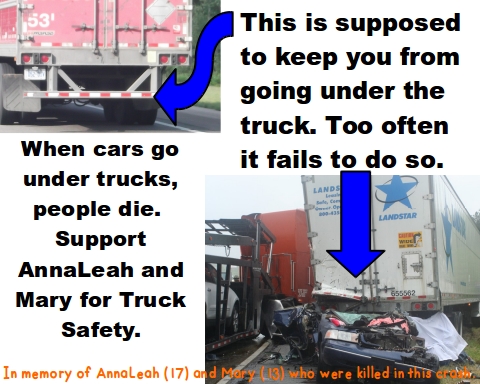
Ted Scott, from the American Trucking Association, just emailed me with the news about the new rear underride guard design announced yesterday by Wabash (a trailer manufacturer).
The new rear impact guard is constructed of advanced high-strength steel. Its patent-pending design features two additional vertical posts and a longer, reinforced bumper tube, all of which are engineered to work together to absorb energy better and deflect rear impact at any point along the bumper. In addition, the new guard is fully galvanized to resist corrosion.Wabash Debuts Rear Impact Guard Design for its Dry Van Trailers
Thank you, Wabash, for your commitment to safer trucks.
“Our work on the rear impact guard, and trailer performance in general, isn’t finished,” added Giromini. “Innovation is ongoing at Wabash National. We’re continually looking at ways to optimize total performance through engineering and the use of advanced materials in ways that make sense for our customers.”
I hope that means that they will also be looking at side guard and retrofitting solutions as well.
And thank you, J.B. Hunt, for already ordering 4,000 new trailers with the improved underride protection to put on our roads.
The question was brought to my attention as to whether truck side guards, if they were strong enough to prevent passenger vehicle underride (i.e., probable death or severe injury), would be more harmful to pedestrians and cyclists (Vulnerable Road Users–VRU).
I didn’t know. So I asked the experts with whom I am acquainted, and this is what I found out:
Hi MarianneWell-designed rear, side, front underride protection on trucks, will not make it more dangerous for pedestrians and cyclists, but potentially make it safer for peds and cyclists.
Adjunct Assoc. Professor George Rechnitzer, Transport and Road Safety (TARS) Research, University of New South Wales (UNSW), Web: http://www.tars.unsw.edu.au/
The other feedback, which I received from a crash reconstructionist friend who sees the aftermath of lots of crashes firsthand, was more short and to the point: “I think that stronger side skirts will save lives no matter what vehicle is in play. Would you, as a cyclist, rather bump your head on a resilient skirt (or a flexible one like mine for that matter) or slide underneath a trailer and end up looking like a pancake?”
Goodness, I sure hope that we can help shed light on issues such as these at the Underride Roundtable on May 5, 2016. Delays resulting from endless debate and/or stalling on problem-solving has already led to too many needless and preventable deaths.
32,719 people died in U.S. traffic crashes in 2013. Two of those people were my daughters, AnnaLeah (17) and Mary (13). That number decreased to 32,675 deaths in 2014–down by 44, but still far too many deaths in my book. In fact, early estimates show 2015 trending higher.
And how many of those deaths were due to truck underride and could have been prevented by a stronger, more effective underride protection system? Underride deaths are preventable and unnecessary and now is the time to take extreme action to reduce these deaths–no matter who caused the crash!
I survived a horrific truck crash in which our car was pushed by a truck into the rear of another truck. Backwards. My daughters in the back seat were not so fortunate; they went under the truck and the truck broke their innocent bodies.
The underride problem is just one example of the fixable problems we need to address. Michael Lemov has written an eye-opener, Car Safety Wars: One Hundred Years of Technology, Politics, and Death in which he tells us that in the more than 110 years since the first traffic crash in 1898, more than 3.5 million Americans have been killed and more than 300,000,000 injured in motor vehicle crashes [p.9]. This, I learned, is 3x the number of Americans who have been killed and 200x the number wounded in all of the wars fought by our nation since the Revolution [p.10]. Imagine.
Worldwide it was estimated that 1.2 million people were killed and 50 million more were injured in motor vehicle collisions in 2004.[2] Also in 2010 alone, around 1.23 million people were killed due to traffic collisions.[3]This makes motor vehicle collisions the leading cause of deathamong children 10–19 years of age (260,000 children die a year, 10 million are injured)[4] and the sixth leading preventable cause of death in the United States[5] (45,800 people died and 2.4 million were injured in 2005).[6] It is estimated that motor vehicle collisions caused the deaths of around 60 million people during the 20th century,[7] around the same as the number of World War II casualties.
Lemov’s book sheds light on many things including the fact that, although the blame was often put on the driver for crashes in the 20th century, in fact crashes and crash deaths are additionally caused by other factors including environmental and vehicle factors. He uses a term which I had never heard before–post-crash injury or “second collision.” He describes it this way: ”
It is the collision of the occupants of a vehicle with its interior, or the road, after the initial impact of a car crash. Ultimately the creativity of a few scientists, doctors, and investigators. . . developed an understanding of what actually happens to a human body in a car crash. . . Researchers gradually developed ideas they hoped would prevent this second collision. [p.16]
We can thank these researchers for paving the way for improved vehicle safety, including things like seat belts, air bags, and even car seats that lock in position. But, for far too long, it has been a major battle –as Lemov says, a car safety war — to bring about changes which will save lives.
Our own crash demonstrated the many factors which can contribute to the occurrence of crashes as well as to the deaths and horrific injuries which too often occur as a result. We learned the hard way that many of these are preventable and that Our Crash Was Not An Accident.
Following that, we worked to promote underride research and have helped to organize an international Underride Roundtable on Thursday, May 5, 2016, when researchers, government officials, and industry leaders will gather to discuss truck underride crashes and how to reduce the risks for passenger vehicle occupants, bicyclists, and pedestrians. We will explore the scope of the problem and how regulation and voluntary action can help address it. There will also be a demonstration of underride guard performance in a crash test.
I learned that one of the biggest obstacles was that public policy and more specifically DOT rulemaking is impacted by a requirement for cost/benefit analysis which tips the scale in the favor of industry lobby and the almighty dollar and makes a mockery out of the word safety. Human life becomes devalued in the process when a safety measure is rejected because it “may not have significant safety consequence.”
This is illustrated in the history of Federal rulemaking on truck underride guards outlined by the Insurance Institute for Highway Safety, where it was indicated that in
1974: US Secretary of Transportation says deaths in cars that underride trucks would have to quadruple before underride protection would be considered cost beneficial.
I determined to battle such an inconceivable, incomprehensible, and unconscionable attitude and determined to find a better way to protect travelers on the road. After talking with numerous engineers who either were convinced that safer underride guards could be made or had already designed ones, I also discovered a global movement that calls for the reduction of crash deaths and serious injuries: Vision Zero – An ethical approach to safety and mobility.
Why are we devoting our lives to pushing for a DOT Vision Zero policy? Because I truly believe that it can have an impact not just on truck safety but on all issues related to highway and auto safety–including auto safety defects, driver training requirements, all kinds of impaired driving (including distracted driving, drunk driving, and driving while fatigued), and proven national traffic safety standards which should be adopted by all states.
Add your voice to ours! Sign & share our Vision Zero Petition. Help us persuade President Obama to set a National Vision Zero Goal & to sign a Vision Zero Executive Order which will allow DOT to adopt a Vision Zero rulemaking policy.
We are taking these petitions (almost 16,000 signatures to date) to Washington, DC, on March 4, where we will be meeting with DOT policy officials to discuss the need for this radical change in how our nation protects the travelers on our roads.
It is time to stop acting like the value of a human life can be measured with and compared to corporate $$$. Every delay costs someone their life.
Let’s get it right, America. Somebody’s life depends on it. Lots of somebodies.
IIHS was reporting on a meeting that took place on March 16, 1977 — three days before I got married! That’s almost 39 years ago — long before any of my 9 children were born, let alone my two youngest daughters, AnnaLeah and Mary!
The government and industry apparently didn’t get underride rulemaking right then! And they clearly hadn’t gotten it right by May 4, 2013 — when Mary and AnnaLeah died from truck underride! But they better watch out, because I am not going to sit by and watch while thousands more die for no good reason!
See the testimony in May 2009 by the Insurance Institute for Highway Safety, in which they call for tougher underride guard standards and with an attachment of the history of federal rulemaking on underride guards (pasted below): http://tinyurl.com/phlaqon
“The history of Federal rulemaking on truck underride guards:
1953 Interstate Commerce Commission adopts rule requiring rear underride guards on trucks and trailers but sets no strength requirements.
1967 National Highway Safety Bureau (NHSB), predecessor to the National Highway Traffic Safety Administration (NHTSA), indicates it will develop a standard for truck underride guards.
1969 NHSB indicates it will conduct research on heavy vehicle underride guard configurations to provide data for the preparation of a standard. In the same year the Federal Highway Administration publishes a proposal to require trailers and trucks to have strong rear-end structures extending to within 18 inches of the road surface.
1970 NHSB says it would be “impracticable” for manufacturers to engineer improved underride protectors into new vehicles before 1972. The agency considers an effective date of January 1, 1974 for requiring underride guards with energy-absorbing features as opposed to rigid barriers.
1971 National Transportation Safety Board (NTSB) recommends that NHTSA require energy-absorbing underride and override barriers on trucks, buses, and trailers. Later in the same year NHTSA abandons its underride rulemaking, saying it has “no control over the vehicles after they are sold” and “it can only be assumed that certain operators will remove the underride guard.” The Bureau of Motor Carrier Safety (BMCS), predecessor to the Federal Motor Carrier Safety Administration, considers a regulatory change that would prohibit alteration of manufacturer-installed equipment. This would nullify the major reason NHTSA cited for abandoning the proposed underride standard.
1972 NTSB urges NHTSA to renew the abandoned underride proposal.
1974 US Secretary of Transportation says deaths in cars that underride trucks would have to quadruple before underride protection would be considered cost beneficial.
1977 IIHS testifies before the Consumer Subcommittee of the US Senate Commerce Committee, noting that devices to stop underride have been technologically available for years. IIHS tests demonstrate that a crash at less than 30 mph of a subcompact car into a guard meeting current requirements results in severe underride. IIHS also demonstrates the feasibility of effective underride guards that do not add significant weight to trucks. IIHS petitions NHTSA to initiate rulemaking to establish a rear underride standard. The agency agrees to reassess the need for such a standard and later in the year announces plans to require more effective rear underride protection. BMCS publishes a new but weak proposal regarding underride protection.
1981 NHTSA issues a proposal to require upgraded underride protection.
1986 IIHS study reveals that rear guards designed to prevent cars from underriding trucks appear to be working well on British rigs.
1987 European underride standard is shown to reduce deaths caused by underride crashes.
1996 NHTSA finally issues a new standard, effective 1998.”
Mariolani, J., Schmutzler, L., Arruda, A., Occhipinti, S. et al., “Impact Project: Searching for Solution to the Underride Problem,” SAE Technical Paper 982755, 1998, doi:10.4271/982755.
“Rear underride crashes kill thousands of people yearly worldwide. Underride guards did not follow the progress achieved by the automotive safety technology. . .”
Summary
This NPRM proposes to upgrade the Federal motor vehicle safety standards that address rear underride protection in crashes into trailers and semitrailers. NHTSA is proposing to adopt requirements of Transport Canada’s standard for underride guards, which require rear impact guards to provide sufficient strength and energy absorption to protect occupants of compact and subcompact passenger cars impacting the rear of trailers at 56 kilometers per hour (km/h) (35 miles per hour (mph)). NHTSA is issuing this NPRM in response to a petition for rulemaking from the Insurance Institute for Highway Safety (IIHS), and from Ms. Marianne Karth and the Truck Safety Coalition (TSC). This is the second of two documents issued in response to the Karth/TSC petition. Earlier, NHTSA published an advanced notice of proposed rulemaking requesting comment on strategies pertaining to underride protection afforded by single unit trucks.
Dates
You should submit your comments early enough to ensure that the docket receives them not later than February 16, 2016.
Jeremy Finley, Investigative Reporter from Nashville, Tennessee, sheds light on the problem with NHTSA’s proposed rule for underride guards on tractor-trailers. He discusses our crash.
Could someone please explain to me why it is that we can invent amazing technology to allow “face time” — among countless other inventions which are unfolding at an unbelievable pace — but we are slow as a snail to solve safety problems.
Why are we not devoting top priority resources (time, money, and the creativity of the human mind — enhanced by the availability of information and technology) to reducing the 33,000 on average annual traffic crash fatalities in the U.S. and 1.24 million crash deaths on the world’s roads in 2010? http://www.who.int/gho/road_safety/mortality/en/
And why is it that getting safety measures passed — whether it be at the legislative level (in getting laws passed) or the administrative level (in getting regulations issued) is a continual battle?
Let me tell you what I think might be some of the reasons:
The industry lobby opposing safety measures has a deep pocket. Need I say more? Well, I will. In less than 3 years since our crash, I have spent countless hours as a volunteer safety advocate (motivated by my daughters’ needless deaths) sending emails and making phone calls and meeting in person with legislators to inform them and attempt to persuade them to support safety measures. All too often, I am back at it again in another six months or so to fight the same battle all over again. https://dawnkinster.wordpress.com/2013/10/02/reflections-on-truck-safety/ & https://dawnkinster.wordpress.com/2014/04/05/for-annaleah-and-mary/
Industry is more often than not reluctant to move ahead with safety measures voluntarily — either because they don’t want to have to re-do it when government regulations finally come out or because cost is a factor (enough said). This, of course, does not mean that all companies do nothing on their own to improve safety.
Now, back to my original question, why is it that we can invent amazing technology to allow “face time” — among countless other inventions which are unfolding at an unbelievable pace — but we are slow as a snail to solve safety problems?
My grandpa was a rural mailman and used a sleigh and horses to deliver mail in the snow. My dad grew up with a wood-burning stove and an icebox for refrigeration. I grew up with the introduction of color television, seat belts, and not until I started raising children did I use things like VCRs or modem dial-up internet access. I went to Europe for a summer in college and had no cell phone to keep in contact with my parents back in the U.S.
Don’t get me wrong, I am thankful for the safety advances made after those famous crashes. But I am appalled that we can’t seem to get it until such tragedies cause us to sit up and take notice. Meanwhile, countless unnoticed-by-the-public tragedies happen daily on roads across the globe. Year after year.
That is why I am devoting myself to raising awareness and calling for change. Come on people, let’s set a National Vision Zero Goal and use our vast resources and brilliant minds to slay this giant. Let’s not keep on putting our heads in the sand, putting bandaids on the problems, and losing these battles at the price of our loved ones. We can do it!
Secretary Anthony Foxx & Marianne Karth discuss truck safety, September 12, 2013
p.s. By the way, the inventor of the NASCAR SAFER Barrier which is now saving lives, thinks that he can invent a much safer truck underride protection system. We just need the money to prove it: https://www.fortrucksafety.com/
Registration is now open for the Truck Underride Roundtable at the IIHS Vehicle Research Center on May 5, 2016.
Here is the Save the Date Flyer:
Please join us on Thursday, May 5, 2016, as researchers, government officials, and industry leaders gather to discuss truck underride crashes and how to reduce the risks for passenger vehicle occupants, bicyclists, and pedestrians. We will explore the scope of the problem and how regulation and voluntary action can help address it. You will also see a demonstration of underride guard performance in a crash test.
Hotel group rates are available:
at the Hyatt Place in Charlottesville, VA, http://charlottesville.place.hyatt.com/en/hotel/home.html, Group Code #GII56, Hyatt Place
2100 Bond Street
Charlottesville, VA 22901
IIHS room rate: $109 Reservation cut-off date: Wednesday, April 20, 2016
at the Omni in Charlottesville, VA, http://www.omnihotels.com/hotels/charlottesvilleBlock Code #112-001-089-76, Omni
212 Ridge McIntire Rd
Charlottesville, VA 22903
IIHS room rate: $199 Reservation cut-off date: Sunday, March 20, 2016
When I google the words “money” and “funding” and “underride guards” and “crash tests,” I mostly come up with links to things which I have written. Try it. If you find someone willing to hand out money for these things, please let me know right away!
Meanwhile, I will keep asking anyone and everyone to help us out: