Tag Archives: underride crash

Adopt a National Vision Zero Goal: Save lives not dollars!

On January 1, 2016, we launched an online petition at Change.org–Adopt National Vision Zero Goal: Save lives not dollars!

Sign & share our new Vision Zero Petitionhttps://www.change.org/p/obama-adopt-a-vision-zero-goal-and-sign-an-executive-order-to-save-lives-not-dollars

During the fall of 2015, we collected over 15,000 signatures on a petition aimed at Secretary Foxx to apply Vision Zero principles to highway safety rulemaking. http://www.thepetitionsite.com/417/742/234/save-lives-not-dollars-urge-dot-to-adopt-vision-zero-policy/

But in order for DOT to act accordingly, they need to be empowered by a National Vision Zero mandate. That is why we are asking President Obama to set a national Vision Zero goal and to sign a Vision Zero Executive Order.

Help us send the message to Washington, DC, that we want to reduce the almost 33,000 crash deaths which occur each year.  This is the petition letter which will be delivered to President Obama: Vision Zero Executive Order Petition Letter to President Obama

This is the executive order which I have drafted (which, of course, is merely my request/ recommendation):  Executive Order Draft Application of Vision Zero Principles to Highway Safety Regulatory Review

Due to a shared interest in reducing preventable traffic fatalities and serious injuries, we are working with the following individuals & organizations to raise awareness and garner widespread support for this VISION ZERO effort (to be updated as more supporters get on  board with us): Letter of Support for Vision Zero Executive Order Petition

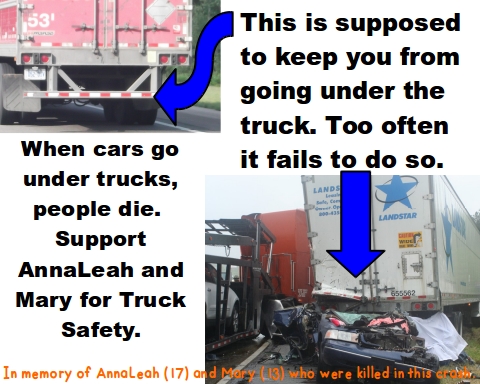
Rebekah photo of crash

Read more about Vision Zero: https://annaleahmary.com/tag/vision-zero/

An example of the application of VZ principles to rulemaking: Underride Guards–Apply Vision Zero principles by requiring crash test-based performance standards for truck underride guards rather than force-based design standards along with success at higher speeds—to include rear (both centered and offset) and side guards for both Single Unit Trucks and trailers.  https://annaleahmary.com/2015/12/a-moms-knee-jerk-reaction-to-nhtsas-proposed-rule-to-improve-rear-underride-protection/

Give $1 for IIHS crash tests on 5/5/16–3 yrs & 1 day after our deadly UNDERRIDE crash

UPDATE 1 year later, December 29, 2016: We are again raising money for crash testing. Crash Test of Innovative Large Truck Side Guard Could Advance Side Underride Prevention Donate herehttps://www.fortrucksafety.com/

It will happen:

  • Cars will continue to collide with larger trucks and ride under them when the too-weak underride guard buckles (or because there is no underride protection on the side of the truck)– with deadly consequences.
  • NHTSA will propose truck underride rules which are weaker than could be possible.
  • The trucking industry, for the most part, will wait to find out what new standards might be required of them for underride protection systems in 3 years or more.
  • The Insurance Institute for Highway Safety (IIHS) will sponsor an Underride Roundtable at their Vehicle Research Center in Ruckersville, Virginia, on May 5, 2016.

What we hope will happen is that:

  • Cars will, in the near future, be better protected from deadly underride when they unfortunately & inevitably collide with larger trucks due to human error and road conditions because. . .
  • NHTSA will propose stronger underride rules which provide the best possible protection for travelers on the road because clear evidence will be available (from underride research & crash tests) for all to see that collisions with trucks should be more survivable than previously thought.
  • The trucking industry will take responsibility and voluntarily work to provide better underride protection for collisions with smaller passenger vehicles–without even waiting for improved federal requirements to go into effect.
  • The Underride Roundtable at IIHS, on May 5, 2016, will bring together experts in many fields who will propose solutions, which will contribute greatly toward realizing a vision of Zero Deaths and Zero Serious Injuries from truck underride crashes.

Be a part of this vision. Contribute to support underride research and crash tests.

Update, April 22, 2016: At this point, any donations given will not be for the crash test taking place at the Roundtable on May 5, but would be used for future research/testing.

You can do so here & now: https://www.fortrucksafety.com/

2

Tell others about it. (See sharing icons below.)

For too long, this problem has been recognized but swept under a rug. It has not been considered a priority and money has not been earmarked to resolve the problem. If we don’t do something about it, who will?!

Watch the informative video below which I discovered yesterday from a 2012 investigative report on underride crashes:


And, out of the mouths of babes. . .

Up for debate: Could & should the proposed UNDERRIDE rule be made stronger?

Stephen Hadley from the Underride Network (http://www.underridenetwork.org/) indicated to me recently his opinion that,

“We need to get media on board that guards must exceed Canadian Standard which only legalizes within two years of implementation 98 % of guards already on the road, this is our best bet to force NHTSA to re-evaluate.”

I have already made this very clear in four media interviews (and two posts) which I had after the proposed rear underride trailer rule was announced:

I’m hoping that the rulemaking process will truly end in the Best Possible Protection.  Somebody’s future is counting on it.

2

Senior Underride Design Project Mid-Year Report Presented by Virginia Tech Students

The coordinator, Jared Bryson, for the Virginia Tech Senior Underride Design Team sent their end of semester report on the underride project to me yesterday.

I have not had time to read it fully yet (rather busy this weekend). But I did look it over quickly and am intrigued by their emphasis on a Wrap Around Bumper concept.

You can read their report here: Virginia Tech Senior Student Underride Design Project December 2015 Report

They are off for Christmas break. But rumor has it that NHTSA’s proposed underride rule for trailers is assigned reading before they come back after the holidays so that they can submit a Public Comment as a team.

“The student’s final fall presentation is tonight.  I will forward the NPRM tomorrow, for reading over the break. We will discuss in length in January, and formulate a group or individual submissions.”

Good work, team. Looking forward to more good news. . .

Underride Research Memegertie 3271

Unexpected Events & Progress in Underride Protection

When we were headed from North Carolina to Texas, on May 4, 2013, and hit by a truck, not only did we lose our two youngest daughters, AnnaLeah (17) and Mary (13), but we lost the joy of celebrating fully with four of our children as they became college graduates in Texas during that month of May.

So, this past weekend, we were looking forward to a more uneventful trip to celebrate one of our sons’ graduation on December 5, 2015, from Concordia University in Austin, Texas. Unexpectedly, it really became a whole lot more.

In fact, we thoroughly enjoyed Levi’s graduation ceremony as he walked across the stage summa cum laude, along with the party afterwards at a Peruvian restaurant where we were able to spend an enjoyable afternoon with his friends.

Texas to North Carolina 2015 023 Texas to North Carolina 2015 062 DSCF6169

On our way back home to North Carolina, we stopped in Arlington to visit with our oldest daughter, Rebekah, and her husband, John. Instead of taking them out to dinner, they took us out to a holiday party hosted by her Tae Kwon Do instructor. There we had the pleasure of meeting with her friends and being there in person as she was presented with an unexpected award for her Indomitable Spirit.

Texas to North Carolina 2015 116 Texas to North Carolina 2015 110

The next day, as we started back toward North Carolina, I found myself going again through many emotions as I realized anew that this trip was the one we were supposed to be taking back home in May 2013 after a week of family celebrations–with AnnaLeah & Mary a part of our festivities and part of the crew returning home. I must admit that the trip was hard–with many memories triggered as we passed by landmarks.

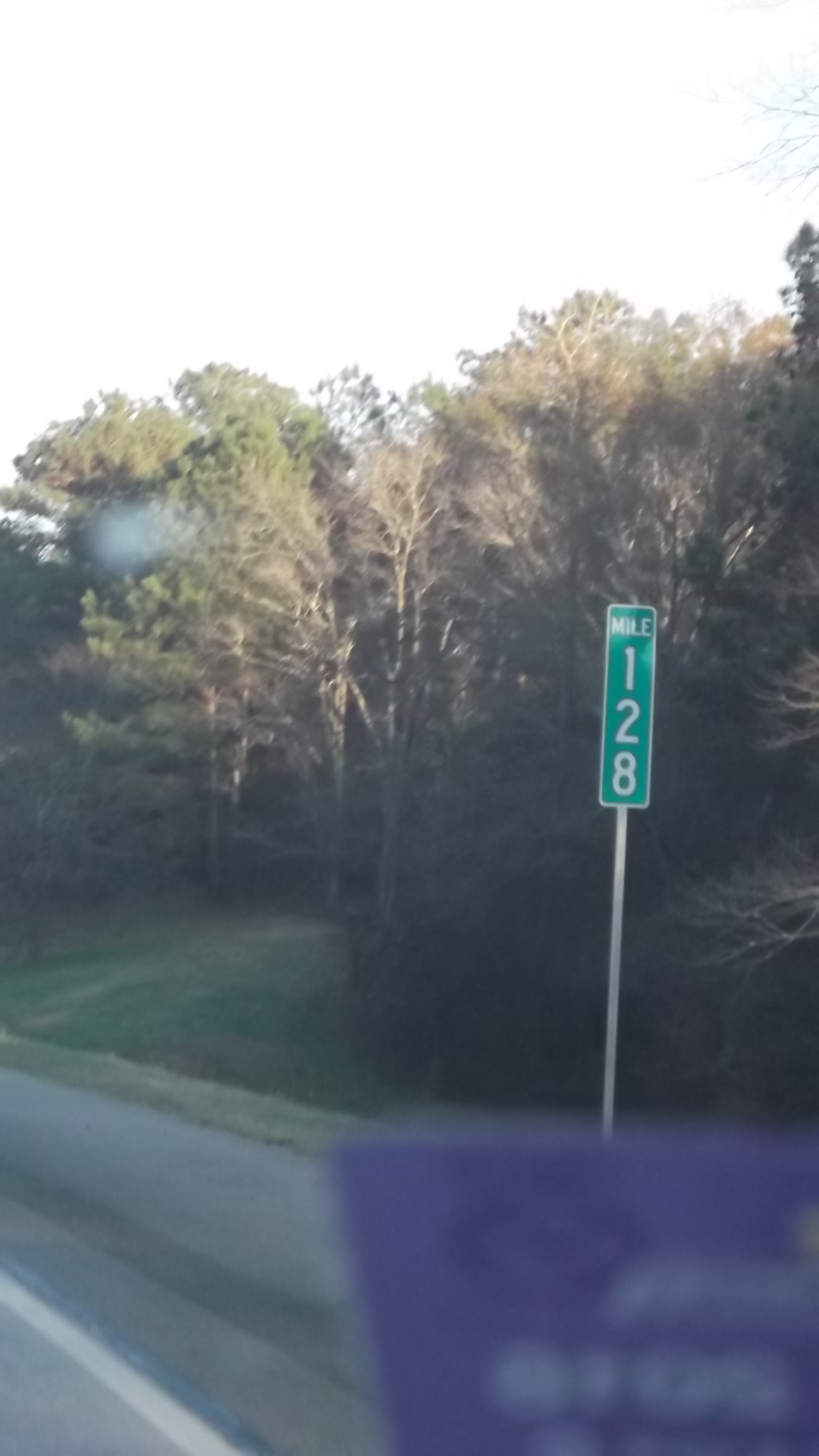
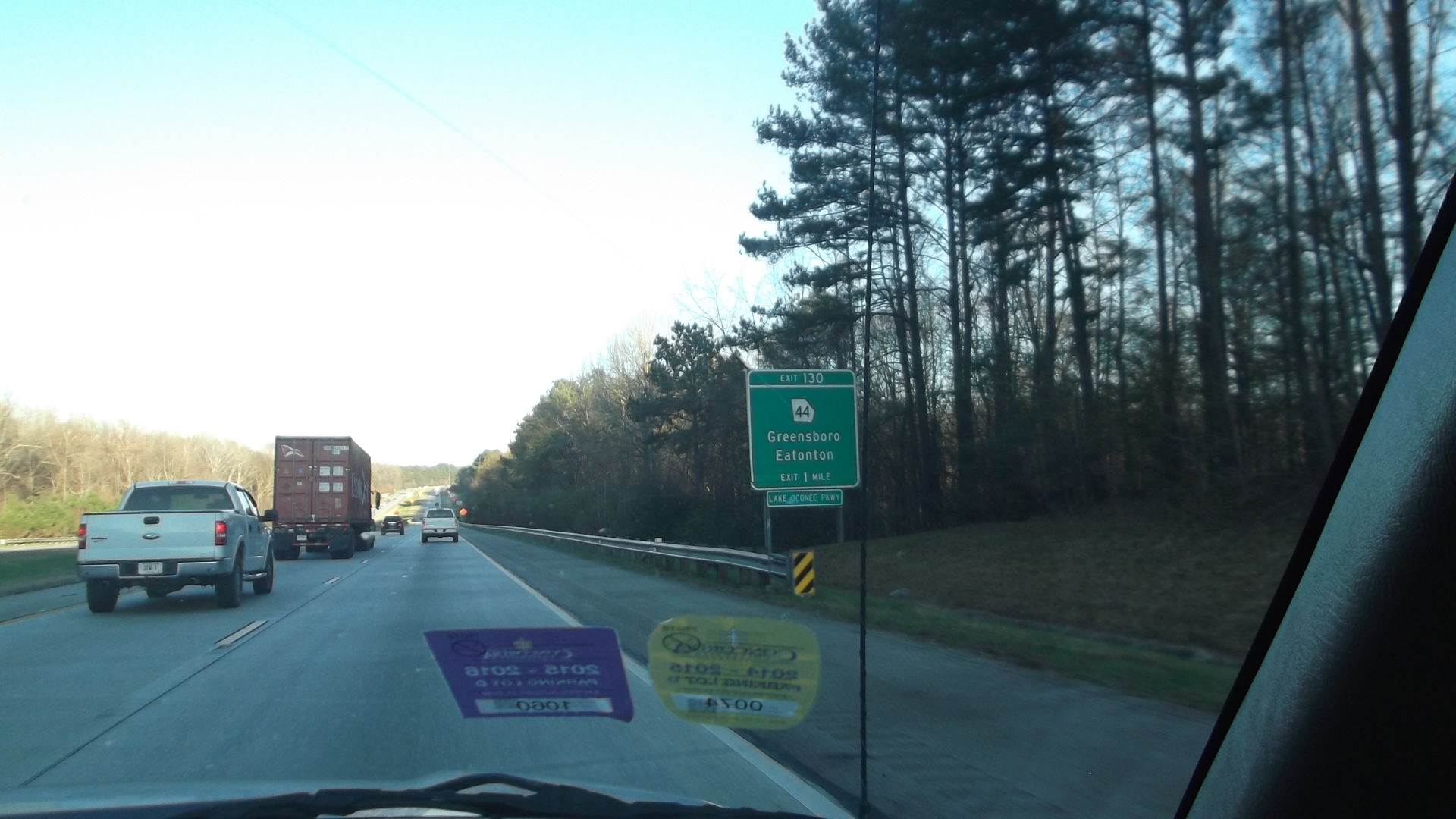
DSCF6259 Exit 128 was where the crash took place 2 hours before ours and 2 miles ahead of our crash at Exit 130. That caused the traffic backup which the truck driver did not notice in time and consequently hit our car pushing us into another truck.DSCF6261

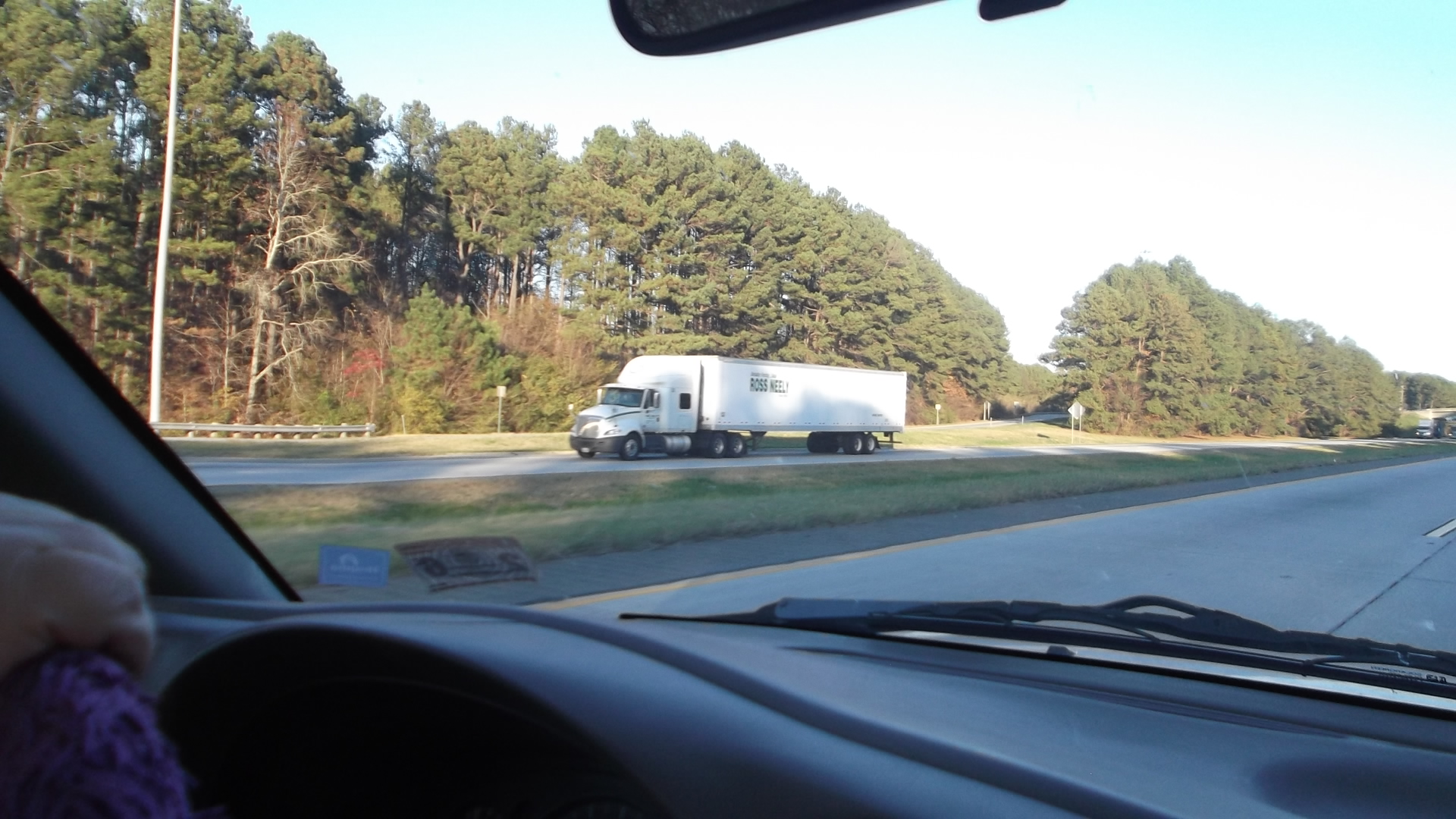
DSCF6264This is where our crash took place–about where that truck is is where we ended up after being dragged under the truck ahead of us.

IMG_4464

That night, as we decided to call it a day and stop for the night in Tuscaloosa, Alabama, I saw a sign for the University of Alabama and I knew that Birmingham was just down the road apiece. I thought, hey, that’s where Dean Sicking is!  We had only talked with Dean on the phone and corresponded with him via email about his proposed Underride Research Project.

Dean Sicking’s Underride Research Project Proposal: Development of Trailer Underride Preventive Measures

So, the next morning, before eating breakfast, I emailed Dean and his Research Assistant, Kevin Schrum, and said we were going to be driving through Birmingham and to give me a call if we could meet. A bit later, first Dean called to say he was going to be in a meeting that morning but he thought Kevin would be available. Then Kevin called and said that he would love to meet with us. We then had a very good meeting with Kevin and even recorded a few minutes of him talking about his passion for research and his confidence that much improvement could be made.

Kevin shared how he–like his mentor Dean Sicking–believes that the underride problem is not insurmountable and is hopeful that, with adequate backing, they could develop a step-by-step solution which could be adopted by the industry to ultimately reduce underride deaths to zero.

We were also able to talk about some ways in which they might be able to help us seek additional funding to back the research.

LOGO AnnaLeah & Mary for Truck Safety https://www.fortrucksafety.com/

After such an eventful trip, I did not have much memory or battery left on my camera, but I was able to capture some of Kevin’s passion and ideas on this video:

As if all of this were not enough, shortly after we got back on the road, I discovered that I had missed a call from Mark Rosekind, the Administrator of NHTSA, who wanted to give me a heads up that they were releasing a NPRM (Notice of Proposed Rule Making) proposing that the requirements for rear underride guards on tractor trailers be improved!

We have been awaiting this news ever since the initial Advance Notice of Proposed Rule Making (ANPRM) was announced in July 2014 following our delivery of  over 11,000 petition signatures requesting this on May 5, 2014. So this was unexpected excitement to add to our trip.

Not being at my computer hampered the following hours as I attempted to find out as much as I could. A summary of the proposed rule is that it will upgrade the requirements to match the Canadian standards (requiring them to withstand a crash at 35 mph rather than 30 mph), which many U.S. companies are already doing.

However, after a very cursory review of the 108 pages, as far as I can tell it does not address the problem with current standards failing in offset crashes (when the smaller vehicle does not hit dead center at the back of the truck). And the NPRM anticipates 1 saved life out of the 125 reported PCI underride crash fatalities on average annually. (Our crash is not reported as a PCI crash fatality but rather is listed in the federal crash data as “Passenger Compartment Intrusion Unknown“!)  What about the other 124?

Shortly after finding out this news, I also got a phone call from Jeff Plungis, a Bloomberg News reporter who had interviewed me last year extensively on the underride issue (http://www.bloomberg.com/news/2014-12-16/dead-girls-mom-says-100-truck-fix-may-have-saved-them.html). He asked me what my reaction was to the NPRM and later in the day published this article:  http://www.bloomberg.com/news/articles/2015-12-07/stronger-truck-guards-proposed-by-u-s-to-cut-rear-impact-deaths.

Here is the press release from NHTSA on the rear underride NPRM:  “A key component of DOT’s safety mission is ensuring that trucking, an essential element in our transportation system, operates not just efficiently, but safely,” U.S. Transportation Secretary Anthony Foxx said. “Today’s proposal is another important step in that effort.” – See more at: https://www.transportation.gov/briefing-room/usdot-issues-nprm-improved-rear-impact-trailers-semitrailers#sthash.j6eu5DN1.dpuf

And here is the NPRM itselfNPRM-underride.Dec2015

Take a moment to read Administrator Mark Rosekind’s thoughts on this important development in truck safety:

“Although the responsibility for both of these measures [this NPRM along with the ANPRM on Single Unit Trucks] lands on truck owners, that’s a function of vehicle design more than crash causality. We’ve also taken a number of steps over the years to prevent crashes resulting from driver behaviors, such as drunk driving, speeding, and distracted driving. And, we’re accelerating the spread of crash avoidance technologies such as automatic emergency braking and lane departure warning for passenger vehicles sold in the US.

But, when we have a cost-effective solution that can reduce the risk of death or injury to passenger vehicle occupants in the event of a crash into the rear of a trailer or semitrailer, our commitment to safety obligates us to propose it. Which is why today we’re proposing this enhancement of current rear impact guard standards.”  https://www.transportation.gov/fastlane/nhtsa-proposes-new-rear-impact-guard-standards

All in all, it was quite an eventful–albeit SAFE–trip!


AnnaLeah & Mary for Truck Safety received word of IRS Tax-Exempt Status! Help us advance Underride Research!

Sharing lots of good news today: along with a grandbaby on the way, we can share that we just received the IRS Tax Exempt Status Approval Letter for AnnaLeah & Mary for Truck Safety!

IRS Tax Exempt Approval Envelope
Support our Underride Research efforts here: https://www.fortrucksafety.com/

“Our grandma wants to make roads safer.” Support Underride Research to Save Lives

I woke up this morning and got into conversation with Jerry about why people are not donating to our truck underride research project. There have been a few who have done so for which we are very thankful.

But what is stopping people who hear our story from being a part of this effort which has so much potential to prevent people from needlessly dying? I don’t understand, do you?

Our grandchildren get it–and wish that underride guards would have been made stronger sooner so that Mary and AnnaLeah might still be  here.

I’m desperate enough to beg you all to help save somebody else this heartache. Just donate $5 to AnnaLeah & Mary for Truck Safety’s Underride Research Project, and then ask your friends to join you. Our website explains it all: https://www.fortrucksafety.com/


Why use the term collision MITIGATION rather than AVOIDANCE?

The American Trucking Association says that they prefer that DOT would focus on collision avoidance technology rather than things like improved underride guards:  https://annaleahmary.com/2014/12/the-passion-of-this-safety-advocate/

I now have a new response to that tiresome attitude toward vital truck safety measures–thanks to this Truckinginfo.com article:  http://www.truckinginfo.com/article/story/2015/10/behind-ups-decision-to-make-collision-mitigation-standard.aspx

“The National Transportation Safety Board recently recommended that all passenger and commercial vehicles use collision avoidance technology. The suppliers of the technology prefer the term ‘collision mitigation,’ because it’s impossible to avoid all accidents, but it can lessen the severity.”

In other words, because we know that we cannot prevent all crashes, it is unimaginable to me that we would not do everything that we could to make those crashes survivable!  https://annaleahmary.com/2015/10/rear-ending-a-truck-should-be-a-survivable-crash-why-isnt-it/

PetitionHeader_option2

Mechanical Engineering Student Makes a Good Case for Preventing Underride Crash Fatalities

Here is another good case for improvement in truck underride regulation and manufacture–this time from a mechanical engineering student:  http://www.regulations.gov/#!documentDetail;D=NHTSA-2015-0070-0078

It’s all good so be sure and read it, but here are some excerpts:

“Let us consider the future instead of the present for just a moment. A scary revelation is that passenger vehicles used by the commuting public are being designed to be smaller, lighter and built of lightweight composite materials. This engineering is done to improve fuel economy, handling, suspension, and improving the drivers experience. The key is to strive for an increase in safety at the same time. On the polar opposite side of the spectrum, the trucking industry has been trying to increase the size and maximum load of their CMVs to increase revenue for a number of years.

I believe the trucking industry should follow in the footsteps of Emilio Lopez, UPS’ Global Fleet Safety Manager, who was recently quoted in an article by Truckinginfo as saying, “It’s hard to put a ROI (return of investment) on saving someone’s life.” After reviewing recent studies on underride, researching previous studies, looking over police scene photographs and sketches, it can be noted that primarily, rear underride accidents occur at night where the driver of a small passenger vehicle cannot perceive a stopped vehicle.

My biggest issue with the NHTSA ANPRM Docket No.: NHTSA-2015-0070 is the following quote, “Among the 122 fatalities examined in this review, 49 (40 percent) were exceedingly severe crashes that were not survivable.” What if we stop believing traffic fatalities are inevitable and start believing that every traffic fatality is preventable? It may be a rather colossal way of thinking. Innovation can be accomplished by thinking big and starting small. Small steps are what eventually climbs the mountain. Introduce increased regulations on SUT in which the rear guard is stronger than FMVSS Nos. 223 and 224, potentially CMVSS No. 223 compliant guards. Use these regulations to collect real-world data from the increased structural rigidity to determine if the problem lies in the fact that the FMVSS Nos. 223 and 224 guards are not strong enough to begin with.”

Trip North May 2015 031We Rescue Jesus Saves 018

Sign & share Vision Zero Petition: http://www.thepetitionsite.com/417/742/234/save-lives-not-dollars-urge-dot-to-adopt-vision-zero-policy/

See how AnnaLeah & Mary for Truck Safety is raising money for underride research and planning an Underride Roundtable at IIHS on May 5, 2016:  https://www.fortrucksafety.com/ and https://annaleahmary.com/2015/10/underride-roundtable-save-the-date-may-5-2016/


Powerful & Informative Case Made for Underride Guard Improvement by Trucker/Attorney

Even if you think that you know all there is to know about truck underride, you’ll want to read the comments by this truck driver/truck crash attorney. He provides an in-depth understanding of how underride occurs and the horrific results.

With the extended Public Comment period coming to a close for Rear Underride Protection on Single Unit Trucks, there are some additional comments just posted on The Federal Register at regulations.gov.  http://www.regulations.gov/#!docketDetail;dct=FR+PR+N+O+SR;rpp=10;po=0;D=NHTSA-2015-0070

Of particular note is a very informative and powerful comment recently posted by Andy Young, a husband, father, truck owner, Class A CDL driver, truck accident attorney and a trial attorney: http://www.regulations.gov/#!documentDetail;D=NHTSA-2015-0070-0075 . The remainder of this post contains his public comment on that website:

“I bring a unique and varied perspective to the very issue under consideration. Not only does my background and experience provide me with credibility to make the within comments, but I have also researched issues regarding rear underride guards, lateral protection devices, and front override prevention. My research has even taken me overseas to see how other countries are handling some of the very issues raised in the comments submitted by original equipment manufacturers and by those who are part of the commercial trucking industry. Due to both my practical experience and research, I comment as a proponent in favor of the advance notice of proposed rulemaking (ANPRM).

Underride Crashes = The Eight Figure Jury Verdict

“The automotive industry spends millions, if not billions, in research and development. This research and development is specific to improving a vehicle’s safety features (energy absorbing bumpers, crumple zones, air bags, seat belts, etc.) all designed to keep the vehicle occupants safe. The engineering behind these safety features can mean the difference between a minor injury and a tragic fatality. No matter how safe the car may actually be, the safety features are only effective if there is good structural interaction (crash compatibility) between collision partners. This means there is a geometrical match up of the crush structure of both the striking vehicle and the vehicle being struck.

“A two vehicle collision involving a single-unit, commercial motor vehicle (CMV) and a light passenger vehicle frequently results in a mismatch of structural components at the first point of impact. The crash incompatibility is in large part due to the height of the CMV. This often results in an “underride” collision. The lower profile passenger vehicle physically goes underneath the higher profile CMV. The first point of impact is beyond the hood and into the glass windshield. The second point of impact then literally becomes the heads, faces, and chest of the lower profile vehicle’s occupants.

“Air bags do not deploy because the lower profile vehicle’s bumpers and air bag sensors are not triggered. Energy absorbing bumpers and crumple zones, all designed to keep the passenger compartment intact, become irrelevant. The load path from the crash results in energy that does not initially strike the intended engineered crush structure of the passenger vehicle. With no air bag and the vehicle traveling underneath the opposing vehicle, the occupant compartment is pierced resulting in a passenger compartment intrusion.

Thereafter, the seat belts restraining the occupants fail to prevent catastrophic injury or deadly consequences as the energy from the collision is absorbed directly by the human body. The car’s occupants then suffer the most horrific crash consequences: death by blunt trauma; decapitation; open skull fractures; traumatic brain injuries; degloving of the face; spinal cord injuries; paraplegia; or quadriplegia.

“The truck driver then suffers with a career-ending criminal vehicular homicide and/or criminal vehicular assault charges. At the very least, the truck driver suffers the psychological trauma associated with being an integral part of such a horrific crash. The truck company then likely encounters a civil lawsuit. The fatalities and catastrophic injuries associated with underride crashes typically produce seven figure to eight figure verdicts, all exceeding minimum insurance requirements. Smaller truck companies are saddled with paying the judgments in excess of insurance coverage. These companies then must sell assets and/or end up filing for bankruptcy.

“Everyone loses in an underride truck crash, the truck company and truck driver included. The typical argument that energy absorbing underride guards would increase weight and costs associated with that increase, simply do not equal the costs associated with the potential of a seven to eight figure jury verdict. My question to those in opposition to this measure is: if you are concerned about saving weight, then why not the same level of concern for saving lives?

Underride Lawsuit Example

“Underride crashes resulting in these devastating injuries and fatal results can even occur at lower speeds. A verdict was recently achieved in an underride collision involving a dump truck and a Honda sedan (Kiara E. Torres and Joshua Rojas vs. Concrete Designs, Inc., et al., Cuyahoga County, Case No. CV 12 795422 & 795474). The first point of impact was the windshield and “A Pillar” of the Honda’s front passenger side coming into contact with the back left corner of the dump truck’s cargo bed. The Honda’s front bumper and hood traveled underneath the dump truck’s steel cargo bed without damage. The geometrical mismatch of the collisions’ two partners caused the corner of the dump truck cargo bed to cut through the Honda’s windshield and into the skull of the right front seat passenger. This young man miraculously survived, but suffered an open skull fracture, a traumatic brain injury, and substantial physical limitations – all requiring a prohibitively expensive life care plan. Unfortunately, the Honda had three other passengers and this young man was not the only one exposed to the passenger compartment intrusion.

“The passenger compartment intrusion continued along the right side length of the Honda. The right backseat passenger succumbed to the load forces and also suffered a traumatic brain injury. Intriguingly and not atypical of collisions piercing into the passenger compartment, the two occupants on the left side of the Honda (the driver and the passenger behind the driver) walked away from the accident with minor injuries. The dump truck driver was also uninjured. Frequently, occupants not effected by the passenger compartment intrusion (particularly at lower speeds) can suffer no injury at all while those effected by the PCI can end up with injuries that result in substantial verdicts. The Jury returned a verdict in favor of the front seat passenger in the amount of $34,600,000.00 and the back seat right passenger in the amount of $7,800,000.00. 100% of the fault was apportioned against the dump truck driver. The total verdict for this underride crash was $42,400,000.00.

Over 62 Years Since Rear Underride Guard Requirement Update On SUTs

“The first standard for rear underride guards on CMVs was issued in 1953 by the Bureau of Motor Carriers. On June 29, 1967, national attention was brought to the issue of rear underride guard protection and vehicle crash compatibility when Jayne Mansfield, American actress, was killed as a front seat passenger in a 1966 Buick Electra. In spite of the 1953 rear guard requirement, this Buick hit the back of a tractor-trailer resulting in beyond the windshield passenger compartment intrusion. Three adults and three children were involved in the crash. The three adults seated in the front seat, Jayne Mansfield, her companion Attorney Sam Brody, and the car driver, Ronald B. Harrison were all killed. The actress’ three children (eight-year-old Mickey, six-year-old Zoltan, and three-year-old Marie) all survived and were claimed to have been in the back seat of the car. Early media reports wrongly believed Ms. Mansfield to have been decapitated.

“In 1969 and 1977, the NHTSA proposed an advance notice of rule making. Both regulatory attempts failed. Forty-five years after the 1953 rule requiring rear underride guards, the NHTSA promulgated an updated rear underride guard standard that became effective in 1998. The new mandate was for combination tractor-trailers only. They did not include single unit trucks (SUTs). The new rule required the following: rear guard ground clearance to be no more than 22 inches; rear wheel setbacks of no more than 12 inches from the cargo bed; and strength testing requirements. To date, the NHTSA has not updated rear underride guard requirements for SUTs. It is hoped that this ANPRM will succeed to regulatory mandate.

“In a letter dated April 3, 2014, the National Transportation Safety Board (NTSB) urged the NHTSA to take action regarding underride guards. The NTSB letter asked for a number of items regarding rear and side underride protections systems all “designed to prevent accidents and save lives” (Hersman, Deborah A.P., Chair, National Transportation Safety Board, Safety Recommendations, H-14-001 through -007, letter to The Honorable David J. Friedman, Acting Administrator, National Highway Transportation Safety Administration, page 14). On July 10, 2014, the NHTSA granted a petition for rule making submitted by Ms. Marianne Karth and the Truck Safety Coalition requesting the agency improve the safety of rear underride guards on trailers and SUTs (DOT, NHTSA, “Grant of Petition for Rulemaking; 49 CFR Part 571 FMVSS, Rear Impact Guards; Rear Impact Protection”). The Petitioners also made a request to improve side underride guards and front override protection.

Comments Against Need To Be Met With Skepticism

“Industry equipment manufacturers state that rear guards cannot be placed on various construction related vehicles. These statements need to be met with skepticism. Many European CMVs already have rear-underride guard protection on trucks, like dump trucks or box trucks with lift gates. Please see the following photographs I took while I attended the Commercial Vehicle Show in Birmingham, England this past April, 2014.

Note: The Public Comment can be accessed here to see the indicated photos.  http://www.regulations.gov/#!documentDetail;D=NHTSA-2015-0070-0075

“As evidenced by the photographs above, the U.S. lags behind other developed nations in providing meaningful rear impact protection. The photos above are just two examples of numerous applications allowing for rear impact protection and a lift gate or dump application. The argument that many SUTs need to have “good off-road mobility at construction sites” or “hitch connections” and therefore cannot have rear impact protection is likewise out-of-date thinking. Below, please see photographs from one vendor at the Commercial Motor Vehicle Show in Birmingham, England.

“While it is not readily apparent by these photographs, the vendor demonstrated how the rear impact protection guard can be adjusted up and down, as needed. Technology exists that debunk the argument that the rear impact guard would interfere with the work that the truck must perform.

Conclusion

“In this magnificent country of ours it is difficult to accept the fact that as a nation we are decades behind protecting our motorists from underride and/or override crash scenarios. The NHTSA has been slow to meaningfully regulate underride guard protection. As such, local governments, such as the City of Boston are passing ordinances requiring lateral protection devices on SUTs. Even the University of Washington announced that it is installing side guards on its campus fleet of SUTs. I implore the NHTSA to seriously consider meaningful passage of the pending proposal. We need to make sure that our citizens have the same protection as those in other nations. Sixty-two years is too long to wait to pass regulatory requirements that afford rear impact protection and other safety devices on single unit trucks.

“If you have any questions, I can be reached at 216-789-4832. My email is andytatransport@gmail.com. My Twitter account is @SafeDriveHome”

Note: Additional information can be gained by an article on underride by the same author: http://www.nphm.com/wp-content/uploads/2014/10/Piercing-The-Passenger-Compartment1.pdf?fd9d09 .

See my Public Comment as a firsthand example of the horrific, fatal injuries which too often occur in underride crashes: Marianne Karth – Comment  http://www.regulations.gov/#!documentDetail;D=NHTSA-2015-0070-0018

Underride Research Meme

Learn how AnnaLeah & Mary for Truck Safety is raising $ for Underride Research–a timely and life-saving effort:  https://www.fortrucksafety.com/

Our Vision Zero Petition seeks to bring about practical solutions to the problem of motor vehicle crash fatalities & injuries: http://www.thepetitionsite.com/417/742/234/save-lives-not-dollars-urge-dot-to-adopt-vision-zero-policy/