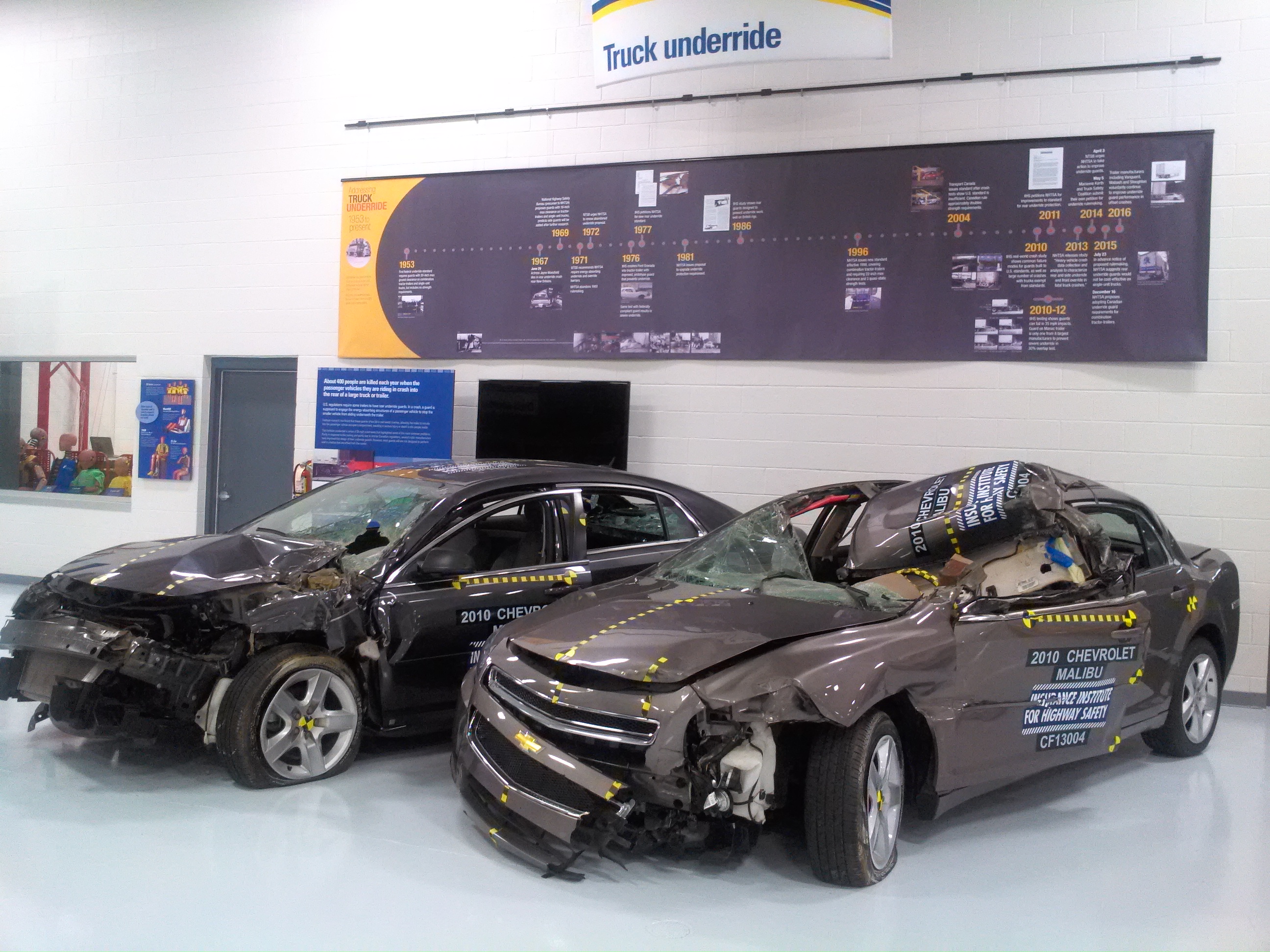
After the STOP Underrides Bill was first introduced on December 12, 2017, several members of Congress –Senators Thune, Rubio, Burr, and Gillibrand — requested that the Government Accountability Office prepare a report on truck underride guards. That report was published today and can be found here.
The online report is organized into sections, including Fast Facts, Highlights, and Recommendations. The GAO Recommendations are:
- Recommendation: The Administrator of the National Highway Traffic Safety Administration should recommend to the expert panel of the Model Minimum Uniform Crash Criteria to update the Criteria to provide a standardized definition of underride crashes and to include underride as a recommended data field.
- Recommendation: The Administrator of the National Highway Traffic Safety Administration should provide information to state and local police departments on how to identify and record underride crashes.
- Recommendation: The Administrator of the Federal Motor Carrier Safety Administration should revise Appendix G of the agency’s regulations to require that rear guards are inspected during commercial vehicle annual inspections.
- Recommendation: The Administrator of the National Highway Traffic Safety Administration should conduct additional research on side underride guards to better understand the overall effectiveness and cost associated with these guards and, if warranted, develop standards for their implementation.
Here is a 46-page pdf of the Full Report.
I’m curious what Members of Congress along with the Department of Transportation and the trucking industry were anticipating to come out of the report. What did they expect to be uncovered that we have not already been talking and writing about and demonstrating for all to see at the D.C. Underride Crash Test on March 26, 2019 — not to mention, more importantly, with the lost lives of countless underride victims?
In a nutshell, the GAO team told the National Highway Safety Administration (NHTSA) that Improved Data Collection, Inspections, and Research were needed. In fact, we already knew that, in order to get an accurate count of underride deaths (and injuries), better collection was needed. We have been talking about the need for rear underride guards to be added to the Vehicle Inspection Checklist. And the STOP Underrides Bill calls for research to find the outer limits of underride protection.
But what the STOP Underrides Bill does not do is say to wait until better data collection has been collected before issuing a mandate to install proven underride protection. That would be like saying: Wait for 14 more years of underride deaths until you have improved collection of how many people are dying and then start using equipment (that was already available) so you know how many people you could have kept alive!
The GAO Report recommends that NHTSA take steps to add underride to the Model Minimum Uniform Crash Criteria (MMUCC) — a guideline to states to use for their crash report forms. However, the next version will not be issued until 2022.
If NHTSA uses this recommendation to justify holding off on underride rulemaking, then they will set us all up for a continuation of same old, same old. NHTSA might sooner or later (in 2022 when the updated MMUCC comes out) START urging states to improve their underride data collection. But then how many years of improved data will they insist that they need before they can proceed with rulemaking (which itself takes 3 or more years before it gets to the implementation phase)?
This is what I foresee, if NHTSA is left to their own devices (unless something else intervenes):
2022 New MMUCC
2024 States are ready for better underride data collection
2028 FARS underride data has maybe improved
2029 NHTSA issues an ANPRM to test the waters
2030 NHTSA issues a NPRM side underride rulemaking (what about the rest?)
2033 Implementation of side guard rule begins for new trucks
2043 The whole fleet will have them on (maybe).
Conservative estimate of 300 underride deaths/year x 14 years (2033) = 4,200 more needless deaths (plus catastrophic injuries) if Congress does not mandate that the Department of Transportation move forward with comprehensive underride rulemaking immediately.
What GAO recommends to NHTSA are good actions, but they fall short of an acknowledgement that people have, are, and will continue to die from truck underride unless we act decisively as a nation to mandate that the industry install equipment to prevent it.
The GAO report acknowledges that the trucking industry is waiting for a mandate before it will act. The report also illustrates how NHTSA has been less than diligent to address the underride problem. So, why would we expect that a mere recommendation to NHTSA (when they have received multiple underride safety recommendations from NTSB and multiple petitions from IIHS and others over the years) would cause them to act in a timely and effective manner to fulfill their safety mission and protect the people of this country from deadly underride?
The fourth GAO recommendation is this: The Administrator of the National Highway Traffic Safety Administration should conduct additional research on side underride guards to better understand the overall effectiveness and cost associated with these guards and, if warranted, develop standards for their implementation.
What more would NHTSA need to know — than what they already know, along with what would come about through the process of issuing a Notice of Proposed Rulemaking, and what they would learn through working with knowledgeable members of the Committee On Underride Protection (or COUP, as mandated in the STOP Underrides Bill), who could help them identify and understand the effectiveness and costs of underride protection?
It seems clear to me that even the under-reported 219 underride deaths, on average each year documented by NHTSA in the FARS data, do indeed warrant the development of standards for implementation of comprehensive underride protection. The side guard crash testing by IIHS and others have proven that this technology is effective at preventing underride. Therefore, I would interpret the fourth GAO recommendation as supporting the need for Congress to mandate that DOT proceed with the rulemaking outlined in the STOP Underrides! Bill. DOT has demonstrated that they have no intention of issuing rulemaking without a mandate which would force them to do so.
In my mind, the GAO Truck Underride Guards Report only confirms and strengthens my opinion that it is high time for Congress to pass the STOP Underrides Bill and get NHTSA and FMCSA started on a rulemaking process for comprehensive underride protection, which we petitioned them to do on May 5, 2014. After years of inaction on that petition, on April 4, 2018, we submitted another petition (for supplemental comprehensive underride rulemaking) to Secretary Chao — still with no tangible action taken.
Congress, the ball is in your court.
If you want to go beyond a cursory understanding of the GAO Truck Underride Report, please read this lengthy analysis of the GAO Underride Report: Karth Cliff Notes on the GAO Truck Underride Report.