Remembering AnnaLeah’s birthday, I took some time to recall moments from her life. How do you pick favorite memories when there will be no new ones? I’d be here all day and fill up the internet.
Just born. . .
Painting at our new house while Isaac watches baby AnnaLeah. . .
AnnaLeah napping with her dad and brother Levi. . .
Riding happily on the rocking horse her grandpa made with her sister Rebekah. . .
Coming home for the first time. . .
Sleeping in the laundry basket. . .
Riding on my back. . .
Being read to. . .
With her big brother Sam–and one of the few times in her life with hardly any hair. . .
Getting into the fridge and SPILLING THE BAG OF RAISINS and EATING the CAT FOOD. . .
With her big brother Peter and Maggie The Cat. . .
Reading books & needing bells on her shoes when she was crawling around because we never knew where she went to in the house. . .
Fell asleep while eating. . .
Acting as Junior in Veggie Tales. . .
When AnnaLeah had the idea to get Mary a St. Bernard stuffed toy for her birthday. . .
With her stuffed dog, Spunky, who got lost when we were packing up to go home from Great-Aunt Flossie’s cottage. . .
Falling asleep while playing during Quiet Time. . .
In the VBS Parade. . .
Playing with her many stuffed toys (especially dogs) and checking all of the dog books out of the Walker Public Library. . .
Having fun with her siblings–every day. . .
Spending time with her grandma in Florida. . .
Spending time with her grandpa. . .when she was little…
And when she got bigger, and stayed in Michigan with him when he was not able to take care of himself. . .
Wiped out on a road trip. . .
Hiking in the woods. . .
Minolta DSCMinolta DSC
With Marcus and Vanessa. . .
Minolta DSC
Having a good time with Mary. . .
At the confirmation of her faith. . .
Always creative. . .
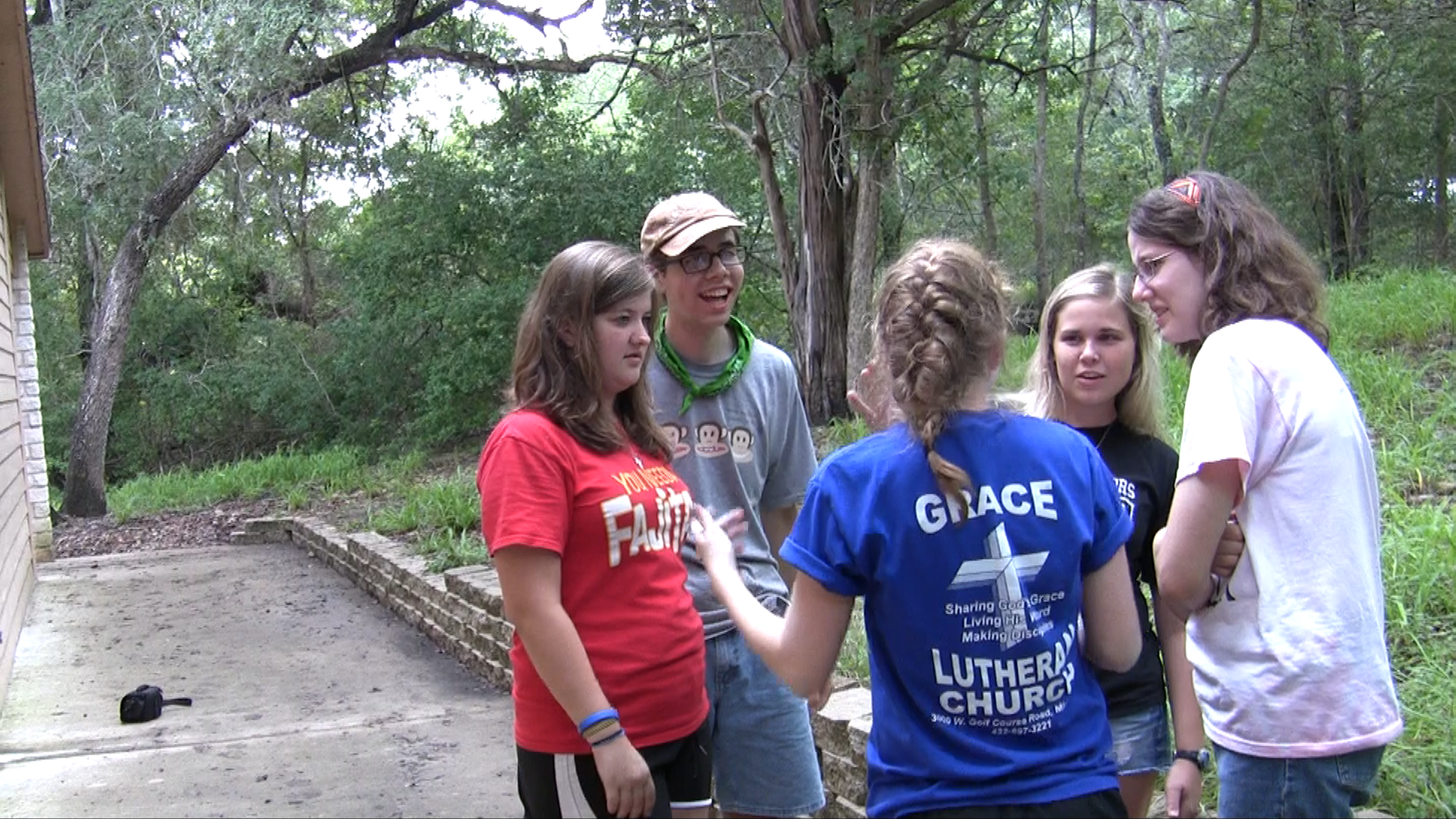
At Camp Lone Star. . .
At her sister’s graduation. . .
Today is the day that AnnaLeah was born 20 years ago. Though she only lived 17 years (almost 18), she filled her time with imaginative & colorful activities and endeavors. Time well-spent.
AnnaLeah had a personal collection of over 600 books–most of which she had read. And she loved to create and share imaginative worlds with words. A wordsmith. . . Here is a poem she wrote when she was 12:
AnnaLeah enjoyed the books of C.S. Lewis and J.R.R. Tolkien, and I am sure that she would have loved to live at the time when The Inklings met in England to discuss the sorts of things she thrived on. So, when I recently read A Grief Observed by C.S. Lewis, I couldn’t help but think of AnnaLeah.
Here are some excerpts from that book which especially resonated with me:
You never know how much you really believe anything until its truth or falsehood becomes a matter of life and death to you. It is easy to say you believe a rope to be strong and sound as long as you are merely using it to cord a box. But suppose you had to hang by that rope over a precipice. Wouldn’t you then first discover how much you really trusted it? (pp. 22-23)
It is hard to have patience with people who say, ‘There is no death’ or ‘Death doesn’t matter.’ There is death. And whatever is matters. And whatever happens has consequences, and it and they are irrevocable and irreversible. You might as well say that birth doesn’t matter. I look up at the night sky. Is anything more certain than that in all those vast times and spaces, if I were allowed to search them, I should nowhere find her face, her voice, her touch? She died. She is dead. Is the word so difficult to learn? (p. 15)
Kind people have said to me, ‘She is with God.’ In one sense that is most certain. . . But I find that this question, however important it may be in itself, is not after all very important in relation to grief. . . You tell me, ‘she goes on.’ But my heart and body are crying out, come back, come back. Be a circle, touching my circle on the plane of Nature. But I know this is impossible. I know that the thing I want is exactly the thing I can never get….It is a part of the past. And the past is the past and that is what time means, and time itself is one more name for death, and Heaven itself is a state where ‘the former things have passed away.’ (pp. 24-25)
Reality never repeats. The exact same thing is never taken away and given back. . . For that is what we should all like. The happy past restored. And that, just that, is what I cry out for, with mad, midnight endearments and entreaties spoken into the empty air. (p. 26)
And poor C. quotes to me, ‘Do not mourn like those that have no hope.’ It astonishes me, the way we are invited to apply to ourselves words so obviously addressed to our betters. What St. Paul says can comfort only those who love God better than the dead, and the dead better than themselves. If a mother is mourning not for what she has lost but for what her dead child has lost, it is a comfort to believe that the child has not lost the end for which it was created. And it is a comfort to believe that she herself, in losing her chief or only natural happiness, has not lost a greater thing, that she may still hope to ‘glorify God and enjoy Him forever.’ A comfort to the God-aimed, eternal spirit within her. But not to her motherhood. The specifically maternal happiness must be written off. Never, in any place or time, will she have her son on her knees, or bathe him, or tell him a story, or plan for his future, or see her grandchild. (pp. 26-27)
Two years ago, May 4, 2013, AnnaLeah went on her last journey on this earth. Little did she know it at the time.
She had worked so hard before we set out for Texas to go to her sister Rebekah’s wedding and college graduations of four older siblings. We were going to be moving into a new home on the Fourth of July. So, she had packed up most of her possessions in preparation for sharing a bedroom with her older sister, Susanna. She had sewn a lovely dress for her niece’s birthday. I was so proud of her.
Then, it all came to an end.
I wanted to share this memorial photo slideshow which her older brother Isaac and sister Susanna put together two weeks later to share at the girls’ funeral. We remember AnnaLeah and the day she was born, May 15, 1995; she would have turned 20 today. Forever 17.
I hope that nothing gets in the way of a proposed study by FMCSA:
“. . . the Federal Motor Carrier Safety Administration is pursuing plans to study whether the way truckers are paid leads to unsafe driving habits, rule-breaking and deadly crashes.
It’s an important study. It’s one that could open the door to federal regulations that determine how drivers are paid, if not how much. And, more significantly, it could lead to safer highways.”
Shortly after we delivered the 11,000+ AnnaLeah & Mary Stand Up For Truck Safety Petitions to Washington, DC, we were invited to tour the research & design center of a tractor-trailer manufacturer. After doing so, my immediate reaction was to wonder what would ever bring about a major improvement in underride guard strength. And I wished that I could just sit down with the trailer manufacturers and hammer out a solution.
An underride (or rear impact) guard is required by federal law for some large trucks to prevent a vehicle from sliding underneath a truck in the event of a collision. Too often, these guards–as in our crash–even if they meet specifications, are properly installed, and are maintained, do not withstand the crash and the smaller vehicle slides under the truck. As a result, life-saving technologies are not put into effect and there is intrusion into the passenger compartment.
In other words, the back of the truck comes into contact with people in the smaller vehicle who then experience horrific injuries and–too often–death.
I emailed many people–hoping to drum up some interest in addressing this issue jointly. When I found out that there was going to be a new administrator, Mark Rosekind, at NHTSA, I wrote to him and asked that NHTSA host an underride roundtable discussion.
After exchanging a few emails, I was contacted by his scheduling assistant, who said that we would have a phone call in mid-February. As it turns out, that conversation never took place. Instead, Mark Rosekind arranged for me to speak on the phone with David Friedman, Deputy Administrator at NHTSA, on March 27, 2015.
When we met with DOT on May 5, 2014, David Friedman was the one who told me that he would let me know when a rulemaking was announced for underride guards. And he did so on July 9, 2014 (after promising that they would make a decision in two months, he was very close!): https://annaleahmary.com/2014/07/nhtsa-has-initiated-a-rulemaking-process-to-evaluate-options-for-improving-underride-guards/ . So, it was fitting that he would be the one to let me know about any progress on meeting our petition requests.
We discussed my hopes for an underride roundtable–to bring together those who could do something about improving underride guards. David told me that–while NHTSA would like to host such events–a discussion of underride would likely not occur until 2016. And, even then, it would probably be only one part of a broader truck safety conference.
That would definitely be a good thing but, in my mind, not give adequate attention to the underride issue. In fact, as we talked, it became clear that if an underride roundtable were going to occur, we would have to spearhead the effort.
So, after thanking him for the update, I scheduled a quarterly phone call for June–at which time he promised to provide me with information on the progress of the truck safety issues in our petition. Then I began brainstorming ways in which we could actually work to organize an underride roundtable–with NHTSA as potential participants.
Earlier, I had spoken about that possibility with John Lannen, Director of the Truck Safety Coalition. So, after speaking with David Friedman, I resumed that conversation. John and I came up with some initial steps to get the process underway. I made a few contacts, and so did he. As a result, we have had some interesting developments and hope to unveil the details soon.
Perhaps we are closer to seeing improvements in underride protection. Perhaps our loss can serve as a catalyst to encourage the development of The Best Possible Protection for preventing future losses from truck underride crashes.
Maybe its’s just me–and my frustrated opinion–but I have had it up to here with the impact of political battles on the safety of travelers on the road.
Just one example is the HOS (Hours of Service) Rules which have been debated forever and a day. Back & forth, back & forth–until what are we left with but an unenforceable mess of regulations and little accountability for truck drivers who are too often driving fatigued, under pressure to drive too many hours to make a living.
Then there is the provision which ties the hands of DOT to increase minimum insurance levels (not done for 35 years)–though they have already issued a lengthy report saying that it is necessary.
And don’t forget the increase in truck length (Double 33s). . . do we really want to share the road with them & will the drivers be trained to handle them?
It seems to me that those who have crafted & approved the anti-safety provisions in the FY2016 THUD Appropriations Bill have either had the wool pulled over their eyes or care very little for the human lives that are ended on a daily basis–whose blood is spilled on the highways of our country.
Preventable, though-unforeseen, inconceivable, unimaginable, irrevocable. . . all these words describe too many truck crash tragedies year after year–as a result of numerous factors which have been argued over too many times.
http://www.insurancejournal.com/news/national/2013/08/06/300846.htm “What’s amazing about these laws is that the trucking industry has been vehemently opposed to them for more than a decade, challenging their legality. Recently, a court of appeals upheld the fatigue laws.” (2013)
We have learned that Congressman David Price (D-NC), Ranking Member of the House THUD Appropriations Subcommittee, is going to be offering an amendment during Wednesday morning’s House Committee on Appropriations markup to strip the FY2016 THUD bill of all of the anti-safety provisions from the bill. Please make as many calls or emails as you can to House Appropriations Committee Members before Wednesday morning and ask them to:
“Vote Yes on the Price (NC) Amendment”. Choose SAFETY: we all travel the roads of this country.
CONTACT INFORMATION for members of the House Committee on Appropriations is listed below.
Special Interest Riders in the FY2016 THUD Bill Include:
FedEx Double 33’ tractor trailers on federal and local roads (House THUD bill Sec. 125). The anti-safety, pro-industry plan will overturn state laws and bulldoze states to accept trucks that are at least 84 feet long on federal, state and local roads.
If truck lengths are increased from 28 to 33 feet, the laws of 39 states (AL, AK, AR, CA, CO, CT, DE, GA, HI, IL, KS, KY, LA, ME, MD, MI, MN, MS, MO, NE, NH, NJ, NM, NY, NC, ND, OH, OK, PA, RI, SC, SD, TN, TX, VT, VA, WA, WV, WI) which currently prohibit longer trailers may be overturned. States where double 33s are prohibited and states where they are not running will be pressured to allow these longer trucks on their roads which are not equipped to accommodate them.
Longer double-trailer trucks will make passing even more dangerous than it already is. A double-trailer truck using 33-foot trailers would be at least 84 feet long, the height of an 8-story office building, and a triple-trailer truck would be at least 120 feet long, equivalent to a 12-story building. These longer trucks would dwarf the size of an average car and are the equivalent of 5 to 8 passenger cars in length
Special interest weight and length exemptions for specific states including Idaho and Kansas (House THUD bill Secs. 124 and 126) or specific industries. The provision would allow Idaho to operate trucks up to 129,000 pounds and Kansas to operate trucks potentially more than 100 feet long.
By overwhelming margins in numerous public opinion polls over the last 20 years, the American public consistently and convincingly rejects sharing the road with bigger, heavier and longer trucks. The most recent poll in January 2015 by Harper Polling revealed that 76% of respondents oppose longer and heavier trucks on the highways and 79% are very or somewhat convinced that heavier and longer trucks will lead to more braking problems and longer stopping distances, causing an increase in the number of crashes involving trucks.
Special interest truck size and weight exemptions are essentially “earmarks” for states and “unfunded mandates” imposed on all American taxpayers who bear the cost of federally-financed infrastructure damage and repairs.
Extension and expansion of the “Collins Amendment” tucked into the 2015 overall federal spending bill last December that dramatically increases the working and driving hours of truck drivers up to 82 hours a week and takes away their “weekend” off, resulting in more tired truckers and jeopardizing safety (House THUD bill Sec. 132).
A provision added to the Omnibus spending bill (Pub. L. 113-235) in December 2014 rolled back important safety reforms to hours of service (HOS) rules which were implemented by the DOT in July 2013 after a lengthy rulemaking process which considered 21,000 formal public comments, thorough and compelling scientific research, extensive stakeholder input, as well as three lawsuits.
This major change will significantly increase working and driving hours for truck drivers, from 70 hours to 84 hours. Essentially, this provision takes away the two-night off “weekend” for truck drivers.
With this provision, the HOS rule reverts to the Bush Administration rule in effect when a 2006 survey of truck drivers found an alarming 65% of truck drivers reported they had often or sometimes felt drowsy while driving and nearly half admitted to falling asleep while driving in the previous year.
A prohibition on rulemaking going on right now at the U.S. Department of Transportation to determine whether or not motor carriers have sufficient insurance coverage, which has not been reviewed and revised since 1985. (House THUD bill Sec. 134) The bill will STOP progress on this needed & already-too-long-delayed increase.
Congress gave the DOT Secretary and FMCSA the authority to review the insurance level. The rule making process, which includes public comments, should be respected and followed.
Minimum levels of insurance for trucks, currently set at $750,000, have not been increased in over 35 years and are woefully insufficient.
The underinsured segments of the industry are effectively subsidized by American taxpayers through unreimbursed social welfare programs including Medicaid and Social Security.
If all of the industry were required to absorb more of the losses they cause, significant changes in the industry would occur, resulting in safer highways for all.
According to Michael R. Lemov, Car Safety Wars, p. 31, “Today, the U.S. DOT uses a figure of $9.2 million per lost life (2013) which includes value for both economic costs and other costs including value for pain and suffering.” Compare this to the $750,000 current trucking minimum liability insurance.
As I am preparing to speak at a press conference in Raleigh today at 11 a.m. in support of needed actions on truck safety, I am reflecting on my morning Bible reading. I ran across the word exceedingly and it reminded me of two other places where I recall reading that word:
Today reading in Jonah…he went to prophesy to the city of Nineveh, which was exceedingly great.
Also in Ezekiel 37:10, where God was fixin’ to raise up an exceedingly great army of His people.
And also in Ephesians 3:20 where God says that He will use His people by His power to do exceeding abundantly above all we can ask or even think.
The problems in truck safety are exceedingly abundant and the opposition against safety measures are also exceedingly powerful, but I have an exceedingly great God that I am calling upon to bring about needed changes to make the roads safer for us all.
Our family greatly appreciates the tender loving care shown to us from the first moment the terrible news of our truck crash became known even through these moments of facing the memories afresh.
I am grateful to not be going through it alone and although members of our family don’t all write about it as much as me (or at all), I know that we are in this together.
I wanted to share some of the things which they have written during this last week:
On May 4, Rebekah wrote, “2 years ago today, 17 year old AnnaLeah Karth was killed due to injuries sustained in a collision in which the car she was riding was hit once by a semi that veered into the next lane where the car was causing the car to be spun around, then hit again and pushed underneath a second semi.
She had talked about possibly studying medieval history at the college level, and she loved to write. Instead of introducing her to some of my medievalist friends from college like I had planned, we dealt with the aftermath of her death.”
Photos she shared:
On May 8, Rebekah wrote, “Two years ago today, Mary Lydia Karth died at the age of 13. Her death was due to severe injuries from a collision involving two semi trucks.
For many other people, however, it was a day of hope, because she was matched with 50 people needing bone marrow, in addition to her corneas being matched as well. 13 years isn’t very long, but that is an amazing impact and legacy to leave behind: the gift of life and the gift of sight.
It doesn’t take away our pain, but I am comforted that there are several other families who received the gift of extra time with their loved ones. http://www.organdonor.gov/whydonate/index.html ”
On May 8, Naomi wrote, “I used to nanny for a little boy who said the sky was “crying” whenever it rained. So it seems pretty appropriate that today, on the two year mark of Mary joining her sister in heaven, that it is pouring out right now.
It’s still so hard to put in words… This feeling. Loss, pain, grief. We miss her. We miss AnnaLeah. So much so that we still can’t talk about the wreck without needing to cry.
It isn’t fair, but I’m so grateful for the precious years we did have- and how Sam’s sisters became my sisters too.
Sam confessed recently that part of his attraction to me was how playful and silly I could be. Much like his Mary, who was his best friend. We will cherish these times most of all, the memories of the impossibly silly* things we did. How we could laugh. How we could try to make anything fun or a game.
And we will remember. And cry. And keep on going.”
Photo shared by Naomi:
On May 5, 2015, Danelle wrote, “May 4th went by as just another ordinary day, but the pain in our hearts is still there. Loved, Missed, and Never forgotten. AnnaLeah Karth, May 15, 1995 to May 4, 2013.”
Photo shared by Danelle:
On May 8, Danelle shared, “My mind is a buzz of thoughts. I have so many things I want to share and I am not quite sure how to keep it brief. On the one hand I want to talk about how grateful I am to be a part of this family and how much it means to me to know each one of my in-laws.
On the other hand I want to share with everyone the wonderful silliness* that Mary shared with everyone that she met. Or how I know my daughter was too young to really remember her, but how I can see some of her silliness rubbed off on her niece as she was such a big part of her early years.
I will forever remember the joyful little girl and the wonderful young woman she had become. I am grateful for the 8 years that I was blessed to know her and the love that she poured into my children. Loved, Missed, and Never forgotten. Mary Lydia Karth. August 6, 1999 to May 8, 2013.”
Photos shared by Danelle:
* Silly Mary. . . with all this talk of silly Mary, here are some glimpses of her fun-loving self, her infectious joie de vivre: