We are excited to see that the FMCSA has released the final rule for Electronic Logging Devices designed to keep better track of truckers’ driving hours and to reduce truck driver fatigue.
After our truck crash on May 4, 2013, for which we never saw the truck driver’s paper log books, we are very happy about this. We never found out for sure why the truck driver who hit us was unable to slow down with the rest of the traffic–which was stopped for another crash two miles ahead of us. But we suspect that fatigue –drowsy driving — may well have played a part.
We are thankful that FMCSA has taken this important step to protect travelers on the road. We hope that it will also be followed by the best possible Hours of Service rules and better wage compensation for truck drivers who work hard to deliver the goods.
Thank you to everyone who signed the AnnaLeah & Mary Stand Up For Truck Safety Petition which we delivered to DOT on May 5, 2014. One of the three requests in that petition was for Electronic Logging Devices to be implemented.
First of all, let me say that I am grateful for the work which NHTSA has done on this problem and their willingness to address it at this time. Then, I have to admit that I am not an engineer. So it’s a good thing that we don’t have to depend on me to be the one to provide a thorough analysis of the recently released proposed rule for the improvement of tractor trailer rear impact protection standards and all of its technical pros and cons.
But I can provide a summary of the highlights included in the NPRM, along with some of my knee-jerk reactions as a mom of two girls, who perished due to a truck underride crash, and as an advocate for better underride protection.
These are my general reactions. . .
While this proposed rear underride rule is definitely a much-needed improvement to the existing standards, it does not appear to embrace a Vision Zero policy approach which would seek to reduce crash deaths and injuries whenever and however possible.
Many of the trailer manufacturers are already meeting Canadian standards, but IIHS research has shown that this is still not adequate to prevent underride in many crash scenarios–particularly offset crashes. http://www.iihs.org/ externaldata/srdata/docs/ sr4907.pdf
Also, when I look at what NHTSA is predicting in terms of lives saved by this proposed rule–1 out of the 125 annual reported PCI underride crash fatalities–I have to ask, “What about the other 124?!” And our daughters, AnnaLeah and Mary, were not even counted in the 2013 FARS crash data for PCI crash fatalities because our crash was listed as “Passenger Compartment Intrusion Unknown“!!!
(Note: See our FARS crash report in my Public Comment on the Single Unit Truck rear impact protection ANPRM and a discussion of the problem of underride crash fatality UNDERREPORTING and how it might impact the count of potential saved lives. . . http://www.regulations.gov/#!documentDetail;D=NHTSA-2015-0070-0018)
In addition, there are many engineers around the globe who have come up with improved designs for underride protection, and there are many who are even now working on solutions that are stronger than the Canadian standards. They just have not yet been widely implemented or required.
It is, undoubtedly, an enormously significant step for NHTSA to acknowledge the need for stronger guards and to propose an improved guard. However, we do not want them to base the final rule merely on what will provide a “cost-effective” solution if, in fact, technology could be utilized which would save additional lives and prevent additional injuries.
One of our big concerns has been the apparently more vulnerable crash scenario when the smaller passenger vehicle hits the rear of the truck at the outer edges of the rear of the trailer. When Jerry and I visited Great Dane’s Research & Design Center in Savannah in June 2014, they pointed out that the company, Manac, which passed the 30% offset crash test had proven to be more vulnerable (although it still withstood the crash) at the 100% overlap test.
I reported on that in a previous blogpost in June 2014: “Great Dane, one of the major trailer manufacturers, observed that they passed all but one of the quasi-static crash tests—the narrow overlap. Great Dane also noted that their guard appeared to perform better on the full overlap test than Manac’s (which was the only company to pass all three tests in 2013). So Great Dane does not want to make a change which will strengthen one section of their guard but weaken another section. That’s understandable.” https://annaleahmary.com/2014/06/underride-guards-can-we-sit-down-at-the-table-together-and-work-this-out/
NHTSA’s comments in the NPRM indicate that they do not want to compromise safety in the more common crash scenario and so have proposed to concentrate on making that area of the trailer safer and do nothing, at least at this stage in the game, about the other weaker area where crashes are reportedly less common. (See p. 44, ” NHTSA is not convinced that improved protection in the less frequent 30 percent overlap crashes should come at the cost of adequate protection in the more common 50 and 100 percent overlap crashes.”)
I just have to ask, Is it really an Either/Or situation? Are we sure that we cannot reasonably address both problems?
We are hoping and working toward the possibility that the Public Comments which will be submitted, the underride research both underway and proposed, and the Underride Roundtable which will be taking place at the IIHS Vehicle Research Center on May 5, 2016, will help to refine this rule so that it results in the best possible protection.
As I reviewed the NPRM document for rear impact protection on tractor-trailers, I created my own 9-page document by copying and pasting some of the highlights of the proposed rule (page numbers are indicated in case you want to go to the original document for further details). You can read my summary of the proposed rule here: Highlights of the NPRM Rear Impact Guards, Rear Impact Protection December 2015 document
More than one person has brought up the question of side guards in response to the recent announcement of a proposed rule on rear guard improvement for tractor trailers.
Here are some ways by which we are trying to address side guards as a solution to the problem of cars, pedestrians, cyclists and motorcyclists riding under the sides of trucks:
https://www.federalregister.gov/articles/2014/07/10/2014-16018/federal-motor-vehicle-safety-standards-rear-impact-guards-rear-impact-protection“By initiating rulemaking to consider enhancing related safety standards, this notice grants the part of the petition for rulemaking submitted by Ms. Marianne Karth and the Truck Safety Coalition (Petitioners) requesting that the agency improve the safety of rear impact (underride) guards on trailers and single unit trucks. Based on the petition, available information, and the agency’s analysis in progress, NHTSA has decided that the Petitioners’ request related to rear impact guards merits further consideration. Therefore, the agency grants the Petitioners’ request to initiate rulemaking on rear impact guards. NHTSA is planning on issuing two separate notices—an advanced notice of proposed rulemaking pertaining to rear impact guards and other safety strategies for single unit trucks, and a notice of proposed rulemaking focusing on rear impact guards on trailers and semitrailers. NHTSA is still evaluating the Petitioners’ request to improve side guards and front override guards and will issue a separate decision on those aspects of the petition at a later date.”
See the draft agenda for the Underride Roundtable on May 5, 2016, which we are planning and which will include presentations on and discussion of side underride protection: Underride Roundtable Agenda November draft
Here are some excerpts from a recent report about fully autonomous trucks:
“‘It’s not clear how quickly the costs for autonomous truck technology will come down,’ [Stephan Keese] said during the first day of the North American Automated Trucking Conference being held here at the Texas Motor Speedway.”
“‘Several challenges exist to allow trucks to be either partially or fully self-driving, ‘Keese explained,’ some technological and some human.'”
“Keese thinks it really won’t be until 2050 that self-driving trucks could be deployed.”
“‘.. what will drivers do for 10 hours, sitting behind the wheel not driving, while being required enough to intervene ‘at a moment’s notice’ should something go wrong.’That is much more stressful that actual driving,’ he said. ‘It takes a driver 90 seconds to become ‘fully re-engaged’ after being unfocused; not just grabbing the steering wheel, which takes 2.5 seconds, but being able to process a situation.’“
When we were headed from North Carolina to Texas, on May 4, 2013, and hit by a truck, not only did we lose our two youngest daughters, AnnaLeah (17) and Mary (13), but we lost the joy of celebrating fully with four of our children as they became college graduates in Texas during that month of May.
So, this past weekend, we were looking forward to a more uneventful trip to celebrate one of our sons’ graduation on December 5, 2015, from Concordia University in Austin, Texas. Unexpectedly, it really became a whole lot more.
In fact, we thoroughly enjoyed Levi’s graduation ceremony as he walked across the stage summa cum laude, along with the party afterwards at a Peruvian restaurant where we were able to spend an enjoyable afternoon with his friends.
On our way back home to North Carolina, we stopped in Arlington to visit with our oldest daughter, Rebekah, and her husband, John. Instead of taking them out to dinner, they took us out to a holiday party hosted by her Tae Kwon Do instructor. There we had the pleasure of meeting with her friends and being there in person as she was presented with an unexpected award for her Indomitable Spirit.
The next day, as we started back toward North Carolina, I found myself going again through many emotions as I realized anew that this trip was the one we were supposed to be taking back home in May 2013 after a week of family celebrations–with AnnaLeah & Mary a part of our festivities and part of the crew returning home. I must admit that the trip was hard–with many memories triggered as we passed by landmarks.
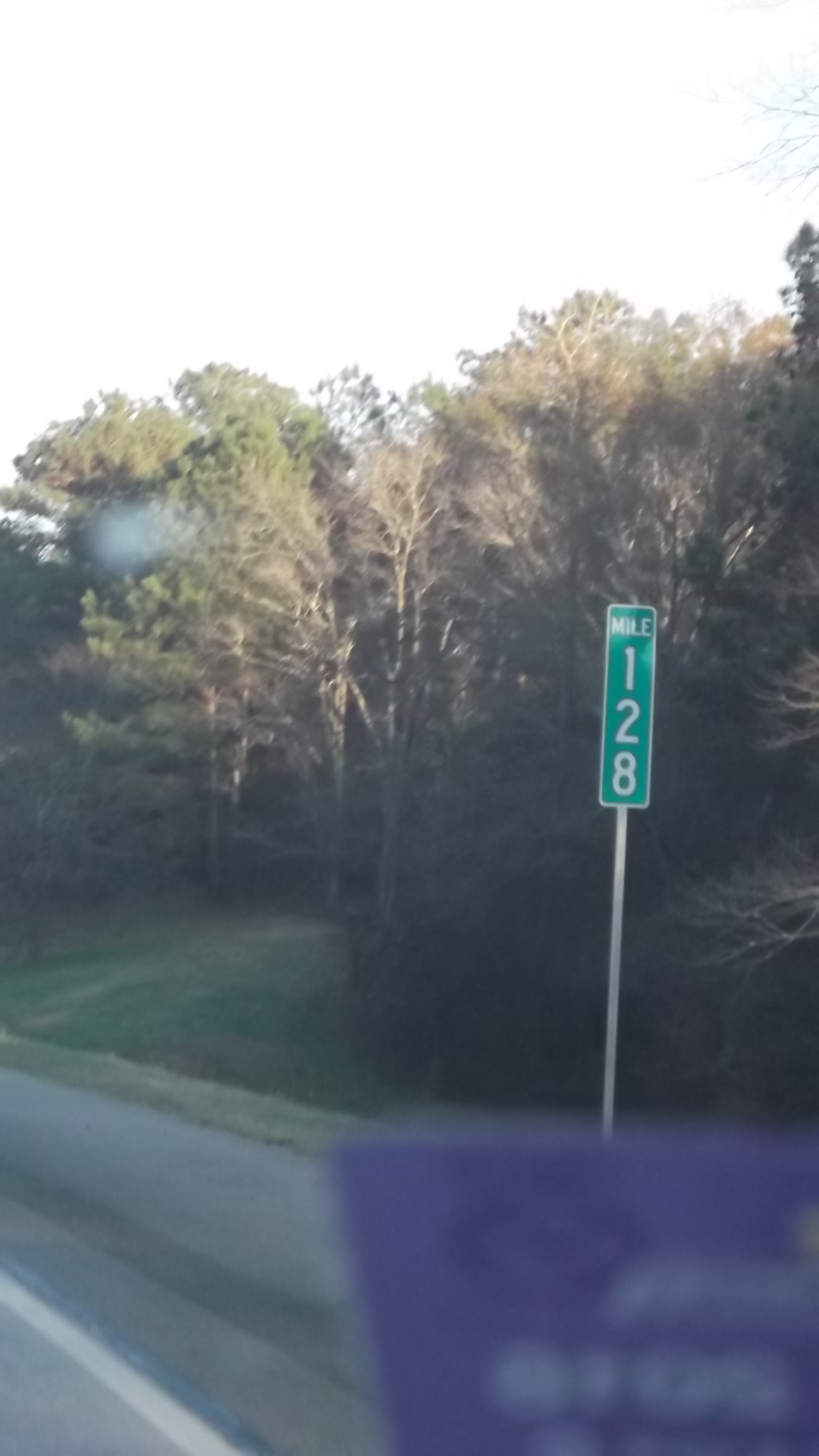
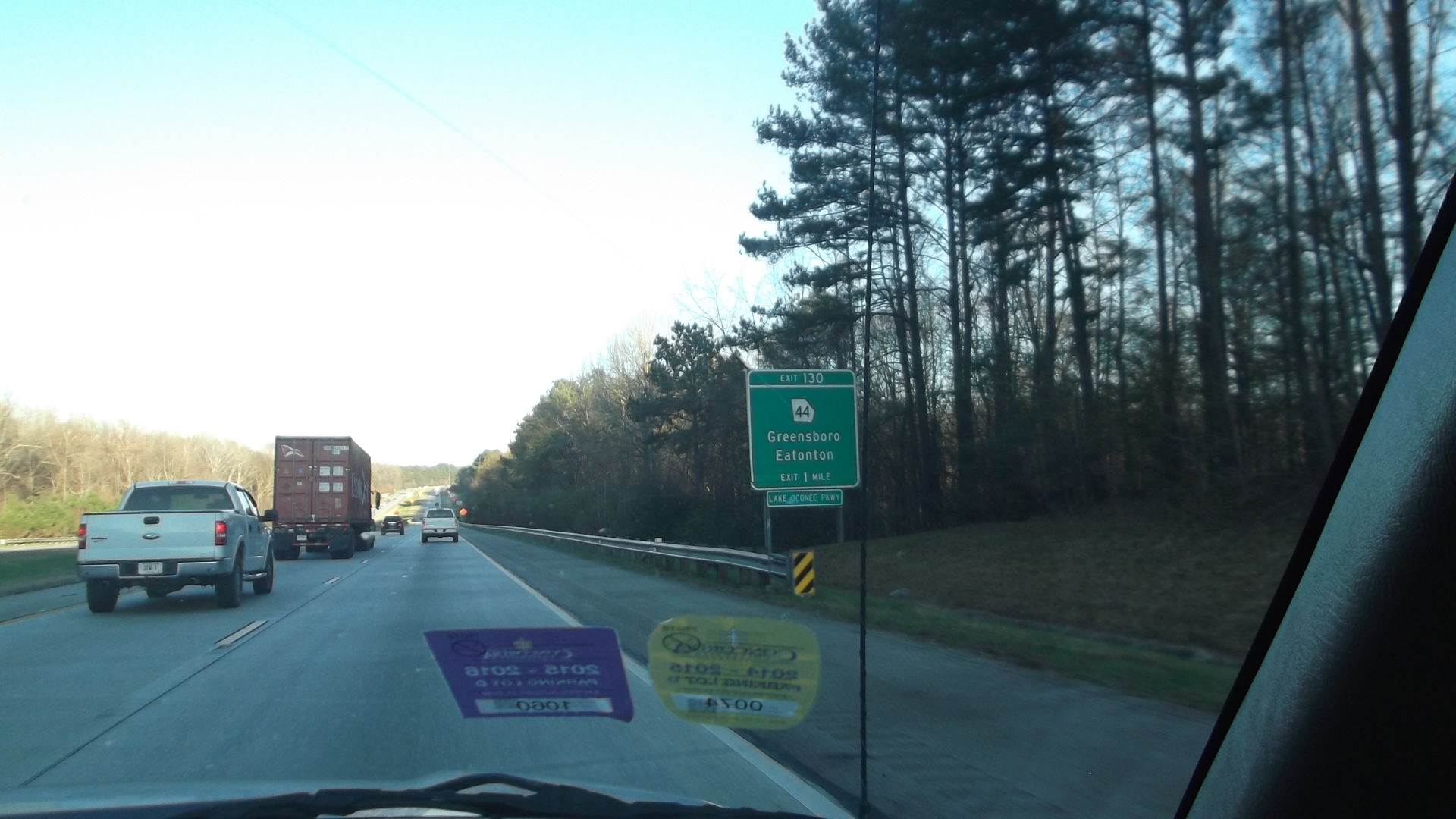
Exit 128 was where the crash took place 2 hours before ours and 2 miles ahead of our crash at Exit 130. That caused the traffic backup which the truck driver did not notice in time and consequently hit our car pushing us into another truck.
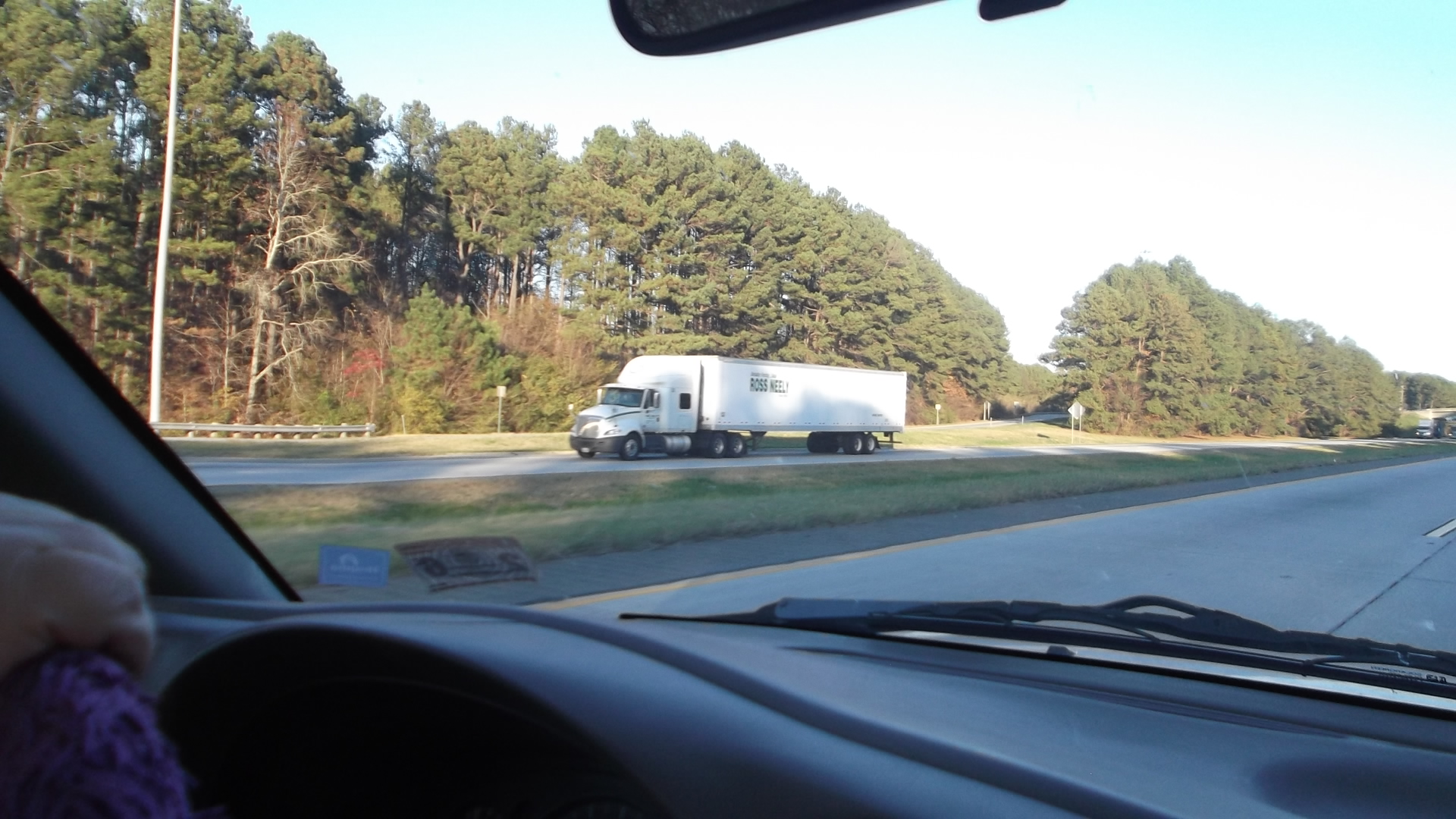
This is where our crash took place–about where that truck is is where we ended up after being dragged under the truck ahead of us.
That night, as we decided to call it a day and stop for the night in Tuscaloosa, Alabama, I saw a sign for the University of Alabama and I knew that Birmingham was just down the road apiece. I thought, hey, that’s where Dean Sicking is! We had only talked with Dean on the phone and corresponded with him via email about his proposed Underride Research Project.
So, the next morning, before eating breakfast, I emailed Dean and his Research Assistant, Kevin Schrum, and said we were going to be driving through Birmingham and to give me a call if we could meet. A bit later, first Dean called to say he was going to be in a meeting that morning but he thought Kevin would be available. Then Kevin called and said that he would love to meet with us. We then had a very good meeting with Kevin and even recorded a few minutes of him talking about his passion for research and his confidence that much improvement could be made.
Kevin shared how he–like his mentor Dean Sicking–believes that the underride problem is not insurmountable and is hopeful that, with adequate backing, they could develop a step-by-step solution which could be adopted by the industry to ultimately reduce underride deaths to zero.
We were also able to talk about some ways in which they might be able to help us seek additional funding to back the research.
After such an eventful trip, I did not have much memory or battery left on my camera, but I was able to capture some of Kevin’s passion and ideas on this video:
As if all of this were not enough, shortly after we got back on the road, I discovered that I had missed a call from Mark Rosekind, the Administrator of NHTSA, who wanted to give me a heads up that they were releasing a NPRM (Notice of Proposed Rule Making) proposing that the requirements for rear underride guards on tractor trailers be improved!
We have been awaiting this news ever since the initial Advance Notice of Proposed Rule Making (ANPRM) was announced in July 2014 following our delivery of over 11,000 petition signatures requesting this on May 5, 2014. So this was unexpected excitement to add to our trip.
Not being at my computer hampered the following hours as I attempted to find out as much as I could. A summary of the proposed rule is that it will upgrade the requirements to match the Canadian standards (requiring them to withstand a crash at 35 mph rather than 30 mph), which many U.S. companies are already doing.
However, after a very cursory review of the 108 pages, as far as I can tell it does not address the problem with current standards failing in offset crashes (when the smaller vehicle does not hit dead center at the back of the truck). And the NPRM anticipates 1 saved life out of the 125 reported PCI underride crash fatalities on average annually. (Our crash is not reported as a PCI crash fatality but rather is listed in the federal crash data as “Passenger Compartment Intrusion Unknown“!) What about the other 124?
Take a moment to read Administrator Mark Rosekind’s thoughts on this important development in truck safety:
“Although the responsibility for both of these measures [this NPRM along with the ANPRM on Single Unit Trucks] lands on truck owners, that’s a function of vehicle design more than crash causality. We’ve also taken a number of steps over the years to prevent crashes resulting from driver behaviors, such as drunk driving, speeding, and distracted driving. And, we’re accelerating the spread of crash avoidance technologies such as automatic emergency braking and lane departure warning for passenger vehicles sold in the US.
“But, when we have a cost-effective solution that can reduce the risk of death or injury to passenger vehicle occupants in the event of a crash into the rear of a trailer or semitrailer, our commitment to safety obligates us to propose it. Which is why today we’re proposing this enhancement of current rear impact guard standards.” https://www.transportation.gov/fastlane/nhtsa-proposes-new-rear-impact-guard-standards
All in all, it was quite an eventful–albeit SAFE–trip!
I woke up this morning thankful that we live one day at a time and wondering how much different our world would be if each person knew the hope and peace and joy and love which was given to us with the birth of Heaven’s Perfect Lamb–and all that followed that momentous event.
Sharing lots of good news today: along with a grandbaby on the way, we can share that we just received the IRS Tax Exempt Status Approval Letter for AnnaLeah & Mary for Truck Safety!
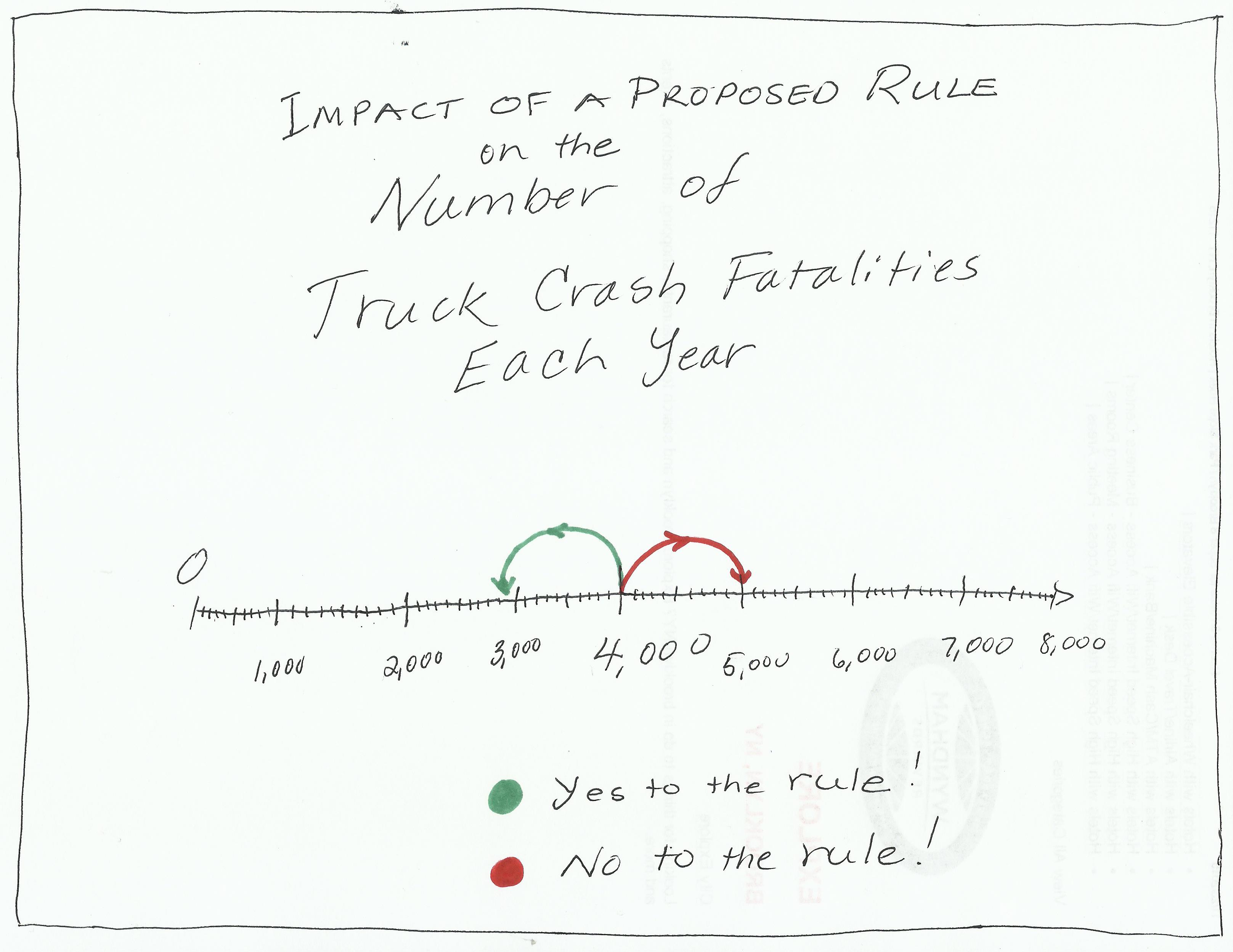
I thought of a very simple way of illustrating how I think that decisions should be made on highway safety rulemaking: a number line. For example, with rules impacting the trucking industry, the starting point would be the average annual truck crash fatality rate of 4,000.
If a proposed rule would be expected to lead to a greater chance of people dying, then the number line would make jumps to a point higher than 4,000 and it would be rejected.
If the proposed rule would help to reduce truck crash fatalities, then the number line would make jumps Toward Zero and would be adopted.
And this method would require solid proof. If there is any question about whether or not it would save lives, i.e. if it there is any chance that it could lead to more tragic, unnecessary, preventable deaths, then forget it! Toss it out or make major changes to preserve human life and health! At minimum, it would require further study before moving forward with it. Much like innocent until proven guilty.
On the other hand, if there is any chance at all that it could save lives, then by all means: Go for it!
I’m a simple person with simple needs.
If your immediate response to my simplistic solution is in any way skeptical, please take 33 seconds of your valuable time to watch this:
And just this morning, I noticed the lid to a pickle jar with this message:
Do not purchase if safety button is up
I took a picture of it but I had a hard time getting the words in focus (I’m no pro). Aren’t we all glad that someone figured out how to make canning jars with that safety feature–once they figured out the danger of unsealed jars of food?! And then someone took a step further to educate the user how to ensure SAFETY.
Participating in a webinar last night about Essential Oils and Grief got me thinking further about some of my struggles in grieving the traumatic loss of my two youngest daughters, AnnaLeah (17) and Mary (13) in a truck underride crash on May 4, 2013.
It has been such a complicated grief. I know that writing about it along the way has helped me tremendously (not sure what shape I would be in otherwise):
But beyond that, I would like to say that it makes sense to me that approaching grief in a way that addresses the needs of the whole person is most likely to bring about wholeness. That includes taking into account the ways that our spiritual, emotional, intellectual and physical needs impact one another.
A book by Dr. Caroline Leaf outlines the ways that our very memories are neurologically impacted by our emotions and that there is an impact of stress on the health of the whole person. Not only that, but she also gives suggestions for how to “detox” and move toward a more healthy lifestyle.
As a part of that webinar I mentioned, I made the comment that I am thankful for the sensory experience which I have known during my grieving by embracing quiet moments of peace in times outside as I breathe in the fresh air and sometimes the fragrance of pine trees or blossoms and become calmer listening to the sounds of the birds or the wind rustling leaves all around. Walking gives me a time away from responsibilities and reminders of the loss–or at least, if I cannot escape reminders entirely I am able to freely express my weeping heart or angry thoughts in the stillness of nature.
And it also makes sense that essential oils could be made a part of the process of promoting whole person healing.
In terms of how I am dealing with the grief spiritually, I know that God allowed their deaths to occur. I also know that He can work to bring good out of their deaths. I have been an obsessive participant in the process as a highway safety advocate because I have observed that God generally does not intervene to protect people from the impact of collisions and that it makes sense that He has given us the brains to figure out what we can do to make people safer. I also know that nothing I do, or help to bring about, will ever bring them back.
Perhaps it is anger at what has not been done compared to what could be done to protect people from preventable crash fatalities that puts me in a position of helpless frustration. When I think of all the things which could have resulted in a different outcome, it leaves me with a roaring rage at the senselessness of their deaths. How can that ever lead to lasting peace?
Just yesterday, I was on an errand and took a different route than usual–because a major year-long construction project had just finished. As a result, I passed by a house which we had considered renting when we first moved to this city. The thought came to me that if we had rented that house, instead of the one we were living in on May 4, 2013, then we probably would not have been at that exact spot in our journey when the truck driver made the fatal mistake of hitting a car. If only. . .
Of course, I understand that there are so many things out of my control and that no one is guaranteed a long life. Nonetheless, I am quite certain that if we had left the restaurant 5 minutes earlier, AnnaLeah and Mary might be with us still today. Or if underride guards had been made stronger or the driver had been paying better attention (no matter what the reason was that he wasn’t). . .
Perhaps that line of thinking won’t get me any closer to accepting their deaths and being okay with their loss and mine. But it gives me an ongoing purpose of promoting safer roads through Vision Zero advocacy efforts to prevent loss and grief for others, as well as devoting my efforts to preserving the memories of two girls who knew how to love and laugh.