Across the nation, there are numerous individuals and organizations calling and working for Vision Zero goals and actions. What is the point? There are tens of thousands of people dying unnatural and preventable deaths each year due to crashes on our roads.
We are working tirelessly to call for President Obama and DOT Secretary Foxx to set a National Vision Zero goal and to change the traffic safety rulemaking policies so that every life possible will be saved.
President Obama: "If there’s even one thing we can do, if there’s just one life we can save—we've got an obligation to try.” #NowIsTheTime
I’m signing because as a Texan, my state has shamefully averaged 3,500 annual road deaths in the past 20 years. Based on historical data, I seriously doubt the Texas state legislature or state DOT has the skill or the desire to improve in the area of fatality reduction on Texas roads. For the safety of all road-users, the USA needs the help of a national Vision Zero strategy.
I am signing this petition as a widow and now single mother of three children because a tired or distracted truck driver killed my husband while he was inspecting a bridge repair in his closed-off work zone. The pain of losing a loved one to these preventable crashes is beyond words. Losing a father at such a young age will leave emotional scars for decades, and our society doesn’t fully understand —or offer appropriate resources for coping.
I am signing in honor of my late wife Tamara Mills-Hadley whom lost her life because a phoney underride guard law was passed that was not meant to save any lives, instead it just legalized the guards already on the road in order to save money and garner campaign donations. We also lost a family friend to unsafe trucks. No more!
Because business shoots for zero defects. Because my wife is dead and two sons seriously injured, one permanently, when an overworked trucker fell asleep at the wheel.
But in order for DOT to act accordingly, they need to be empowered by a National Vision Zero mandate. That is why we are asking President Obama to set a national Vision Zero goal and to sign a Vision Zero Executive Order.
Help us send the message to Washington, DC, that we want to reduce the almost 33,000 crash deaths which occur each year. This is the petition letter which will be delivered to President Obama: Vision Zero Executive Order Petition Letter to President Obama
Due to a shared interest in reducing preventable traffic fatalities and serious injuries, we are working with the following individuals & organizations to raise awareness and garner widespread support for this VISION ZERO effort (to be updated as more supporters get on board with us): Letter of Support for Vision Zero Executive Order Petition
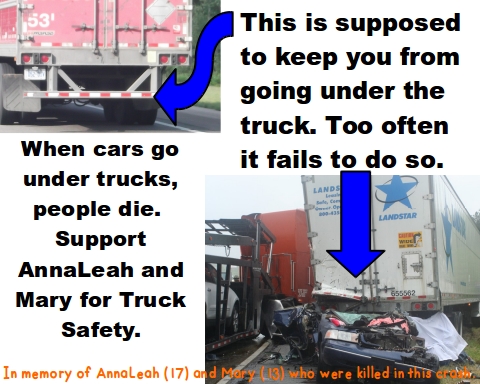
An example of the application of VZ principles to rulemaking: Underride Guards–Apply Vision Zero principles by requiring crash test-based performance standards for truck underride guards rather than force-based design standards along with success at higher speeds—to include rear (both centered and offset) and side guards for both Single Unit Trucks and trailers. https://annaleahmary.com/2015/12/a-moms-knee-jerk-reaction-to-nhtsas-proposed-rule-to-improve-rear-underride-protection/
The Economics of Traffic “Safety” has been on my mind for awhile. I am not really ready and/or qualified to write a full-fledged commentary on the topic, but I did want to jot down some of the thoughts and questions I have about this vital area.
Are we ready, as a society, to instead embrace the notion that a large percentage of traffic deaths could and therefore should be prevented?
Are we willing, as a society, to commit to sharing the burden of the cost of safety measures to Save Lives rather than involuntarily sharing the burden of paying for the cost of tragically-Lost Lives (and those with serious life-changing injuries)–including the immeasurable worth of those no longer with us?
What would a Vision Zero philosophy/goal/policy mean to us as a country? Here is how Neil Arason, Canadian author of No Accident, views Vision Zero: “I think people have different views about vision zero but here is mine. The airline industry does not apply cost benefit analysis to fixing aviation problems. They just fix problems and that is that. Using a cost benefit model is incompatible with vision zero because it applies trade-offs and vision zero does not entail that. Vision zero is about making the system a safe one and does not assign value to a human life because doing that, the thinking goes, is unethical. “
We want to change this situation for the better; we want to bring Americans together in a massive movement Toward Zero Deaths. Stay tuned for our upcoming online launch of a Vision Zero Executive Order Petition.
Memorial bricks placed for AnnaLeah & Mary Karth by Midland College (viewed by their niece & nephew)
Cars will continue to collide with larger trucks and ride under them when the too-weak underride guard buckles (or because there is no underride protection on the side of the truck)– with deadly consequences.
NHTSA will propose truck underride rules which are weaker than could be possible.
The trucking industry, for the most part, will wait to find out what new standards might be required of them for underride protection systems in 3 years or more.
The Insurance Institute for Highway Safety (IIHS) will sponsor an Underride Roundtable at their Vehicle Research Center in Ruckersville, Virginia, on May 5, 2016.
What we hope will happen is that:
Cars will, in the near future, be better protected from deadly underride when they unfortunately & inevitably collide with larger trucks due to human error and road conditions because. . .
NHTSA will propose stronger underride rules which provide the best possible protection for travelers on the road because clear evidence will be available (from underride research & crash tests) for all to see that collisions with trucks should be more survivable than previously thought.
The trucking industry will take responsibility and voluntarily work to provide better underride protection for collisions with smaller passenger vehicles–without even waiting for improved federal requirements to go into effect.
The Underride Roundtable at IIHS, on May 5, 2016, will bring together experts in many fields who will propose solutions, which will contribute greatly toward realizing a vision of Zero Deaths and Zero Serious Injuries from truck underride crashes.
Be a part of this vision. Contribute to support underride research and crash tests.
Update, April 22, 2016: At this point, any donations given will not be for the crash test taking place at the Roundtable on May 5, but would be used for future research/testing.
For too long, this problem has been recognized but swept under a rug. It has not been considered a priority and money has not been earmarked to resolve the problem. If we don’t do something about it, who will?!
Watch the informative video below which I discovered yesterday from a 2012 investigative report on underride crashes:
Here at the end of another calendar year–a year that AnnaLeah & Mary along with many other traffic fatalities did not get to enjoy–I want to say one more time: Let’s work together to solve the problem of Death by Motor Vehicle.
What if we truly worked together to reduce the number of deaths and very serious injuries from traffic crashes? In terms of why people die on the roads, there is no one reason. Pointing fingers at who is to blame and leaving it at that gets us where?
The first thing that I noticed, when I started reading investigative articles about underride guards on trucks, was how some people took the focus off of the problem of weak underride protection systems and wanted to talk about how car drivers were to blame for the crash anyway* and how the answer was to develop crash avoidance technology.
It seems to me that what wasn’t being understood here was the deaths which actually occur from Second Collisions rather than the first collision, which is often due to human error or road conditions or whatever might have been to blame for the crash to occur.
Who said that it had to be an Either/Or solution? This is a perfect example of something which we can work together to solve–improving truck underride protection systems because it can be done. The result: less people dying from what could be a survivable crash.
At the same time, people can be busy working on trying to reduce the number of crashes to begin with through development of tested crash avoidance technology AND by raising awareness and motivating people to be Safer Drivers.
And that is why I am about ready to launch a Vision Zero Executive Order Petition. And I will be asking you to hop on board with me. Let’s do this because we can and because somebody is counting on us to help them make it through another year.
* “‘The disproportion of passenger-vehicle driver errors in fatal crashes may be in a sense related to the fact that a fatality occurred, rather than that they are more culpable,” he says. “Rear-end collisions provide the clearest example, because a fatality is more likely to occur if a passenger vehicle strikes the rear of a truck, rather than the truck striking the rear of the passenger vehicle.’
“According to Blower, rear-end collisions caused by passenger-vehicle drivers may occur because of driver inattention, unsafe speed and truck conspicuity, while harder-to-explain head-on crashes may be due to alcohol use, night-time travel and weather.
“’It is clear that addressing the ‘truck safety problem’ must take into account more than just trucks and truck drivers,” he says. “The actions of other vehicles on the road contribute substantially to the toll. Even if all trucks were operated perfectly, only a minority of the fatal crashes would be eliminated.
“’Truck crashes do not occur in isolation, but as part of a larger system, involving the roadway and environment, vehicle condition and the other vehicles in the traffic system. If we want to reduce the toll of truck accidents, we need to broaden our understanding beyond just trucks and truck drivers.'” http://ur.umich.edu/9900/Nov08_99/18.htm
And besides, did you ever think about the terrible ongoing trauma of those who survive horrific crashes when others do not? Let’s keep them in mind as well.
To clarify, my point is not that no one is to blame, but that if we each spend our time pointing at someone else who has to resolve their problem, it is too easy to forget that there are fingers pointing back at ourselves–things we need to take care of, as well.
I just read a post by a friend whom I’ve met because she also lost a loved one in a truck crash. It uncorked those feelings of sadness that the season brings.
On Christmas Eve, she wrote, “I am sad that tomorrow means nothing to me at all. I feel like there’s something wrong with me because I feel nothing at all.”
I commented, “I find that familiar Christmas carols bring on a peculiar melancholy feeling which I never would have imagined. An enduring sadness which I can’t shake. I suppose it is because this is a time so packed with memories–bittersweet–and it takes more work to create new ones (without them).”
It’s a shame really because I love music. So, I’d like to share this song which has the power to bring forth my feelings which are lurking under the surface–along with healing tears.
“We need to get media on board that guards must exceed Canadian Standard which only legalizes within two years of implementation 98 % of guards already on the road, this is our best bet to force NHTSA to re-evaluate.”
I have already made this very clear in four media interviews (and two posts) which I had after the proposed rear underride trailer rule was announced:
The coordinator, Jared Bryson, for the Virginia Tech Senior Underride Design Team sent their end of semester report on the underride project to me yesterday.
I have not had time to read it fully yet (rather busy this weekend). But I did look it over quickly and am intrigued by their emphasis on a Wrap Around Bumper concept.
They are off for Christmas break. But rumor has it that NHTSA’s proposed underride rule for trailers is assigned reading before they come back after the holidays so that they can submit a Public Comment as a team.
“The student’s final fall presentation is tonight. I will forward the NPRM tomorrow, for reading over the break. We will discuss in length in January, and formulate a group or individual submissions.”
Good work, team. Looking forward to more good news. . .
Comments can now be submitted on NHTSA’s proposed rule for rear impact guards and rear impact protection on trailers. The Public Comment period will end on February 16, 2016.
It is our hope that public comments on this rule, and the Underride Roundtable planned for May 5, 2016, will result in the best possible protection on the backs of trucks. Please pray for this important process.




2