Category Archives: Truck Safety

@EricFlack & @WUSA9 Win Murrow Journalism Award for Truck Underride Series

Many reporters have helped to raise awareness of this hidden problem. By working together, we are getting closer to ending preventable underride tragedies.

What if we proved truck side guards could stop a car at 47 mph? Would we mandate their use? Guess what!

Even though the DOT has been talking about the need for side guards on trucks since 1969, they have still not required them to be put on large trucks — despite the fact that hundreds of people die every year when their car goes under a truck. Imagine.

What will it take to get them to mandate this safety feature? So far, the successful crash test at 35 mph into a side guard in March 2017 at the Insurance Institute for Highway Safety (IIHS) has not resulted in a Notice of Proposed Rulemaking on this needed safety countermeasure. Neither has the successful crash test at 40 mph, which took place at the IIHS during the August 29, 2017, Underride Roundtable, seemed to convince them to act.

Well, what if we show them that the AngelWing side guard was successfully tested at 47.2 mph by its inventor, Perry Ponder of Seven Hills Engineering? (Which would, of course, change the cost benefit analysis required for rulemaking. . . with proof of more potential lives saved!)

Side Underride Guard Test at 47.2 mph. 44 mph delta-V. Dummy results excellent. Test conducted at Karco Engineering by Seven Hills Engineering. www.7he.us. 850-222-7973.

Let’s hope that this proof, of the ability of engineers to solve a deadly problem, will wake up the sleeping giant to act decisively and issue a supplemental comprehensive underride protection rulemaking to protect us all from preventable Death by Underride — which could, of course, be mandated by an act of Congress called the STOP Underrides! Bill of 2017 (still waiting to be passed into law).

Who will have the guts (courage, conviction, resolve) to do the right thing?

Could Mary Barra Help Me Make Sure the Buck Stops Where It Should For Truck Underride Responsibility?

Message to Leaders in the Government and Trucking Industry:

Where does the buck stop? Who should we hold responsible for these deaths?

It’s all too easy to wait for SOMEONE ELSE to take responsibility and DO SOMETHING about this! How else do people sleep at night unless they convince themselves that IT ISN’T UP TO THEM to solve the problem?

Who gets blamed? The victim or the truck driver.

p.s.  And what about these life-long injuries that rarely get included in the benefit category when there is the inevitable CBA?

Marianne’s To Do List:
  1. Call Mary Barra to discuss her strategy to deal with the GM Nod and the GM Salute.
  2. Oh, wait! She only had to deal with internal problems in one company not a multi-layered complex underride fiasco.


What are we waiting for? People continue to die from underride crashes. Solutions are available.

Four more reasons to move forward with the STOP Underrides! legislation.

Truck Underride Prevention Doesn’t Fit Mold of Occupant Protection or Public Health Injury Prevention

So why has the underride problem — known about for decades — not been adequately addressed? It does not fit into traditional Public Health injury prevention categories such as driver behavior, air bags, seat belts or car seats.  It has fallen between the cracks because it does not properly fit into traditional Occupant Protection classifications.

Underride protective devices are meant to protect the occupants of passenger vehicles, but they are not installed in or on the passenger vehicle. They are (or would be if they were mandated) installed on commercial motor vehicles, but they do not protect the occupants of commercial motor vehicles.

The owners of commercial motor vehicles receive no benefit from underride technology. In fact, it has generally been their perspective that it would cost them far more than the risk that they would avoid, because, if they meet the federal underride standard, then they have no liability for deaths and injuries which occur when cars go under their trucks.  So, why would they bother to install this equipment? TRANSPORTATION RESEARCH CIRCULAR E-C117 The Domain of Truck and Bus Safety Research, pp. 133-135

Beyond that, at least some in the industry have made the claim that the manufacturer has no duty to protect non-occupants  — that is, occupants of vehicles which collide with the commercial motor vehicle:

The Mieher court made a critical distinction between its holding and other cases where Illinois courts have held that vehicle manufacturers owe a duty to their vehicle’s occupants to manufacture a vehicle in which it is safe to collide. In such cases, the courts have held that a manufacturer can be liable for defects in its vehicle that cause injuries over and above those that would have occurred from the accident but for the defective design. This is commonly referred to as the “enhanced injury,” “second collision” or “crashworthiness” doctrine. In these cases, after the initial impact, occupants of a vehicle sustain enhanced injuries due to alleged defects in the vehicle.

In Larsen v. General Motors Corp., 391 F.2d 497 (8th Cir. 1968), the court held that injury-producing impacts are “foreseeable” and, therefore, a manufacturer has a duty to design its vehicle to avoid subjecting its user to an unreasonable risk of harm. The Mieher court, however, refused to expand the “foreseeability” rule set forth in Larsen to find that a vehicle manufacturer owes a duty to non-occupants of its vehicle. The Mieher court explained that the foreseeability rule was not “intended to bring within the ambit of the defendant’s duty every consequence which might possibly occur.” The Mieher court logically explained that “in retrospect almost nothing is entirely unforeseeable” and, therefore, vehicle manufacturers do not have a duty to design vehicles to prevent injuries to non-occupants who collide with their vehicles. Thus, following Mieher, a plaintiff could bring a claim for enhanced injuries against the manufacturer of the vehicle in which he was riding, but could not bring a claim against the manufacturer of the vehicle with which his vehicle collided. Illinois vehicle manufacturers have no duty to protect non-occupants who collide with their vehicles

See where that leads. . . no liability. No responsibility for protection of the vulnerable motoring public who is daily at risk of underride upon collision with commercial motor vehicles due to the geometric mismatch between truck and car bumpers.

The problem has, in fact, been studied by the NHTSA, as described in that same article,

In fact, in looking at the history of the federal regulations, there is evidence that rear underride guards may not even decrease the risk of injury to occupants of vehicles that collide with the rear of tractors and trailers. The NHTSA began to study the rear underride issue in an attempt to improve underride protection for passenger car occupants as far back as 1967. 32 Fed. Reg. 14278 (10/14/67); see also NHTSA Docket No. 1-11. In 1971, however, the NHTSA abandoned its initial efforts after reviewing accident data and evaluating costs. It determined that the benefit from underride guards was not commensurate with the cost of implementing a standard. In fact, subsequent studies showed that rigid underride guards increased deceleration forces on the colliding vehicle and actually increased the risk of injury to occupants. See, e.g., 46 Fed. Reg. 2136, 2138 (1/8/81). As a result, the NHTSA began to perform testing in an effort to identify a guard that would absorb a sufficient amount of energy during impact without increasing deceleration forces. The NHTSA, however, estimated that only between four and fifteen lives per year would be saved even with this new type of guard. Illinois vehicle manufacturers have no duty to protect non-occupants who collide with their vehicles

Two problems which I have with that are:

  1. It is well known that underride has been under-reported and thus under-counted — perhaps it is actually involved in 50% of truck/car fatalities rather than the FARS reported 4% according to this study. And consider that only one of my two daughters is listed as an underride fatality in the 2013 FARS data. Thus, the cost/life saved will always seem to be higher than it actually would be. In addition to that, technology has been developed to prevent more underride events than what NHTSA has previously considered possible; that will also change the cost/benefit analysis.
  2. I’d like to see the sources for the studies referred to here: subsequent studies showed that rigid underride guards increased deceleration forces on the colliding vehicle and actually increased the risk of injury to occupants. And I would like to know how those studies would be interpreted now given the change in passenger vehicle crashworthiness since those studies were completed (including crumple zones and airbags). What might we gain were public health injury prevention professionals to take an interest in this dilemma? Certainly crash testing has produced data from studying the impact on crash dummies.

Along that line, check out this very enlightening 2010 article by Safety Research & Strategies, Inc.:  Are Rear Underride Guards Overrated?

Also, read this discussion of the deceleration forces controversy: Urgent Underride Discussion of Deceleration Forces/High Speeds. Don’t Dawdle.

My conclusion, therefore, is that Underride Protection has not previously been categorized as a Public Health Injury Prevention or Occupant Protection issue. Traffic Safety professionals have apparently turned a blind eye to the problem (whether out of ignorance or helplessness, I don’t know) and left it to the trucking industry to deal with. The bottomline is that: No one has been able to effectively stick up for the occupants of passenger vehicles who are at risk of going underneath large trucks and experiencing life-threatening injuries — despite the fact that promising technology has been and continues to be suggested.

It is high past time for underride to get the attention it deserves. Certainly underride victims themselves, for the most part, are not still around to speak up. Had our car rear-ended a truck in the normal fashion, I would be one of those victims myself — rather than my daughters AnnaLeah & Mary — and so I would not be here to uncover and expose the facts.

Perhaps we need a Public Health professional to be appointed as National Traffic Safety Ombudsman  — someone who has a visible role and can serve as a vigilant voice to advocate for vulnerable victims of vehicle violence, in this case the very violent Death By Underride. Let this person serve on the Committee On Underride Protection which the STOP Underrides! Act of 2017 mandates be established in order to facilitate effective collaboration to solve the underride problem.

Just ask those who have already lost a loved one because of misconceptions or outright resistance. I’m sure they might tell you, “Please don’t dawdle. Preventing underride is an urgent matter!”

Other posts on Public Health & Underride:

“Public Health’s Contribution to Motor Vehicle Injury Prevention”

Just read a great article, Public Health’s Contribution to Motor Vehicle Injury Prevention, and sent an email off to the author, Dr. Patricia F. Waller — only to find that she died in 2003. Wish I could have met her and strategized with her.

Some excerpts:

  • The evidence on occupant restraints began accumulating
    almost as soon as safety belts were first available
    in passenger vehicles. As other nations enacted legislation
    and belt usage rose, the data clearly showed the
    life-saving effects. Even so, in this country little was
    done to translate findings into legislation and enforcement.
    Legislators were presented with what we in the
    academic community considered convincing evidence,
    and were told, “Is that all you have? I could never get
    this out of committee!” It was easy to become
    discouraged.
  • It was citizen action groups that provided the impetus
    for major changes in public policy governing drinking
    and driving. Their activities generated public support
    for enforcement of existing laws and enactment of new
    ones. Research findings were translated into laws and
    programs.
  • Data alone were not sufficient to bring about major
    changes in policies affecting individual behavior. Success
    is attributable to a wide range of participants,
    including legislative, enforcement, judicial, public
    health, medical, and public organizations and advocates.
    The individual and community actions that resulted were fostered by education, stimulated by social norms, and encouraged through public policy, and are
    examples of the value of taking a health promotion
    approach to motor vehicle injury prevention.
  • The CDC’s National Center for Injury Prevention and
    Control is playing the major role in developing and
    sustaining researchers in injury prevention—a role that
    must clearly continue. The benefits to society from
    the public investment in research and training in this
    field are enormous in both human and monetary
    terms. With over 41,000 deaths annually, motor vehicle
    crashes remain a major preventable public health problem.
    Implementation of the recommendations in this
    supplement holds the promise of further reducing what
    remains an unacceptable toll.

Advocating for Transportation Safety: Solving a Major Public Health Problem Is a ‘Winnable Battle’

The theme of the 2018 National Public Health Week’s final day was, Advocating for Everyone’s Right to a Healthy Life. The School of Public Health at the University of Michigan chose that day to publish the article,  Advocating for Transportation Safety: Solving a Major Public Health Problem Is a ‘Winnable Battle’.*

Who will protect the public from vulnerability to vehicle violence?

*CDC: Winnable Battle

In Memory of Trooper Kevin Miller

The Office of the Chief Medical Examiner released the cause of death for a state trooper who was involved in a crash last week. 

It said Trooper First Class Kevin Miller, 49, died of blunt force impact to the head, torso, and extremities with fractures and visceral injuries.

Miller’s cruiser collided with the back end of a tractor-trailer on Interstate 84 eastbound by exit 68 on Thursday afternoon.

He was just shy of reaching the 20-year mark with Connecticut State Police.

According to the accident report released last week, the tractor-trailer was traveling in the right lane at a rate that was slower than the flow of traffic.

Miller struck the back of it.

No charges were filed. http://www.wfsb.com/story/37859648/funeral-arrangements-for-state-trooper-killed-in-crash-announced

Find out more here: CT Trooper Kevin Miller Became a Victim of Preventable Underride When He Rear-Ended a Tractor Trailer

See more underride tragedies at Underride Crash Memorials and on our Interactive Underride Crash Map. To add more information on this story or to add other underride crashes to this map, send an email to underridemap@gmail.com; use this Interactive Underride Crash Map Crash Location Input Form.

Note: In order to raise awareness and preserve the memories of underride victims — precious ones gone too soon — I have been writing memorial posts on what appear to me to be underride crashes. I am not a crash reconstructionist, and I do not have all the facts on these crashes; but underride should be investigated as a potential factor in truck crash injuries and deaths.

CT Trooper Kevin Miller Became a Victim of Preventable Underride When He Rear-Ended a Tractor Trailer

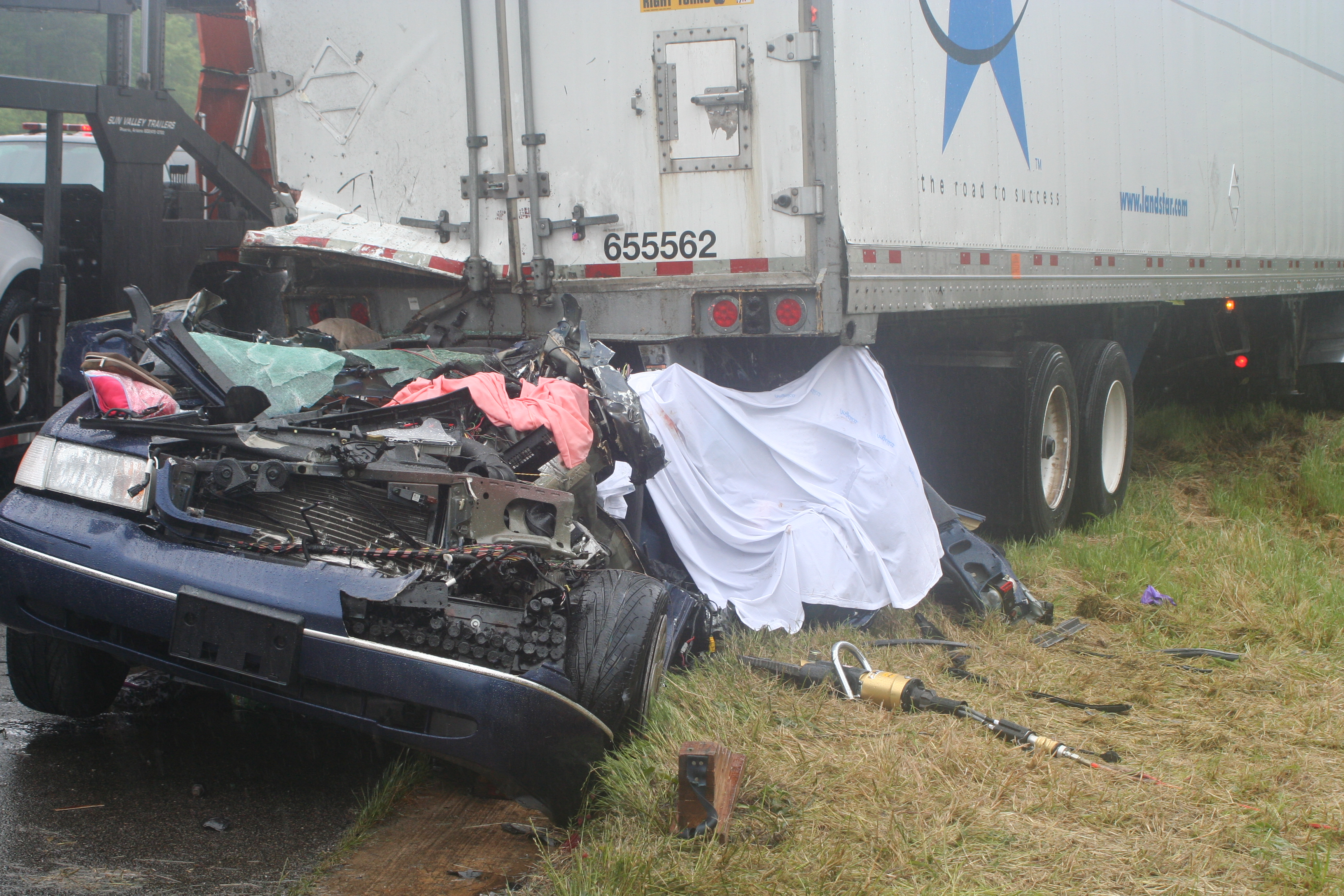
Connecticut Trooper Kevin Miller was killed due to truck underride last Thursday when he rear ended a tractor trailer. He should have been protected from this senseless tragedy which can happen to ANYONE at ANY TIME.

His family will probably get his death certificate in the mail like we did. It will not mention DEATH BY UNDERRIDE. His obituary said: “Kevin unexpectedly entered into eternal life.” Too Soon. He had lots of living left.

AnnaLeah wrote in her statement of faith: “I believe that I, and all true believers, will one day join Him in Heaven.” That fills me with joy and peace. But it was Too Soon. AnnaLeah and her sister Mary had lots of living left.

Sign the STOP Underrides! Petition so we can end these senseless deaths: Congress, Act Now To End Deadly Truck Underride!

Comments on this article illustrate how greatly TRUCK UNDERRIDE is misunderstood:   Funeral arrangements for state trooper killed in crash announced

People place the blame for the death on everything but the lack of effective underride prevention equipment. They blame the victim. They blame the truck driver. Let’s put the blame where it belongs: geometric mismatch between truck and car bumpers. And then let’s hold the trucking industry & the federal government accountable to solve the problem once & for all!

It’s an engineering problem with engineering solutions:

Big Rigs, Big Risks series by WUSA9

Go Fund Me announced by the Connecticut State Troopers Union: https://www.gofundme.com/tfc-kevin-miller-1015

In Memory of Trooper Kevin Miller

Truck Owners Can Deduct Underride Protection Cost Dollar for Dollar. So Why Don’t They Want to Put It On?

“So tell me, why were we talking about side guards on March 19, 1969 — almost 50 years ago — and we still have not put them on trucks?!” Thousands of people have needlessly died. (Questioning the industry panel at the Road to Zero Coalition meeting in DC)

(Click on Q & A at this link: http://nsc.capitolconnection.org/032018/nsc_archive_flv.htm)

Not only that, but we did our taxes today and I asked the tax consultant what it would mean to a truck owner if they took advantage of IRS Tax Code Section 179 and deducted the purchase of underride prevention equipment. She said that they would be able to deduct the cost of the equipment — dollar for dollar.

As my son pointed out, they will not get all of their money back. But they will get the deduction. They will get fuel savings with side guards that are combined with side skirts and thus a quick ROI. They will get back on the road more quickly in the event of a collision when there is not a fatality and their truck is not as damaged. Their insurance liability will be less and perhaps the insurance companies will jump on board and lower their costs. They will be helping to save lives and reduce the number of horrific injuries and, in the process, gain some peace of mind themselves.

What are we waiting for? Let’s get this show on the road!